Updated January 2026 | By Lily Clark
Affiliate Disclosure: This article contains affiliate links. If you purchase through them, I may earn a small commission at no extra cost to you. I only recommend cookware I personally test and cook with in my kitchen
Modern pressure cooker safety features rely on layered mechanical and electronic systems—lid pin-locks, pressure relief valves, gasket blowout paths, thermal runaway sensors, and overbuilt locking lugs—that prevent explosions, overheating, and lid failure even if multiple systems fail at once.
That’s the short answer.
The longer—and more important—answer is why these systems work, what mistakes trigger them, and what they still can’t protect you from. That’s what actually keeps you safe.
Before we dissect individual safety mechanisms, we need to establish one thing clearly:
Not all pressure cookers are engineered the same way.
Electric pressure cookers, stovetop models, and multi-cookers use different control logic, pressure regulation methods, and failure protections.
If you’re comparing models or still deciding what to buy, start with this pillar guide first:
This article assumes you’re using a modern electric pressure cooker or multi-cooker, because that’s where the most advanced safety engineering exists—and where most confusion comes from.
Why Modern Pressure Cookers Are Fundamentally Safer
Old pressure cookers depended on:
- A single weight
- Manual heat control
- The user’s judgment
Modern pressure cookers assume:
- Users will overfill
- Food will foam
- Liquids will scorch
- Sensors may fail
So they design for failure.
Today’s pressure cooker safety features are redundant, layered, and intentionally biased toward shutdown, not “powering through.”
Think aviation, not cookware folklore.
The Lid Cannot Open
The Float Valve (Pin-Lock) Explained Correctly
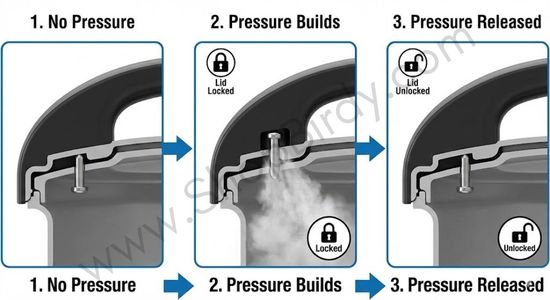
Most modern pressure cooker lids use a float valve, sometimes called a pin-lock. This is not software-based. It is not electronic.
It is pure mechanical physics.
How it actually works
- As soon as even a small amount of vapor pressure builds (often under 1 PSI)
- Steam pressure pushes a metal pin upward
- That pin wedges into a slot in the handle assembly
- The lid becomes physically locked
Even if:
- The cooker loses power
- The control board fails
- The appliance is unplugged
As long as vapor pressure exists, the lid cannot rotate.
This is critical:
The lid lock is powered by the same pressure it is designed to contain.
That makes it inherently fail-safe.
Pressure Relief Is Not One Valve
Starchy foods foam.
Foam clogs valves.
That’s why single-valve systems failed historically.
Modern pressure cookers use multiple independent pressure relief paths, each designed to activate under different failure conditions.
And if all of them fail? There’s still one final physical override.
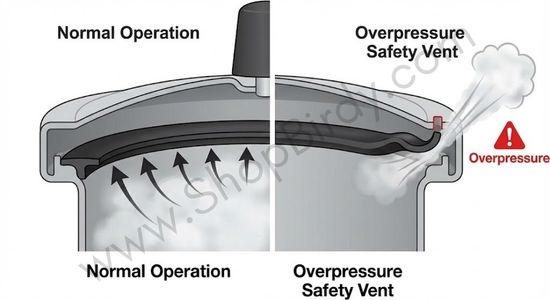
The Gasket Blowout Notch: The Ultimate Fail-Safe
(Critical Safety Feature Most Brands Don’t Explain)
Almost every modern stainless-steel pressure cooker lid contains:
- A small rectangular cutout in the rim
- Positioned next to the gasket channel
This is called the gasket blowout notch.
What happens in a worst-case scenario
If:
- The primary steam release valve clogs
- The secondary safety valve clogs
- Pressure continues rising
The silicone gasket is designed to deform and push outward through this notch.
When that happens:
- A large, controlled steam vent opens instantly
- Internal pressure drops rapidly
- The metal vessel is never stressed to failure
This is not a defect.
This is intentional mechanical relief engineering.
Software can fail.
Physics always wins.
And the gasket blowout notch ensures physics wins safely.
Thermal Runaway Protection
Most articles say pressure cookers have temperature sensors.
That’s true—but incomplete.
Modern electric pressure cookers don’t just measure temperature.
They measure the rate of temperature rise.
Why this matters
A pot filled with liquid heats slowly and predictably.
A dry pot heats far faster than physics allows.
When the control board detects:
- A temperature increase that is incompatible with liquid cooking
- Especially at the base plate
It identifies a thermal runaway condition and cuts power instantly.
This prevents:
- Heating element burnout
- Warped inner pots
- Long-term structural weakening
It’s not a thermostat.
It’s an active thermal safety algorithm.
Burn Errors Are Safety Features
If you’ve ever triggered a “Burn” or “Food Burn” error, you probably assumed the cooker was being overly sensitive.
It isn’t.
That alert exists to prevent:
- Carbonized food layers
- Insulated heat buildup
- Localized stress on the heating element
Carbon buildup traps heat.
Trapped heat damages components over time.
This longevity-linked safety logic is explained in detail here:
How Long Do Electric Pressure Cookers Last? Pressure Cooker Lifespan Audit
Burn detection protects:
- The appliance
- The vessel
- The safety systems themselves
Locking Lugs
Pressure cookers don’t rely on thin metal or friction to stay sealed.
They rely on locking lugs:
- Heavy steel “teeth” around the lid and pot rim
- Evenly spaced to distribute force
These lugs are engineered to withstand:
- Approximately 4–6× normal operating pressure
- Long before any permanent deformation occurs
In plain terms:
The vessel itself is never the weak point.
Safety systems are designed to activate long before the structure is stressed.
The Complete Safety Systems Audit
Pressure Cooker Safety Systems — Failure-First Breakdown
Safety Layer | The Mechanism | The Failure Scenario | Why It Works |
Float Valve (Pin-Lock) | Mechanical metal pin driven by vapor pressure | User attempts to force lid open under pressure | Physics: Vapor pressure physically wedges the pin—no electricity required |
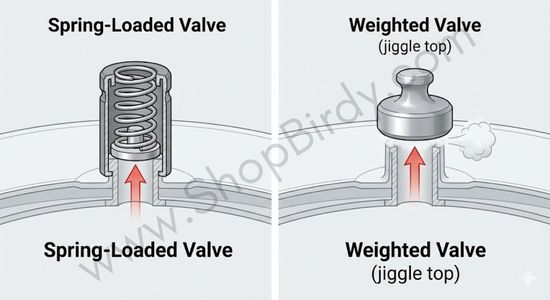
Primary Steam Release | Weighted or spring-loaded valve | Pressure exceeds normal cooking range | Gravity/tension vents excess steam to stabilize ~12 PSI |
Secondary Safety Valve | Independent relief path | Main valve clogs with foam or starch | Redundancy: Separate vent prevents pressure buildup |
Gasket Blowout Notch | Controlled gasket deformation | All valves clogged simultaneously | Structural veto: Gasket pops outward before metal integrity is threatened |
Thermal Runaway Sensor | Rate-of-rise algorithm | Pot boils dry or food carbonizes | Logic: Detects “impossible” heat spikes and cuts power |
Burn Detection Logic | Bottom-plate thermal feedback | Thick sauces stop circulating | Prevents carbon insulation and component stress |
Locking Lugs | Interlocking steel teeth | Extreme overpressure event | Structural margin: Rated for ~5× operating pressure |
The “Silly Human” Factor: What Safety Systems Cannot Fix
Modern pressure cookers are engineered not to explode.
They are not engineered to stop you from putting your hand over a steam jet.
Escaping steam is:
- Invisible
- Moving at high velocity
- Hot enough to burn skin instantly
The pot may be perfectly safe.
Your fingers are not.
Brutal safety tip from my own kitchen
Always release steam using:
- A wooden spoon
- Or a long silicone utensil
Never your hand.
Never your face.
No safety system can override that mistake.
Do Add-Ons Compromise Safety?
Air fryer lids and modular attachments raise a fair concern: added hardware means added heat paths.
Whether that’s safe depends on thermal isolation and control logic, which I break down here:
Is Multi Cooker Air Fryer Lid Worth It? The Technical Hardware Audit
Short version: well-designed systems isolate pressure logic from air-fry logic. Poor ones don’t.
Smart Pressure Cookers vs Traditional Models
Smart cookers add:
- Error logging
- Sensor redundancy
- Predictive shutdowns
But they do not replace mechanical safety systems.
That comparison is fully audited here:
Chef iQ vs. Instant Pot: The Best Smart Pressure Cooker Audit
Smart features are additive—not foundational—to safety.
Final Verdict: Should You Trust Modern Pressure Cookers?
Yes—if you understand how they protect you.
Modern pressure cooker safety features assume mistakes will happen.
They plan for clogged valves, dry pots, scorched food, and user error.
From pin-locks powered by vapor pressure, to thermal runaway algorithms, to gasket blowout paths that override software entirely—these machines are engineered to fail safely.
That’s why I’m comfortable leaving mine unattended while prepping sides.
And that’s something I would never say about the pressure cookers I grew up with.
Legal Information
Shopbirdy.com is a participant in the Amazon Services LLC Associates Program, an affiliate advertising program designed to provide a means for sites to earn advertising fees by advertising and linking to Amazon.

About the Author
Lily Clark has spent years testing cookware and kitchen appliances the way most people actually use them — on a home circuit, in a real kitchen, cooking real meals.
At ShopBirdy, she applies a structured methodology to every product she tests: tracking heat distribution, pressure stability, coating integrity, and long-term build quality across repeated use cycles. She cares less about features listed on the box and more about what happens after six months on your counter. Her reviews are written for people who want to buy once and cook well.