Updated January 2026 | By Lily Clark
Affiliate Disclosure: This article contains affiliate links. If you purchase through them, I may earn a small commission at no extra cost to you.
“Smart” has become one of the most misleading labels in kitchen appliances.
When people compare Chef iQ to Instant Pot, the discussion usually stalls at Wi-Fi, apps, and presets. That’s surface-level thinking.
The real question isn’t whether a cooker connects to your phone.
It’s whether that intelligence actually improves cooking outcomes or just adds another layer between you and the food.
Before we get specific, it helps to zoom out.
If you’re still deciding what category of cooker belongs in your kitchen, start with our Best Multi-Cookers & Pressure Cookers guide. It explains pressure cookers, hybrids, and smart systems at a systems level, so this comparison makes sense in context.
With that framework in place, let’s audit whether Chef iQ deserves the title of best smart pressure cooker, or whether Instant Pot’s intentionally “dumb” approach is quietly smarter in the long run.
The One-Sentence Verdict
- Chef iQ is a guided, sensor-driven cooking system that tries to predict outcomes for you.
- Instant Pot is a manual pressure system with safety rails that assumes the cook is in charge.
Everything else flows from that philosophical split.
Feature | Chef iQ (Smart System) | Instant Pot (Manual System) |
Core Philosophy | Guided / Outcome-Predictive | Manual / Execution-Focused |
Integrated Scale | Yes (Measures mass for heat logic) | No (Relies on temp sensors only) |
Steam Release | Automatic (Pulse/Controlled) | Manual (Mechanical switch) |
Power Output | ~1200 Watts (Faster ramp) | ~1000 Watts (Slower ramp) |
Sauté Control | Software-managed (Conservative) | Direct-heat (Aggressive) |
Cleaning | Complex lid (Hand-wash preferred) | Simple lid (Dishwasher safe) |
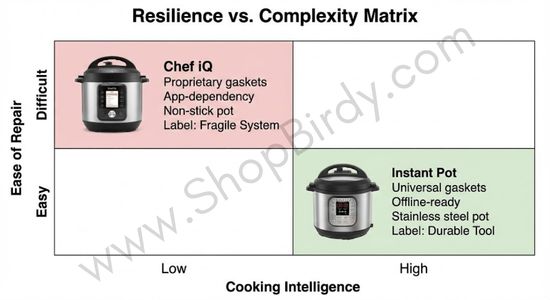
Resilience | Proprietary gaskets/parts | Universal/Generic gaskets |
Vibe | “The machine knows the way” | “I’m the chef, just cook it” |
What “Smart” Actually Means in a Pressure Cooker
Chef iQ: Intelligence Lives in the Machine
Chef iQ is designed to:
- Reduce decision-making
- Guide you step by step
- Correct mistakes with software
It doesn’t just cook. It instructs.
This appeals to cooks who want confidence without mastering pressure physics.
Instant Pot: Intelligence Lives with the Cook
Instant Pot takes the opposite stance:
- You choose timing
- You choose release method
- The machine enforces limits, not strategy
It doesn’t tell you what to cook.
It simply executes what you decide.
That distinction becomes more important the longer you own the machine.
The Integrated Scale: Chef iQ’s One Truly Legit Smart Feature
This is the most impressive piece of Chef iQ hardware — and the most overlooked.
Chef iQ includes an integrated scale that weighs ingredients as you add them. This is not a gimmick.
By knowing:
- The total mass of ingredients
- The amount of water added
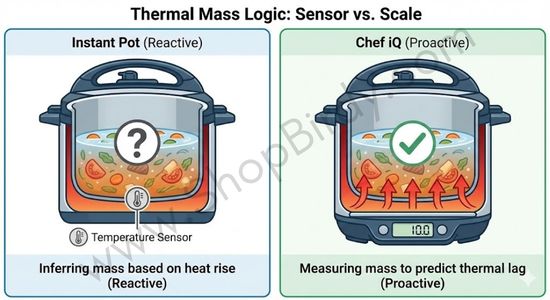
The cooker can estimate the specific heat capacity of the contents inside the pot.
Why this matters:
- Ramp-up time depends on mass and water content
- Excess water increases thermal lag
- Thermal lag is what causes mushy rice, grains, and vegetables
Instant Pot doesn’t know what’s inside. It infers conditions after the fact, based on temperature behavior.
Chef iQ measures first, then predicts.
That allows it to:
- Anticipate vapor density more accurately
- Adjust pressure timing
- Reduce overcooking caused by excess liquid
This isn’t marketing fluff. It’s applied thermodynamics — and the strongest argument for Chef iQ as the best smart pressure cooker.
Automated Steam Release
Another meaningful difference shows up at the end of the cook.
Instant Pot: Manual Release, Manual Risk
With Instant Pot, pressure release usually means:
- You flick a switch
- Steam exits rapidly
- You control the speed, whether you intend to or not
For starchy foods like beans, oats, and rice, this can cause:
- Foaming
- Valve clogging
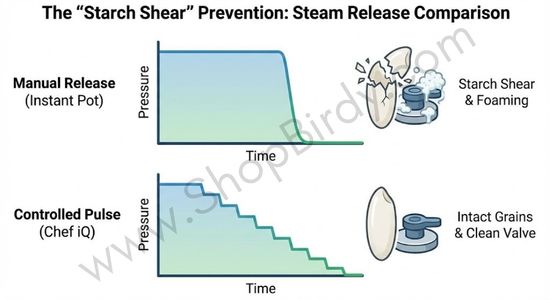
- Starch shear (ruptured grains)
Chef iQ: Software-Managed Release
Chef iQ handles steam release automatically, often in controlled pulses.
This:
- Improves safety — no sudden steam jets
- Improves food texture — pressure drops gradually
By managing the pressure gradient, Chef iQ:
- Reduces violent starch expansion
- Protects grain integrity
- Prevents the “volcanic eruption” effect common with manual quick release
This is more than convenience. It’s a physics guardrail Instant Pot largely leaves to the user.
App Dependency & Connectivity Friction
To be clear: if the Chef iQ app or Wi-Fi goes down, the cooker does not become a brick.
But the experience degrades — significantly.
Without reliable connectivity:
- Guided recipes disappear
- Smart prompts are limited
- Much of the “intelligence” becomes inaccessible
The cooker still works, but it feels hollowed out.
This raises a longer-term concern. Smart hardware often depends on a cloud service that may not exist in 5 or 10 years.
Instant Pot avoids this entirely:
- No servers
- No accounts
- No updates required
It will behave the same way in 2035 as it does today.
Chef iQ may continue to be supported — but that continuity is a promise, not a guarantee.
Instant Pot Pro Plus (And Why It Still Falls Short)
To be fair, Chef iQ isn’t competing against every Instant Pot.
The only model that truly enters the “smart cooker” conversation is the Instant Pot Pro Plus, with app control and a wireless venting valve.
Even then, one gap remains.
The Pro Plus still lacks an integrated scale.
Without a mass sensor, it has no idea:
- How much food is inside
- How much water was added
- What the actual thermal mass is
It relies on the same logic as other Instant Pots — reacting to temperature rise instead of predicting it.
So even against Instant Pot’s smartest model:
- Pro Plus = timer + app
- Chef iQ = mass-aware thermal system
That distinction still matters.
The Sauté Question: Where Smart Gets in the Way
Chef iQ’s intelligence becomes a liability during sautéing.
It offers three sauté levels, but it is:
- Heavily sensor-protected
- Aggressively thermally managed
If it detects a localized hot spot, it often reduces or cuts heat entirely.
This protects electronics — but limits searing authority.
You may struggle to achieve:
- A true Maillard crust
- Deep browning on meat
- Strong fond development
Instant Pot’s simpler heating plate is more tolerant:
- Hotter sustained sauté
- Better browning
- More reliable fond formation
Ironically, Instant Pot’s lack of intelligence gives it more authority at this stage.
Software-Gated Sauté (Weeknight Friction)
Chef iQ sauté is also software-gated.
Before full heat is unlocked, the machine often runs a “Preheating” sequence, waiting for sensors to agree conditions are safe.
In theory, this protects the system.
In practice, it feels like the machine is gatekeeping dinner.
On a weeknight:
- Oil is in the pot
- Onions are ready
- You’re waiting… while the app says “Preheating”
Instant Pot doesn’t do this. You turn sauté on, heat happens, food goes in when you decide.
Momentum matters more than people realize.
The Proprietary Gasket Trap
Pressure cookers are high-wear systems. Silicone is consumable.
Instant Pot gaskets are:
- Cheap
- Universal
- Available locally or delivered in hours
If one fails, dinner survives.
Chef iQ gaskets are proprietary.
If one tears:
- You wait for shipping
- You hope stock exists
- You cancel dinner plans
If that happens on Thanksgiving, the meal is over.
As we’ve explained in our Best Pressure Cooker Accessories audit, a cooker is only as good as its replacement ecosystem. Proprietary parts turn “smart” into fragile.
Wattage Density: Why Chef iQ Feels Faster
Some differences aren’t about software at all.
They’re about power.
- Chef iQ: ~1200 watts
- Most 6-quart Instant Pots: ~1000 watts
That 20% energy advantage matters.
Combined with the integrated scale, Chef iQ:
- Delivers more energy per second
- Predicts energy requirements more accurately
- Reaches pressure faster
It’s not just smarter code.
It’s a stronger heating coil using better data.
Rice Is the Canary in the Coal Mine
Rice exposes weaknesses quickly:
- Too much water → mush
- Too fast a release → starch shear
- Too much heat → broken grains
Chef iQ’s scale and controlled release give it an edge for guided rice cooking.
But neither replaces a dedicated rice system.
If rice quality is non-negotiable, see Zojirushi vs Instant Pot: Which Is Better for Rice?
Complexity vs Reliability (Over Time)
Chef iQ over time:
- More sensors
- More software
- More failure modes
When it works, it feels futuristic.
When it doesn’t, troubleshooting becomes opaque.
Instant Pot over time:
- Fewer systems
- Predictable wear points
- Easier diagnostics
This mirrors what we see in more complex hybrids like Ninja Foodi, explored in Ninja Foodi vs Instant Pot: The Brutal Hardware Audit.
Final Verdict: Is a Smart Cooker Worth It?
The best smart pressure cooker isn’t the one with the most sensors.
It’s the one whose intelligence actually reduces failure, not just decisions.
Chef iQ earns real credit for:
- Its integrated scale
- Managed steam release
- Predictive ramp-up logic
But it also introduces:
- Proprietary dependencies
- Reduced searing authority
- Long-term software risk
Instant Pot looks less impressive, but remains:
- More durable
- More adaptable
- More transparent
Smart cooking works best when it assists physics, not replaces it.
Choose Chef iQ if you want a guided system.
Choose Instant Pot if you want a tool that grows with you.
That — not Wi-Fi — is the difference that matters five years from now.
The Maintenance & Resilience Audit
Feature | ||
Inner Pot | Non-stick only (Fragile coating) | Stainless Steel (Induction ready / Metal utensil safe) |
Sealing Ring | Proprietary (Harder to find) | Universal (Buy anywhere) |
Lid Cleaning | Complex / Multi-part | Simple / Dishwasher safe |
Offline Function | Limited (Recipes require cloud) | 100% (No internet needed) |
Note: The Chef iQ’s 1200W heating element is a significant performance win over the standard 1000W Instant Pot Duo. If speed to pressure is your #1 priority, the Chef iQ’s “Smart” hardware actually delivers the raw energy to back it up.
Legal Information
Shopbirdy.com is a participant in the Amazon Services LLC Associates Program, an affiliate advertising program designed to provide a means for sites to earn advertising fees by advertising and linking to Amazon.