Updated January 2026 | By Lily Clark
Affiliate Disclosure: This article contains affiliate links. If you purchase through them, I may earn a small commission at no extra cost to you. I only recommend cookware I personally test and cook with in my kitchen
Quick Answer
Pressure cooker steam release methods control how pressure, temperature, and internal fluid motion change after cooking. Quick Release causes sudden depressurization that stops cooking but can shock proteins and agitate starches, while Natural Release allows pressure and heat to decay gradually, preserving texture, moisture, and system stability.
That’s the short answer.
The longer answer—and the one that actually improves your food and protects your cooker—is understanding steam release as a state-change operation, not a preference setting.
Steam Release Depends on the Cooker You Own
Steam release behavior is not universal. It’s determined by:
- Pot volume
- Lid geometry
- Valve design
- Sensor logic
- Thermal mass
Before applying any steam-release advice, you need to know what class of machine you’re working with.
If you haven’t already, start with this foundational guide:
This article assumes a modern electric pressure cooker or multi-cooker, where pressure release is actively managed and safety systems are redundant.
Steam Is Stored Energy — Not Just “Hot Air”
Inside a pressure cooker, liquid water remains stable far above 212°F (100°C). That heat energy is stored under pressure.
Steam release is the moment when:
- Pressure collapses
- The boiling point drops instantly
- Liquid and vapor violently re-negotiate equilibrium
How fast you allow that transition determines texture, safety, and equipment wear.
Quick Release (QR): Sudden Depressurization by Design
Quick Release vents steam rapidly, collapsing pressure in seconds.
This causes:
- Immediate drop in boiling point
- Flash-boiling inside the pot
- Violent liquid agitation
Quick Release doesn’t just “let steam out.”
It forces an abrupt phase transition.
That’s useful—but it comes with consequences.

The Protein Seizing Physics (Why QR Can Ruin Meat)
This is the part most guides skip.
When you Quick Release meat:
- External pressure vanishes almost instantly
- Internal temperature of the meat is still well above boiling
That creates a dangerous mismatch.
What happens at the cellular level
Moisture trapped inside protein fibers:
- Flash-boils
- Expands rapidly
- Forces fibers to contract or tear
This is thermal shock, not overcooking.
It’s why meat can feel:
- Stringy
- Dry
- Chalky
Even when it’s sitting in liquid.
Why Natural Release fixes this
Natural Release allows:
- Internal and external pressures to equalize gradually
- Moisture to redistribute instead of erupt
- Protein fibers to relax instead of seize
This is why pot roast, pulled pork, and short ribs require Natural Release to stay juicy.
Natural Release (NR): Managed Heat Decay
Natural Release lets pressure fall slowly as the cooker cools.
That means:
- Gentle temperature decline
- Calm liquid behavior
- Continued low-energy cooking
Natural Release isn’t passive.
It’s controlled decompression.
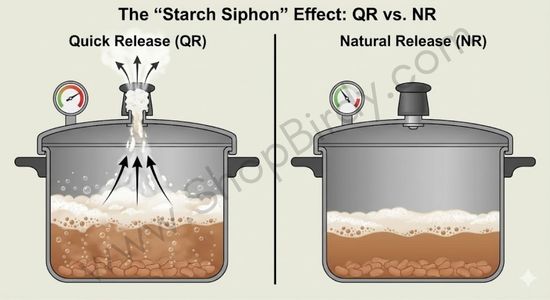
The Foam Volcano: Fluid Dynamics of Starch Failure
You already know starchy foods foam.
Here’s why Quick Release makes them dangerous.
The vapor-to-liquid ratio problem
In starchy liquids (beans, oats, lentils):
- Bubbles don’t pop easily
- They stack into stable foam columns
Quick Release creates:
- A massive pressure differential between pot and kitchen
- A high-velocity flow toward the valve
This creates a siphon effect.
What goes wrong
The pressure drop:
- Pulls the foam stack upward
- Funnels it directly into the valve assembly
Once starch dries inside those tiny channels:
- It behaves like glue
- It compromises the primary steam vent on future cooks
The cooker won’t explode—but you’ve quietly damaged a safety system.
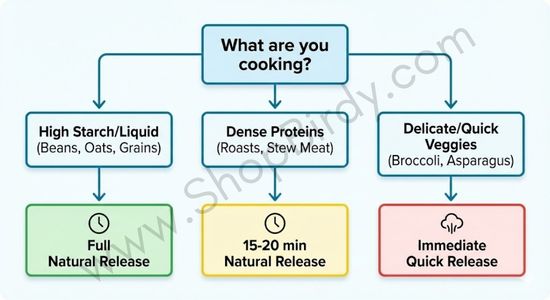
This is why full Natural Release is non-negotiable for starchy foods.
The Steam Release Master Table
Pressure Cooker Steam Release Methods — What Actually Happens
Feature | Quick Release (QR) | Natural Release (NR) |
Physical Action | Sudden depressurization | Gradual heat decay |
Internal Effect | Flash-boiling & agitation | Calm simmering |
Protein Result | Thermal shock, fiber seizing | Fibers relax, retain moisture |
Starch Result | Foam siphon risk | Starch stays suspended |
Liquid Motion | Violent surge | Stable circulation |
Carryover Cooking | Minimal | Significant |
Best For | Broccoli, asparagus, eggs | Beans, pot roast, bone broth |
The Invisible Steam Warning
Steam exiting the valve starts as a gas.
The visible white cloud forms after the steam has cooled and condensed.
That means the most dangerous zone is:
- The clear, invisible gap between the valve and the cloud
That invisible jet:
- Moves at high velocity
- Causes third-degree burns instantly
If someone is burned by steam, it usually happens before they see anything.
This is physics—not fear-mongering.
The “Silly Human” Factor
Modern pressure cookers are engineered not to explode.
They are not engineered to protect your hand from steam.
Brutal but necessary rule
Always operate the valve using:
- A wooden spoon
- Or a long silicone utensil
Never your hand.
Never your face.
The cooker is safe.
Your skin is not.
Manual Release Tip
If you’re using an older Instant Pot–style flick switch and realize too late that:
- Your dish is starchy
- Foam risk is high
You can sometimes limit damage.
Pulse the release
- Vent steam in short bursts
- Pause between pulses
- Let agitation settle
This doesn’t eliminate foam—but it can prevent a full siphon eruption.
Latent Heat, Thermal Mass, and Pot Size
Natural Release time isn’t fixed.
It’s governed by:
- Surface area
- Thermal mass
- Volume of liquid
An 8-quart pot holds significantly more stored energy than a 6-quart unit.
What that means in practice
An 8-quart cooker can take ~30% longer to Natural Release than a 6-quart cooker with the same food.
So if a recipe says:
“10 minutes Natural Release”
That 10 minutes means:
- Less carryover heat in a small pot
- Much more carryover heat in a large one
Adjust accordingly—especially for proteins.
This thermal mass logic ties directly into cooker design and safety redundancy, which is broken down here:
Modern Pressure Cooker Safety Features: The Hardware Redundancy Audit
Steam Release Affects Cooker Longevity Too
Repeated violent Quick Releases:
- Stress seals
- Drive starch into valve channels
- Increase gasket wear
Over time, this shortens the usable life of the machine.
That long-term impact is analyzed here:
How Long Do Electric Pressure Cookers Last? Pressure Cooker Lifespan Audit
Steam release choices don’t just affect dinner—they affect durability.
Hybrid Cookers and Air Fryer Lids
Hybrid systems introduce:
- Additional heat paths
- New airflow patterns
- Different vent geometry
Whether that’s safe depends on thermal isolation and control logic, not marketing claims.
That hardware reality is covered here:
Is Multi Cooker Air Fryer Lid Worth It? The Technical Hardware Audit
Final Verdict
Pressure cooking doesn’t end when the timer beeps.
It ends when pressure is released correctly.
Once you understand:
- Protein thermal shock
- Foam siphon dynamics
- Latent heat and thermal mass
Pressure cooker steam release methods stop feeling mysterious—and start feeling precise.
That’s when pressure cooking becomes predictable instead of stressful.
And that’s when your food finally matches the promise of the machine.
Legal Information
Shopbirdy.com is a participant in the Amazon Services LLC Associates Program, an affiliate advertising program designed to provide a means for sites to earn advertising fees by advertising and linking to Amazon.

About the Author
Lily Clark has spent years testing cookware and kitchen appliances the way most people actually use them — on a home circuit, in a real kitchen, cooking real meals.
At ShopBirdy, she applies a structured methodology to every product she tests: tracking heat distribution, pressure stability, coating integrity, and long-term build quality across repeated use cycles. She cares less about features listed on the box and more about what happens after six months on your counter. Her reviews are written for people who want to buy once and cook well.