
Updated January 2026 | By Lily Clark
Affiliate Disclosure: This article contains affiliate links. If you purchase through them, I may earn a small commission at no extra cost to you. I only recommend cookware I personally test and cook with in my kitchen
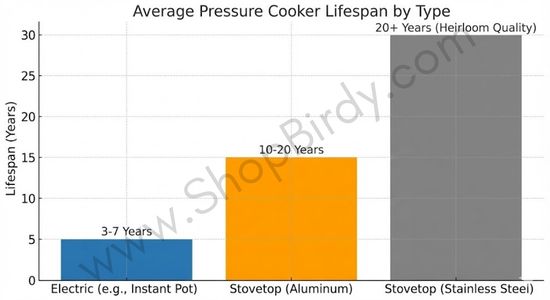
The short answer: 4–7 years with regular use. Up to 9 years if you’re careful. As few as 2 years if you cook daily and skip maintenance.
But those numbers only tell you when — not why. And understanding why pressure cookers fail is the only way to push yours toward the longer end of that range.
Beneath the calm exterior of an electric pressure cooker is a compact stack of electronics, heating elements, silicone elastomers, sensors, and micro-switches — all operating inches apart under heat, steam, and pressure.
This guide breaks down exactly what fails, when, and what you can do about it.
If you’re still deciding which class of cooker even belongs in your kitchen, start with Best Multi-Cookers & Pressure Cookers. It breaks down electric, stovetop, hybrid, and “smart” systems as complete durability architectures—so lifespan expectations make sense before money changes hands.
With that framework, let’s talk honestly about pressure cooker lifespan—not as marketing, but as an engineering reality.
The Honest Lifespan Range
Across repair data, teardown analysis, and long-term user reports, electric pressure cookers fall into a predictable band.
Realistic Lifespan Expectations
Usage Pattern | Typical Lifespan | What Fails First |
Light use (1–2×/week) | 6–9 years | Gasket → electronics |
Regular use (3–5×/week) | 4–7 years | Gasket → sensors → board |
Heavy use (daily) | 2–5 years | Electronics dominate |
Brand matters less than heat exposure frequency.
Electronics don’t age by calendar time.
They age by thermal cycles.
Failure #1: The Capacitor Plague
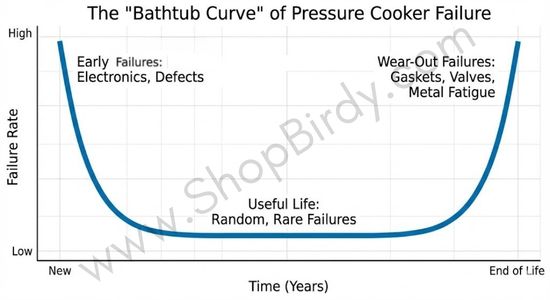
This is the primary cause of “sudden death” in electric pressure cookers.
The Design Reality
In nearly all electric models:
- The logic board lives directly beneath the heating element
- Insulation is minimal
- Venting prioritizes steam escape, not electronics cooling
Every long cook—beans, stocks, bone broth—creates heat soak.
That heat radiates downward and bakes the electronics.
What Actually Dies
The weakest link is the electrolytic capacitor.
Over thousands of hours:
- Electrolyte dries out
- Voltage regulation drifts
- Signal noise increases
Symptoms include:
- Flickering screens
- Phantom button presses
- Random shutdowns
- “Dead” units that aren’t truly dead
This failure typically appears after year 4—conveniently after most warranties expire.
That’s not an accident.
It’s physics.
This is also why stovetop systems often outlive electrics by decades, as explained in T-Fal Clipso vs. Instant Pot: The Electric vs. Stovetop Audit
Failure #2: The Micro-Switch (The $2 Part That Kills $150 Machines)
A shocking number of “dead” pressure cookers aren’t dead at all.
They’re victims of a lid micro-switch.
What the Switch Does
Inside the lid rim is a tiny mechanical switch that tells the computer:
“Yes, the lid is locked.”
If that signal fails, the cooker will:
- Refuse to pressurize
- Throw vague errors
- Appear completely broken
Why It Fails
That switch lives in a brutal environment:
- Steam
- Starch vapor
- Aerosolized grease
Over time it:
- Corrodes
- Sticks
- Loses spring tension
The Lid Hygiene Connection (Critical)
This failure accelerates in complex lids.
Smart systems and hybrid accessories—like air fryer lids—introduce:
- More sensors
- More cavities
- More condensation paths
Every extra feature is another place for starch and grease to settle.
This is why advanced systems demand stricter maintenance, a theme explored deeply in Is Multi Cooker Air Fryer Lid Worth It? The Technical Hardware Audit
Brutal Storage Advice
Here’s one of the most effective—and ugliest—lifespan hacks.
Never Store the Cooker with the Lid Locked
When stored closed:
- The gasket stays under compression
- The micro-switch stays engaged
- Silicone takes a permanent “set” faster
- Springs lose tension
Brutal but effective rule:
👉 Store the lid upside down on top of the pot.
It looks wrong.
It works.
This single habit can add 1–2 years to:
- Gasket life
- Switch reliability
- Seal consistency
Pretty kitchens kill appliances.
Functional kitchens keep them alive.
Failure #3: Inner Pot Corrosion
Stainless steel is durable—but it is not immortal.
Chloride Stress Corrosion
If you frequently:
- Cook brines
- Use soy sauce
- Leave salty liquid overnight
You trigger pitting corrosion.
Microscopic chloride attacks create:
- Pin-holes
- Rust freckles
- Weak spots in the base
In a pressurized environment, this is not cosmetic.
If you see rust-colored dots inside the pot, the pot is done—even if the electronics still work.
Failure #4: Silicone Gaskets & Compression Set
Gaskets don’t just “wear out.”
They suffer from compression set.
What That Means
Each cycle:
- ~12 PSI
- ~240°F
- 30–90 minutes
Eventually the polymer:
- Loses rebound
- Stays flattened
- Stops sealing reliably
At ~25% compression set:
- Steam leaks
- Pressure stability fails
- Cooking becomes inconsistent
Why Rotation Works
Rotating two gaskets:
- Reduces cumulative deformation
- Slows permanent set
- Extends usable life by ~20–30%
This matters even more on sensor-heavy systems like Chef iQ, where sealing accuracy affects software behavior—covered in Chef iQ vs. Instant Pot: The Best Smart Pressure Cooker Audit
The Lifespan Logic Table
Failure Level | Consumable | Repairable | Death Sentence |
Component | Silicone gasket | Float valve / lid switch | Logic board / capacitors |
Timeframe | 1–2 years | 3–5 years | 5–8 years |
Why it fails | Compression set | Corrosion, starch buildup | Thermal fatigue (heat soak) |
Fixability | ~$10 (user fix) | ~$5 + 20 min DIY | $150+ (replace cooker) |
This table explains why most cookers die when they do.
Warranty Reality
Most electric pressure cookers carry:
- 1-year warranty
- Occasionally 2 years (rare)
But here’s the uncomfortable truth:
The warranty is designed to expire before physics-driven failure begins.
Capacitor drift, switch corrosion, and gasket compression all occur after year 3.
By year 4:
- You’re on your own
- Repairs aren’t economical
- Replacement is the intended outcome
Understanding this doesn’t make you cynical.
It makes you informed.
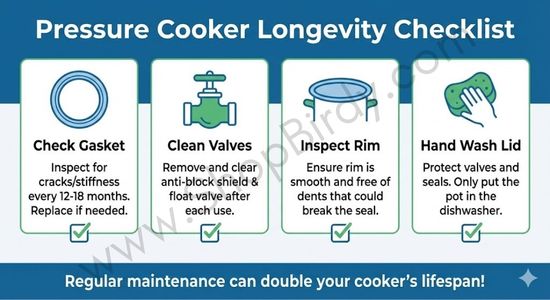
How to Maximize Pressure Cooker Lifespan
If you want the upper end of the lifespan curve:
- Rotate gaskets
- Store lid upside down
- Never leave salty liquid overnight
- Clean lid channels gently but regularly
- Avoid repeated burn errors
- Let the unit cool between long cycles
These habits alone can add years, not months.
Frequently Asked Questions
How often do I actually need to replace the silicone gasket?
From a structural standpoint, silicone suffers from “compression set” under repeated high heat and pressure. For daily users, this mechanical degradation happens in 12 to 18 months.
If your cooker is leaking steam or the ring feels stiff rather than elastic, it has failed. We recommend rotating two gaskets to split the thermal cycles and extend their operational life.
How long do electric pressure cookers last?
Most electric pressure cookers last 4–7 years with regular use. Light users (1–2 times per week) can expect 6–9 years. Heavy daily users typically see 2–4 years before electronics or gaskets fail. The primary failure points are the silicone gasket (18 months), the lid micro-switch (3 years), and capacitor drift on the logic board (5–8 years).
My pressure cooker refuses to pressurize. Is the machine dead?
Usually, no. Before declaring it a total loss, inspect the lid’s micro‑switch. This tiny component signals the logic board to engage the heating element. Starch buildup and steam corrosion often cause this switch to stick, causing a “false dead” state.
⚠️ Always unplug the cooker and wait 10 minutes before accessing the switch. Clean with a dry toothbrush or compressed air – never use liquids or metal tools. Cleaning the switch mechanism or replacing a flattened gasket resolves the majority of pressurization failures.
The display screen is flickering and shutting off randomly. Can I fix this?
In our analysis of failed units, this generally indicates capacitor degradation on the primary logic board. Because the board is housed directly beneath the heating element, years of residual baking heat eventually dry out the electrolytic capacitors.
Once power regulation fails, the machine requires replacement.
What is the best way to store an electric pressure cooker to maximize lifespan?
Never store the unit with the lid locked in the closed position. Constant engagement puts the silicone gasket in a continuous state of compression and maintains unnecessary tension on the internal locking pins.
Store the lid inverted (upside down) on top of the base to eliminate mechanical stress while the machine is offline.
Why did my inner stainless steel pot pit and rust?
Most stainless steel inner pots (including 18/8 and 304 grades) are vulnerable to chloride pitting corrosion. Leaving highly salted liquids, acidic broths, or soy sauce in the inner pot overnight breaks down the protective chromium oxide layer.
Always transfer leftovers and wash the inner pot to prevent microscopic pinhole pitting.
Does a 1-year manufacturer warranty actually protect me?
A 1-year warranty only protects against immediate manufacturing defects. The true physics‑driven failure points – such as capacitor drift, micro‑switch corrosion, and compression set – rarely manifest before year 3.
Component longevity ultimately depends on maintenance and usage frequency, not the warranty window.
Final Verdict on Pressure Cooker Lifespan
Electric pressure cookers don’t fail randomly.
They fail predictably:
- Electronics bake
- Switches corrode
- Silicone flattens
- Steel pits
For most homes:
- 4–7 years is realistic
- 7–9 years is achievable with care
- 2–4 years is common with heavy use
Knowing why they fail lets you:
- Buy smarter
- Maintain better
- Replace only what’s truly dead
That—not brand loyalty—is how you win long term.
TL;DR
- Pressure cooker lifespan is dictated by heat, not hype
- Capacitors and gaskets fail before heaters
- Many “dead” units are victims of tiny switches
- Salt and storage habits quietly shorten life
- Warranties end before failure begins
This is how you stop being surprised—and start being prepared.
Legal Information
Shopbirdy.com is a participant in the Amazon Services LLC Associates Program, an affiliate advertising program designed to provide a means for sites to earn advertising fees by advertising and linking to Amazon.

About the Author
Lily Clark has spent years testing cookware and kitchen appliances the way most people actually use them — on a home circuit, in a real kitchen, cooking real meals.
At ShopBirdy, she applies a structured methodology to every product she tests: tracking heat distribution, pressure stability, coating integrity, and long-term build quality across repeated use cycles. She cares less about features listed on the box and more about what happens after six months on your counter. Her reviews are written for people who want to buy once and cook well.