Updated January 2026 | By Lily Clark
Affiliate Disclosure: This article contains affiliate links. If you purchase through them, I may earn a small commission at no extra cost to you. I only recommend cookware I personally test and cook with in my kitchen
When people argue about electric versus stovetop pressure cookers, they usually frame it as modern convenience vs old-school control.
That’s not wrong—but it’s incomplete.
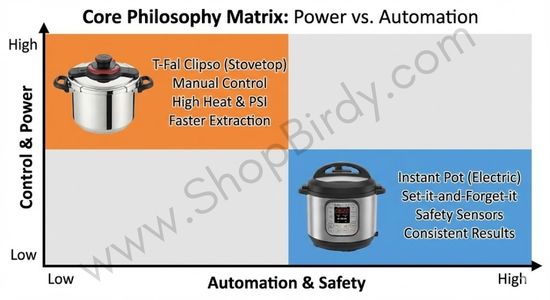
The real difference between a stovetop pressure cooker like the T‑Fal Clipso and an electric pressure cooker like the Instant Pot comes down to physics, sensory feedback, and responsibility.
You’re not choosing which one is “better.”
You’re choosing where the intelligence lives: in the machine, or in you.
Before we dive in, it helps to anchor this comparison inside the larger cooker ecosystem.
If you’re still deciding which category of cooker even belongs in your kitchen, start with our Best Multi-Cookers & Pressure Cookers guide. It explains where stovetop, electric, and hybrid machines each shine—and where they quietly fail.
With that context, let’s run a true electric vs stovetop pressure cooker audit.
The One-Line Verdict
- T-Fal Clipso (stovetop) gives you higher pressure, higher heat, and faster chemical reactions—but demands constant awareness.
- Instant Pot (electric) gives you automation, safety buffers, and repeatability—at the cost of raw thermal power.
Now let’s explain why that’s true, using real numbers instead of vibes.
Quick Comparison
Feature | T-Fal Clipso (Stovetop) | Instant Pot (Electric) |
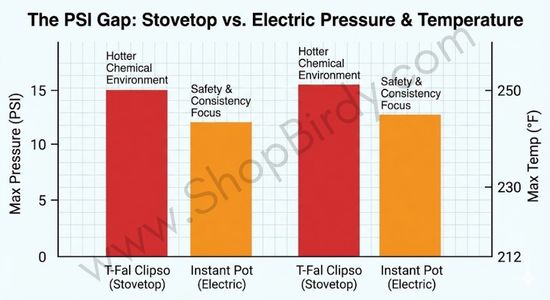
Max Pressure | 15 PSI (Industry Standard) | 11.6 – 12 PSI (Approx.) |
Max Temperature | ~250°F (121°C) | ~242°F (117°C) |
Heat Source | External (Gas, Electric, Induction) | Internal Heating Element |
Speed to Pressure | Fast (High-BTU burner input) | Moderate (Software-controlled) |
Pressure Release | Manual / Cold-Water Sink Method | Natural / Steam Vent Valve |
Monitoring | Sensory (Sound/Visual) | Digital Display / Sensors |
Best For | Extraction, Speed, Bone Broths | Automation, Rice, Set-it-and-Forget-it |
Longevity | 20+ Years (No electronics) | 5–10 Years (Electronic lifespan) |
1. The PSI Gap: Why Stovetop Is Physically Hotter
This is the most important distinction—and the one most comparisons gloss over.
The Hard Numbers (No Marketing Spin)
- T-Fal Clipso: operates at a true 15 PSI (high pressure)
- Most Instant Pots: max out around 11.6–12 PSI
That ~3 PSI gap sounds small. It isn’t.
Why 3 PSI Matters
Pressure raises the boiling point of water.
That difference:
- Increases internal cooking temperature by ~8–10°F
- Speeds up collagen breakdown in meat
- Accelerates Maillard-adjacent browning reactions
- Shortens cooking time for beans, stocks, and tough cuts
This is why a stovetop pressure cooker isn’t just “faster.”
It is operating in a hotter chemical environment that electric pressure cookers physically cannot reach.
Electric cookers trade peak pressure for safety and consistency. That’s a design choice—not a flaw—but it has consequences.
Flavor Development vs. Browning
It’s important to be technically accurate here: pressure cookers do not sear food while under pressure.
True Maillard browning requires:
- Surface temperatures above ~300°F
- A relatively dry environment
Inside a pressure cooker—stovetop or electric—the environment is hot, but still liquid-dominated.
Where the T-Fal Clipso’s advantage shows up is not surface browning, but flavor extraction.
Because the Clipso operates at a true 15 PSI, the liquid inside the pot is several degrees hotter than in an electric pressure cooker. That extra heat accelerates:
- Collagen breakdown
- Gelatin release
- Flavor compound extraction into the cooking liquid
The result isn’t a browned roast—it’s a deeper, more developed braising liquid.
Think:
- Richer stock
- Fuller sauce body
- More pronounced savory depth
The Instant Pot can produce good results, but the stovetop cooker’s hotter liquid environment creates stronger flavor development, not searing. That distinction matters.
2. Heat Source Geometry: Burner vs Bottom Plate
Pressure is only half the story. Where the heat comes from matters just as much.
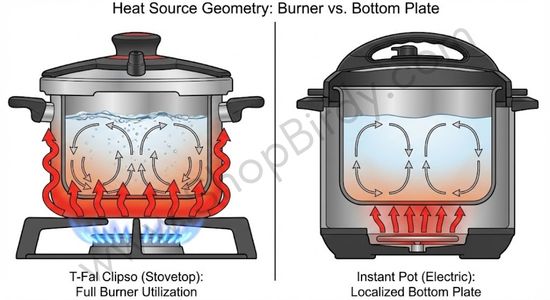
Instant Pot: Localized Bottom Plate
Instant Pots use:
- A fixed-diameter internal heating disc
- Heat concentrated in a small area
- Relatively static convection inside the pot
This creates a vertical thermal gradient:
- Hotter at the bottom
- Cooler toward the top
- Reliant on steam circulation to equalize temperature
It’s controlled, predictable, and gentle—but not aggressive.
T-Fal Clipso: Full Burner Utilization
With the Clipso, your range burner becomes the heating system.
That means:
- Larger heat footprint
- More aggressive convection currents
- Faster energy transfer into the liquid
On a wide gas or induction burner, the entire base of the pot is energized. Liquid circulates more violently, which is why stovetop pressure cookers often produce:
- Deeper-tasting stocks
- Better extraction from bones
- More complete breakdown of legumes
This is not nostalgia. It’s fluid dynamics.
3. Time to Pressure: Cold Start vs Hot Start
Here’s where many home cooks feel a difference, even if they can’t name it.
Stovetop Reality (Clipso)
- Cold start → high flame → rapid pressure
- After sauté → add liquid → pressure builds almost instantly
There is no “mode switching.”
Thermal energy carries forward seamlessly.
Electric Reality (Instant Pot)
Instant Pots must:
- End sauté mode
- Re-establish pressure logic
- Recalculate thermal conditions
This creates a thermal recovery delay, especially noticeable after heavy browning.
It’s safer. It’s gentler.
But it’s slower—and more abstract.
Deglazing Authority: Where Stovetop Pressure Cookers Quietly Win
This is one of the most underappreciated advantages of stovetop pressure cookers—and one of the biggest real-world failure points for electric models.
On a stovetop pressure cooker like the T-Fal Clipso:
- You deglaze over full burner power
- You have total visual access to the pot bottom
- You can aggressively scrape fond until the surface is perfectly clean
If something sticks, you see it and fix it immediately.
In an Instant Pot, deglazing is riskier:
- Heat is limited to a small internal plate
- Visibility is reduced once liquid is added
- Any missed fond becomes a liability
If even a thin patch of browned residue remains, the Instant Pot may interpret the localized heat spike as an overheat condition and shut itself down with a burn warning.
This isn’t user error—it’s a design limitation.
For cooks who routinely brown meat before pressure cooking, the stovetop cooker offers absolute deglazing authority. You control heat, you see the surface, and nothing proceeds until the pot is truly clean.
In a “brutal hardware audit,” this is a decisive win for stovetop pressure cooking.
4. “Searching for Seal”: Sensory Feedback vs Black Box
This is a psychological difference that matters in daily cooking.
Instant Pot: Black-Box Sealing
With an Instant Pot:
- Display says “On”
- Nothing seems to happen
- You wait for the float pin
For new users, this creates anxiety:
“Did I add enough liquid?”
“Is it sealing correctly?”
“Why hasn’t the pin popped yet?”
The machine knows. You don’t.
T-Fal Clipso: Immediate Sensory Feedback
With the Clipso:
- You hear steam
- You see vapor
- You adjust the valve manually
That feedback loop is instant.
For experienced cooks, this reduces uncertainty. You’re not waiting for confirmation—you’re watching the physics unfold in real time.
This is why many seasoned cooks prefer stovetop pressure cookers despite the learning curve. Control reduces anxiety once skill is established.
The Quick-Release Reality: Manual Control Still Matters
Here’s a control advantage electric pressure cookers simply cannot replicate.
With a stovetop pressure cooker:
- You can place the pot under cold running water
- Pressure drops almost instantly
- Cooking stops immediately
This is invaluable for:
- Delicate vegetables
- Fish
- Checking meat doneness mid-cook
- Preventing overcooking by seconds, not minutes
With an Instant Pot, you are limited to:
- Natural release
- Programmed quick release
Both are slower and less precise than cold-water depressurization—and you cannot accelerate them safely.
This reinforces the core philosophical divide:
- Electric pressure cookers manage outcomes
- Stovetop pressure cookers hand control back to the cook
For experienced users, that instant pressure dump isn’t just convenient—it’s surgical precision.
5. Texture & Food Outcomes: Force vs Forgiveness
Stovetop Texture Profile
Higher pressure + aggressive convection =
- Faster breakdown
- Stronger extraction
- Less margin for error
Excellent for:
- Beans
- Bone broth
- Short ribs
- Tough cuts
Less forgiving for delicate foods.
Electric Texture Profile
Lower pressure + controlled environment =
- Gentler cooking
- Less violent boiling
- Better consistency for everyday meals
This is why electric pressure cookers tend to perform better for:
- Rice
- Yogurt
- Custards
- Weeknight stews
If rice quality matters deeply to you, that conversation deserves its own branch—covered in Zojirushi vs Instant Pot: Which Is Better for Rice? where pressure physics vs thermal precision really diverge.
6. Inner Pot Material: A Hidden Multiplier
Electric and stovetop pressure cookers usually ship with different default pots.
- Instant Pot → stainless steel
- Many stovetop models → thicker aluminum or steel bases
Material affects:
- Heat retention
- Searing performance
- Scorch risk
If you want the deep dive on how pot material changes sticking, browning, and release behavior, see Stainless Steel vs. Ceramic Inner Pot Material: The Stick Test. It explains why stainless steel gives early feedback while coated pots hide problems until failure.
7. Safety Philosophy: Passive vs Active Protection
T-Fal Clipso Safety Model
- Mechanical valves
- Physical locks
- User-managed heat
Safe—but safety depends on attention.
Instant Pot Safety Model
- Sensors
- Software limits
- Automatic shutoffs
Safer for:
- Multitasking
- Busy households
- New pressure-cooker users
This difference isn’t about intelligence.
It’s about who carries responsibility.
8. Counter Space, Storage, and Longevity
Clipso
- Lives in a cabinet
- No electronics
- Can last decades
Instant Pot
- Lives on the counter
- Electronics age
- Lifespan is finite (but usually long)
If you’ve explored hybrid machines that try to do everything, you’ll recognize many of these trade-offs. We break that down bluntly in Ninja Foodi vs Instant Pot: The Brutal Hardware Audit, which shows how complexity compounds over time.
Who Each Cooker Is Actually For
Choose T-Fal Clipso (Stovetop) if:
- You value speed and power
- You enjoy hands-on control
- You cook beans, stocks, and tough meats often
- You trust your instincts more than presets
This is a tool for cooks who want direct authority over heat and pressure.
Choose Instant Pot (Electric) if:
- You cook pressure meals weekly
- You multitask while cooking
- You want repeatability over peak power
- You value safety buffers
This is a system designed to absorb cognitive load.
Final Take
The electric vs stovetop pressure cooker decision isn’t about which is “better.”
It’s about where you want the thinking to happen.
- Stovetop pressure cookers give you raw power and immediate feedback.
- Electric pressure cookers give you automation and consistency.
Neither is outdated.
Neither is foolproof.
But only one will fit how you cook when life is loud, busy, and imperfect.
Choose the one that matches your tolerance for control—not just your appetite for speed.
Legal Information
Shopbirdy.com is a participant in the Amazon Services LLC Associates Program, an affiliate advertising program designed to provide a means for sites to earn advertising fees by advertising and linking to Amazon.

About the Author
Lily Clark has spent years testing cookware and kitchen appliances the way most people actually use them — on a home circuit, in a real kitchen, cooking real meals.
At ShopBirdy, she applies a structured methodology to every product she tests: tracking heat distribution, pressure stability, coating integrity, and long-term build quality across repeated use cycles. She cares less about features listed on the box and more about what happens after six months on your counter. Her reviews are written for people who want to buy once and cook well.