
Updated February 2026 | By Lily Clark
Affiliate Disclosure: This article contains affiliate links. If you purchase through them, I may earn a small commission at no extra cost to you. I only recommend cookware I personally test and cook with in my kitchen
If your electric wok has ever:
- Sizzled aggressively for 40 seconds
- Gone strangely quiet
- Then surged back to life
- Then cooled again
You’re not imagining things.
That’s thermal cycling.
And if your vegetables turned soggy or your garlic burned while your chicken stayed pale, you didn’t fail.
Your sensor system did.
Most buyers think wattage determines performance.
In reality, sensor architecture determines whether your stir-fry succeeds or collapses.
Before we dissect this properly, zoom out.
If you’re still deciding what kind of electric wok system even belongs in your kitchen, start with the full Best Electric Woks Reviews & Buying Guide. It explains heating systems, base construction, airflow geometry, and sensor design so you can evaluate performance as a system — not as a spec sheet.
Now let’s talk about why cheap electric woks “cycle” — and what that actually means.
What “Cycling” Means (Technically)
Cycling is aggressive ON/OFF switching of the heating element.
Instead of maintaining steady heat, the system behaves like this:
- 100% power
- Overshoot
- Full shutdown
- Excessive cooling
- Slam back to 100%
This is not temperature control.
This is a rollercoaster.
Stir-frying requires thermal continuity — not spikes and collapses.
Stir-Fry Is the Ultimate Sensor Stress Test
Stir-frying demands:
- Surface temperatures above 350°F
- Fast recovery under cold-load shock
- Minimal time in the “steam plateau” (280–320°F)
If your wok dips below the Maillard threshold repeatedly, browning halts.
The result:
- Moisture accumulation
- Protein steaming
- Soft vegetables
Cycling destroys texture because it forces the pan repeatedly into the steam zone.
The Two Sensor Architectures
Electric woks generally use one of two systems:
Probe-Based Thermostat (Entry-Level Design)
- External probe
- Mechanical snap-switch
- Wide hysteresis band
Integrated Sensor System (Higher-End Design)
- Embedded thermal sensor
- Digitally managed modulation
- Narrow control band
The difference is not cosmetic.
It’s structural.
The Thermal Lag Anatomy (Interface Resistance Explained)
Here’s where cheap systems fail.
Lily’s Forensic Note:
In probe systems, heat must travel through the base, across an air gap, into the probe housing, and finally trigger a mechanical switch. This creates Interface Resistance and Sensor Inertia. By the time the probe “feels” the cold chicken you just added, the cooking surface has already crashed.
This delay is called thermal lag.
The probe is not measuring surface temperature.
It’s guessing based on indirect heat.
Integrated sensors remove the middleman.
They live inside the thermal bridge.
Less distance = less inertia = faster reaction.
Binary Switching vs. Modulation
Cheap probe thermostats use bimetal snap switches.
They are:
- Fully ON
- Or fully OFF
There is no intermediate state.
They are binary devices — fully on or fully off, with no intermediate state. Stir-fry heat requires modulation, not binary switching.
Binary heat creates violent oscillation.
Modulated heat creates stability.
The Hysteresis Gap (Why Cheap Woks Swing 75°F)
Hysteresis = allowable temperature swing before switching.
Example of a cheap probe:
- Target: 400°F
- Shut off at: 425°F
- Turn back on at: 325°F
That’s a 100°F swing.
Stir-frying needs ±15°F precision.
Here’s what that looks like:
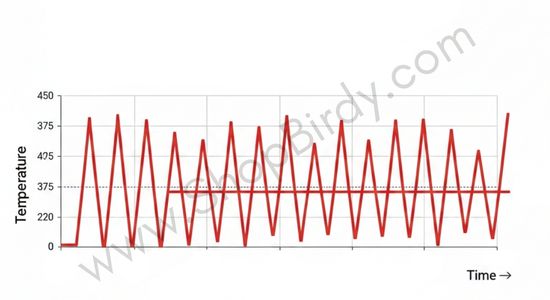
Cheap probe system: spikes and crashes.
Now compare that to integrated modulation:
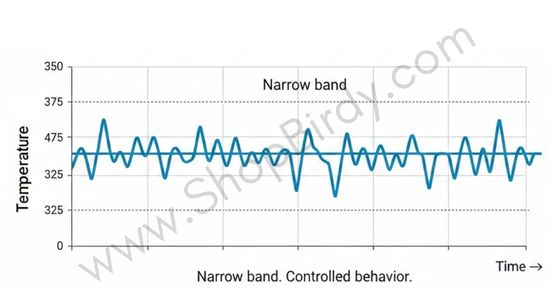
Narrow band. Controlled behavior.
One is chaos.
One is control.
The Recovery Slope Diagnostic
Recovery slope — the speed at which temperature returns after food is added — is the single best diagnostic of sensor quality.
If your temperature rebounds in 30–60 seconds:
You’re searing.
If it takes 2–3 minutes:
You’re steaming.
Cheap probe systems produce shallow recovery curves.
Integrated systems produce steep recovery curves.
This is the difference between crisp and limp.
For deeper heat recovery modeling, see Electric Wok vs. Induction Wok: The Thermal Efficiency Audit
Proportional–Integral–Derivative (PID) Control: The Gold Standard
The best systems don’t just integrate sensors.
They use PID control.
PID = Proportional–Integral–Derivative logic.
Instead of flipping between 0% and 100%, PID:
- Calculates error difference
- Predicts trend direction
- Applies fractional power
Lily’s Analogy:
PID is cruise control for your wok. It keeps you at speed without slamming the brakes or flooring the accelerator. It turns the rollercoaster into high-speed rail.
This is what separates precision appliances from budget ones.
Some higher-end systems use PID-style modulation (NuWave Mosaic is a known example), while entry-level electric woks rely on snap-switch logic.
Sensor Fusion
To be fair:
Not all probe systems are bad.
Advanced appliances may use:
- Fast-response thermocouples
- Dual-sensor fusion (base + ambient)
- Narrow hysteresis calibration
In theory, a well-calibrated probe system could approach integrated performance.
In practice?
Most consumer electric woks use slow mechanical probes with wide tolerance swings.
Integrated sensors remain the more reliable indicator of precise temperature control.
Sensor Placement Matters Too
Even integrated systems vary.
- Center-mounted sensors detect load collapse faster.
- Edge-mounted sensors react slower.
- Uneven placement can cause asymmetric heating.
Precision depends not just on sensor type — but location.
Why This Matters in Real Kitchens
In my testing (detailed fully in How I Actually Test Electric Woks), cycling failures show up immediately during:
- Garlic bloom phase
- First protein contact
- Vegetable moisture release
Cheap probe systems:
- Burn aromatics
- Undercook proteins
- Steam vegetables
- Click audibly every 30–60 seconds
That clicking sound?
That’s the snap switch engaging.
It’s the sound of lost crust.
Precision Skillet ≠ Wok
It’s important to distinguish this from precision skillets.
For example, the Zojirushi EP-PBC10 is excellent at maintaining even heat for shallow cooking — but it is not engineered for high-load stir-fry recovery.
Surface area, thermal mass, and airflow differ fundamentally.
(For deeper comparison, see Zojirushi EP-PBC10 Review: The Precision Skillet That Isn’t a Wok)
Why do cheap electric woks cycle?
Because they use probe-based thermostats with wide hysteresis and slow response times.
What is sensor inertia?
Sensor inertia is the delay caused by indirect temperature measurement and interface resistance.
What is PID modulation?
PID logic calculates how much power to apply continuously, rather than switching fully on or off.
Why does cycling ruin stir-fry?
Because temperature repeatedly falls below the Maillard threshold, causing steaming instead of searing.
The Bottom Line
Cheap electric woks don’t fail because they lack power.
They fail because they lack precision.
Probe systems:
- React late
- Swing wide
- Create thermal chaos
Integrated + PID systems:
- Detect instantly
- Adjust continuously
- Maintain tight control
Stir-fry is unforgiving.
If your wok cycles aggressively, technique won’t save it.
Because stir-fry isn’t about hitting 400°F once.
It’s about staying there.
Legal Information
Shopbirdy.com is a participant in the Amazon Services LLC Associates Program, an affiliate advertising program designed to provide a means for sites to earn advertising fees by advertising and linking to Amazon.

About the Author
Lily Clark has spent years testing cookware and kitchen appliances the way most people actually use them — on a home circuit, in a real kitchen, cooking real meals.
At ShopBirdy, she applies a structured methodology to every product she tests: tracking heat distribution, pressure stability, coating integrity, and long-term build quality across repeated use cycles. She cares less about features listed on the box and more about what happens after six months on your counter. Her reviews are written for people who want to buy once and cook well.