Updated February 2026 | By Lily Clark
Affiliate Disclosure: This article contains affiliate links. If you purchase through them, I may earn a small commission at no extra cost to you. I only recommend cookware I personally test and cook with in my kitchen
“Efficiency” is one of those words that gets used a lot in cookware — and understood very little. In a home kitchen, efficiency isn’t about lab charts or marketing claims. It’s about how quickly and predictably heat moves from electricity or flame into your food, and how much of that energy gets wasted along the way.
This is why the debate between electric woks, induction plates with stovetop woks, and traditional burners never really goes away. Each system feels different in practice, even when the numbers look similar on paper.
Before we compare them directly, it helps to understand the broader landscape of countertop wok-style cooking. If you haven’t already, start with our category overview:
Best Electric Woks: Reviews and Buying Guide
That guide explains how these systems are designed. What follows explains why they behave so differently.
What “Efficiency” Means When You’re Actually Cooking
In the kitchen, efficiency isn’t just power input. It’s a combination of:
- Thermal coupling: How directly energy reaches the pan
- Recovery speed: How fast heat returns after food is added
- Uniformity: How evenly the cooking surface heats
- Losses: How much energy escapes into the room instead of the food
Two systems with the same wattage can feel wildly different depending on how those factors stack up.
The Thermal Coupling Factor
This is the most important concept — and the one most reviews skip.
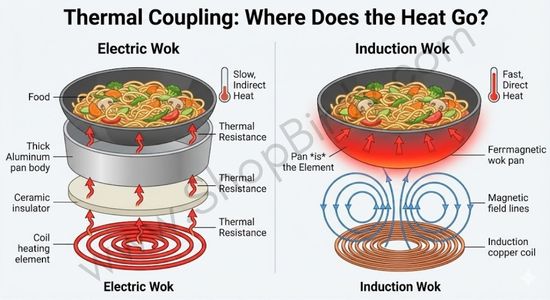
In a traditional electric wok, heat must travel through a chain:
Heating coil → ceramic insulator → aluminum body → food
Every step introduces thermal resistance. Energy is lost at each interface before it ever reaches the cooking surface.
In induction cooking, that chain disappears.
The pan itself becomes the heating element.
There is no coil-to-pan transfer. No insulator. No intermediary. The magnetic field excites the metal directly, and heat is generated inside the pan.
Why Thermal Coupling Shows Up on the Plate
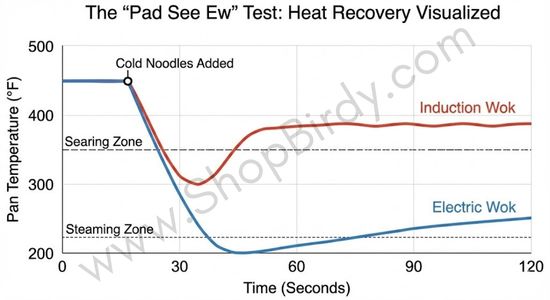
This difference isn’t theoretical — it’s painfully practical. The first time I tried to make Pad See Ew in a thin-wall electric wok, I followed the recipe perfectly and still failed. The moment the cold noodles and sauce hit the pan, the heat crashed. What should have been charred, chewy noodles turned into a grey, soupy tangle before the element ever clicked back on.
That dish didn’t fail because of seasoning or timing — it failed because the heat had too many places to get lost before it reached the food. In induction cooking, the pan is the heating element. There’s no waiting for energy to travel through layers. That’s why coupling efficiency isn’t a spec-sheet concept — it’s the difference between browning and boiling.
Lily’s note:
This is why induction wins on “coupling efficiency.” There is nowhere else for the energy to go. In an electric wok, heat is delivered. In induction, heat is created.
This single difference explains:
- Faster recovery
- Less ambient heat
- More consistent browning
It’s not magic — it’s physics.
System 1: Traditional Stovetop Wok (Gas or Electric Coil)
A classic stovetop wok — especially over gas — is still the emotional benchmark for many cooks.
Efficiency Strengths
- Extremely high peak heat
- Instant recovery after tossing
- Flame wraps around curved wok walls
Efficiency Weaknesses
- Massive heat loss to air
- Inconsistent contact on flat electric coils
- Poor precision at lower temperatures
Gas burners deliver raw energy, but they are inefficient in how much of that energy actually enters the pan. A lot of BTUs heat your kitchen, not your food.
BTU vs. Wattage
This is where many cooks get confused, especially when moving from gas.
Here’s a practical translation:
- 1500W electric wok ≈ 5,000 BTU gas burner
- 1800W induction system can feel like 8,000–10,000 BTU
- Why? Because induction loses far less heat to the room
Lily’s note:
If you’re coming from a powerful gas range, standard electric woks often feel like a downgrade. Induction is the only electric system that doesn’t.
This is why induction surprises people. The numbers look modest, but the experience feels stronger.
System 2: Electric Wok (Coil / Probe-Based)
Electric woks trade peak performance for simplicity and consistency.
Examples include:
- Ovente Electric Wok Review: The Honest Budget 13-Inch Audit
Budget Electric Wok Limitations - Aroma AEW-306 Review: The Honest 5-Quart Electric Wok Audit
Family-Size Electric Wok Capacity - Zojirushi EP-PBC10 Review: The Precision Skillet That Isn’t a Wok
Precision Electric Skillet Vs Wok
Efficiency Profile
- Moderate coupling efficiency
- Predictable long-term heat
- Slower recovery under load
Electric woks are efficient at holding heat, not regaining it. That makes them well suited to:
- Simmering
- Steaming
- Braising
- Scheduled family meals
Where they struggle is the moisture window — the moment cold food hits the pan and steam overwhelms available energy.
System 3: Induction Plate + Stovetop Wok
Induction combines the geometry of a real wok with the coupling efficiency of magnetic heating.
The best example of this approach is the NuWave Mosaic:
NuWave Mosaic Review: The Only Electric Wok That Actually Sears?
Efficiency Strengths
- Highest coupling efficiency
- Fastest recovery (often under 10 seconds)
- Minimal wasted heat
- Precise control at both high and low temps
Efficiency Tradeoffs
- Audible induction hum
- Higher upfront cost
- Requires compatible cookware
In pure energy terms, induction does more with less. Less wattage is wasted, so more goes into cooking.
Real-World Trade-offs (The Stuff Specs Don’t Tell You)
Noise
- Gas: Quiet, but ventilation noise may dominate
- Electric wok: Silent
- Induction: Low hum or buzz at high power
Cleaning
- Gas: Burners and grates require frequent cleaning
- Electric wok: Single pan cleanup
- Induction: Cool surface wipes clean instantly
Cleaning Reality (And a Pro Tip Most Manuals Won’t Tell You)
Electric woks and induction pans are generally easier to clean than gas setups — there are fewer parts, and no burners or grates to scrub. That said, there’s one caveat worth stating plainly.
Pro tip: Even if the manual says dishwasher-safe, don’t do it. The harsh detergents used in modern dishwashers are extremely aggressive on nonstick coatings. They’ll eat that surface for breakfast long before normal hand-washing ever would. A soft sponge, warm water, and mild soap will add months — sometimes years — to the life of the pan.
Lifespan & Replacement
- Electric woks: Heating element failure ends the unit
- Induction: Cooktop may outlast multiple pans
- Gas: Burners last, but woks warp over time
These factors matter just as much as heat charts for everyday cooks.
Efficiency in Practice: What Actually Cooks Better?
Stir-Fry & Searing
- Winner: Induction + wok
- Reason: Fast recovery + minimal steam stall
Family Meals & Stews
- Winner: Electric wok
- Reason: Capacity + stable long cooks
Precision Sauces & Table-Side Cooking
- Winner: Zojirushi-style electric skillet
- Reason: Tight temperature bands
Restaurant-Style Wok Hei
- Winner: Gas
- Reason: Flame chemistry (still unmatched)
Choosing the Right System
Choose a traditional stovetop wok if:
- You already have strong gas
- You value flame technique
- Ventilation isn’t a concern
Choose an electric wok if:
- You want consistency over speed
- You cook for families
- You prefer “set and manage” heat
Choose induction + wok if:
- You want the best efficiency per watt
- You cook in small kitchens
- You want electric power without compromise

Final Verdict: Efficiency Is About Where the Heat Goes
Efficiency isn’t about the biggest number on the box. It’s about how directly energy reaches the food.
- Gas delivers raw power, but wastes a lot of it
- Electric woks are gentle, predictable, and convenient
- Induction wins on physics — the pan is the element
If efficiency means less wasted heat, faster recovery, and better browning, induction takes the crown. If efficiency means ease, capacity, and consistency, electric woks still earn their place.
The best system is the one that matches how you actually cook.
Legal Information
Shopbirdy.com is a participant in the Amazon Services LLC Associates Program, an affiliate advertising program designed to provide a means for sites to earn advertising fees by advertising and linking to Amazon.

About the Author
Lily Clark has spent years testing cookware and kitchen appliances the way most people actually use them — on a home circuit, in a real kitchen, cooking real meals.
At ShopBirdy, she applies a structured methodology to every product she tests: tracking heat distribution, pressure stability, coating integrity, and long-term build quality across repeated use cycles. She cares less about features listed on the box and more about what happens after six months on your counter. Her reviews are written for people who want to buy once and cook well.