Updated January 2026 | By Lily Clark
Affiliate Disclosure: This article contains affiliate links. If you purchase through them, I may earn a small commission at no extra cost to you. I only recommend cookware I personally test and cook with in my kitchen
If you’ve ever stood over a pan waiting for that satisfying sizzle—only to hear a sad hiss instead—you already know why people start looking for electric woks.
I’ve been there.
Chicken goes in cold. The pan goes quiet. Liquid pools. And suddenly what should’ve been a stir-fry turns into a shallow boil.
It’s not the recipe.
It’s not your timing.
It’s heat behavior.
Electric woks promise restaurant-style results without gas lines, outdoor burners, or industrial ventilation. In 2026, they can deliver—but only if you understand what you’re buying. This guide exists to teach you exactly that.
Even if you don’t choose one of my picks, you’ll know how to spot a good one—and avoid the quiet disappointments.
What an “Electric Wok” Really Is in 2026
Ten years ago, an electric wok meant one thing: a bowl-shaped pan with a heating element underneath.
Today, the category is broader—and smarter.
Modern “electric wok” solutions include:
- Traditional electric wok bowls
- Precision induction cooktops paired with real carbon-steel woks
- Electric hot pots built for boiling and communal meals
They all solve the same problem in different ways: how to deliver usable, consistent heat on a countertop.
None of them replicate a 600°F restaurant gas jet—and that’s okay. In a home kitchen, chasing that number is unsafe and unrealistic.
What actually matters is what happens when food hits the pan.
The Physics of a Good Electric Wok
Before brands or prices, you need to understand four fundamentals. This is where most guides stop short—and where frustration begins.
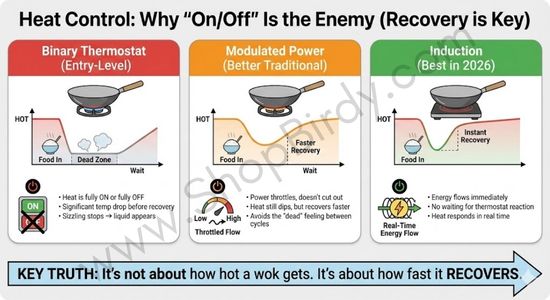
1. Heat Control: Why “On/Off” Is the Enemy
The first time I noticed this was cooking fried rice. The pan was hot. The rice went in. Everything stalled. Moisture bloomed. No crisping—just steam.
That’s thermostat lag.
There are three types of heat control you’ll encounter:
Binary Thermostats (Entry-Level Electric Woks)
- Heat is either fully ON or fully OFF
- Temperature must drop significantly before heat returns
What it feels like:
Food goes in → sizzling stops → liquid appears → browning loses.
Modulated Power (Better Traditional Electric Woks)
- Power throttles instead of cutting completely
- Heat still dips, but recovers faster
This is why older premium electric woks felt better to cook on—they didn’t “go dead” between cycles.
Induction (Best in 2026)
- Energy flows immediately
- No waiting for a thermostat to react
- Heat responds in real time
Key truth:
It’s not about how hot a wok gets.
It’s about how fast it recovers.
2. Material Science: Why the Pan Matters More Than the Plug
I learned this cooking the same dish on two different setups.
One pan browned.
The other steamed.
Same recipe. Same heat setting.
The difference was material.
Carbon Steel (Best for Induction)
- Reacts instantly to heat changes
- Develops natural nonstick seasoning
- Delivers crisp browning
It does require care, but it behaves like a real wok.
Die-Cast Aluminum (Great, but Fading)
- High thermal mass
- Even heat distribution
- Often paired with nonstick
Excellent for consistency—but coatings cap peak heat.
Nonstick Coatings (Convenient, Limited)
- Easy cleanup
- Safer at moderate temps
- Not built for aggressive searing
Rule of thumb:
If it’s nonstick, it’s designed for control, not extremes.
3. Geometry & Vapor Clearance: Why Some Woks Steam Food
This lesson clicked for me while cooking beef and broccoli for four. Same heat. Same oil. Different result.
One pan stayed dry.
The other trapped steam.
Why? Vapor clearance.
Stir-frying is a race between:
- Browning
- Moisture release
A good wok lets steam escape. A bad one traps it.
What to look for:
- Wide rim (13.5–14 inches is ideal)
- Sloped walls, not vertical
- Space for vapor to move upward and out
The 30-Second Rule:
If liquid pools for more than 30 seconds after food hits the pan, the wok has failed the recovery test.
4. The Wattage Truth
Most electric woks sit around 1400–1500 watts because of US household limits.
That means wattage alone is almost meaningless.
A poorly controlled 1500W wok can perform worse than a lower-wattage induction setup.
Mantra worth remembering:
It’s not about max watts.
It’s about how those watts are managed.
The Field of Competitors
You may still see names like:
- Older Breville electric woks (excellent, but discontinued)
- Stainless electric bowls with simple thermostats
- Thin, lightweight “wok pans” marketed as do-everything tools
Many of these aren’t bad. They’re just outpaced.
This guide focuses on what’s currently available, reliable, and relevant.
Price: Roughly $160 | Capacity: 5 quarts | Power: 1800W | Max temp tested: 575°F
This is the setup that finally stopped my fried rice from steaming. Induction eliminates the biggest electric-wok failure point: delayed heat response. When cold food hits, power flows immediately—no waiting, no stall.
Why I picked it: It’s the only electric system that utilizes a real Carbon Steel wok. You get the benefits of induction precision paired with the ability to develop a natural, “Wok Hei” seasoning that non-stick woks can’t touch.
Cooking test:
Heat time: Instant magnetic engagement; reached 400°F in under 60 seconds.
Cook time: Chicken and broccoli for two finished in 6 minutes with a deep, dark sear.
Recovery test: Adding 1 lb of cold protein caused zero liquid pooling; browning began immediately.
Pros:
Zero Hysteresis Lag; the most responsive electric heat on the market.
Carbon steel bowl is durable, metal-utensil safe, and improves with age.
“Lift and Toss” sensor allows for traditional wok technique without shut-off.
Cons:
Requires a two-piece setup (cooktop + wok) which takes up more counter space.
The wok requires manual seasoning and maintenance.
Verdict: The definitive benchmark for performance. If you care about stir-fry texture more than “all-in-one” convenience, this is the only system worth the investment.
Price: roughly $70 | Capacity: 5 quarts | Power: 1500W | Max temp tested: 400°F
This is the last traditional electric wok I still recommend without hesitation.
It’s roomy, honest, and versatile—but it expects you to meet it halfway.
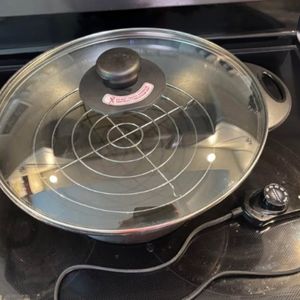
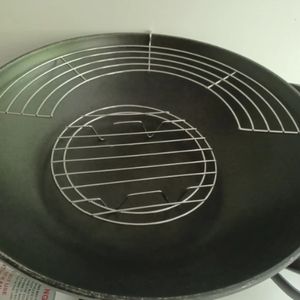
Why I picked it: Aroma bundled accessories that actually matter — a steaming rack, tempura tray, and long chopsticks. It’s built for feeding people and making shared meals easy.
Cooking test:
- Heat time: Around 2 minutes up to 400°F.
- Cook time: Veggie stir-fry for 4 finished in about 9 minutes.
- Steam test: Dumplings steamed perfectly in 7 minutes with the included rack.
Pros:
- Accessories add real value for home cooks.
- Accurate temperature control and cool-touch handles.
- Nonstick surface and dishwasher-safe parts.
Cons:
- Nonstick can degrade if you habitually overheat it.
- The slightly flatter bottom means you’ll stir more for even sear.
Verdict: Excellent balance of price, features, and capacity for families. The included accessories make it feel like a complete cooking system.
Price: Roughly $120 | Capacity: 3.7 quarts | Power: 1350W | Max temp tested: 430°F (Dry)
This isn’t a stir-fry tool—and that’s exactly why it excels. If your meals lean toward broths, noodles, and table-side cooking, precision matters more than peak heat. It holds a simmer without scorching or drama.
Why I picked it: Zojirushi’s temperature control is the most precise in the industry. While budget hot pots aggressively cycle on and off, this unit maintains a steady, “gentle” boil that is perfect for communal dining.
Cooking test:
Simmer test: Maintained a perfect 205°F broth temperature for 2 hours without a single “surging” boil.
Searing test: Sautéed aromatics evenly, though it lacks the “aggressive” sear of the NuWave.
Clean test: The ceramic-coated inner pan wiped clean of oily broth residue with zero scrubbing.
Pros:
Unrivaled simmering stability; no liquid “splatter” during long meals.
Durable ceramic-coated pan is tougher than standard non-stick.
Multi-functional: great for braising, steaming, and even “dry” grilling.
Cons:
Lower thermal recovery speed; not optimized for high-volume stir-frying.
Smaller capacity than the Aroma or VonShef models.
Verdict: The undisputed king of the table-side meal. Buy this for social cooking and shared hot pots, not for searing meat.
Price: Roughly $45 | Capacity: ~4 quarts | Power: 1400W | Max temp tested: 400°F
This is not a traditional heavy-duty wok, and I want to be honest about that. But for seniors, smaller kitchens, or cooks who value lightweight handling over extreme heat, the Ovente is a surprisingly capable daily workhorse.
Why I picked it: It’s approachable. It’s lightweight, heats up fast, and the copper-finish non-stick is exceptionally slick. It’s the “Value” choice for anyone who finds the NuWave or Breville too heavy or complicated.
Cooking test:
Heat time: Reached 350°F in about 3 minutes.
Cook time: A light veggie stir-fry for two finished in 10 minutes.
Ease of use: Cool-touch handles and the glass lid made monitoring “one-pan” pasta meals effortless.
Pros:
Extremely lightweight and easy to store in small cabinets.
The copper-colored surface provides excellent visual contrast for browning.
Highly affordable price point for entry-level cooks.
Cons:
Lower thermal mass; temp “crashes” quickly if overfilled.
1400W is the lowest power in this group, leading to longer recovery times.
Verdict: A gentle, user-friendly option for light cooking. It won’t win any performance awards, but for a simple, reliable weeknight meal, it gets the job done without the bulk.
Comparison Cheat Sheet
Type | Model | Heating Tech | Best For | Key Limitation |
Induction + Wok | NuWave Mosaic + Carbon Steel | Induction | Real stir-fry & browning | Requires separate wok |
Traditional Electric | Aroma AEW-306 | Modulated electric | Families, value | Slower recovery |
Hot Pot | Zojirushi EP-PBC10 | Precision thermostat | Broth & simmering | Not for searing |
Lightweight Skillet | Ovente SK3113CO | Basic electric | Ease, accessibility | Limited depth |
Mastering Your Electric Wok
For Induction + Carbon Steel
- Season properly
- Preheat fully
- Add oil just before food
- Don’t overcrowd
For Traditional Electric Woks
- Preheat until shimmering
- Cook proteins in batches
- Pat food dry
- Use spatula folding, not wrist tossing
This is where most frustration disappears.
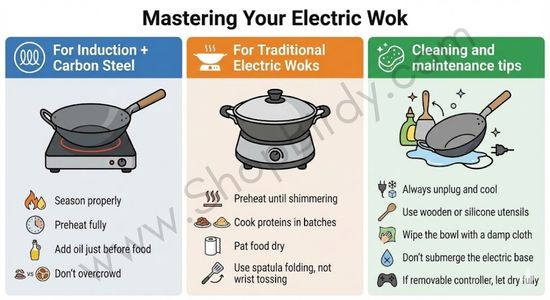
Cleaning and maintenance tips (from the kitchen)
- Always unplug and cool the unit before cleaning the bowl or heating element area.
- Use wooden or silicone utensils to protect the nonstick coating.
- Wipe the bowl with a damp cloth after each use; most bowls and lids are dishwasher-safe but check your manual.
- Don’t submerge the electric base in water — only wipe it dry.
- If your wok has a removable temperature controller, remove it before washing and let the unit fully dry before reassembly.
Recipe Philosophy: What Works (and What Doesn’t)
Works well:
- Beef & broccoli
- Chicken stir-fry
- Fried rice (day-old)
- Noodles
- Hot pot & soups
Struggles:
- Very wet marinades
- Huge single-batch proteins
- Recipes written for open-flame wok hei
FAQs & Myths
Can electric woks make real wok hei?
No—but they can make excellent stir-fry flavor with good heat recovery.
Is nonstick safe at high heat?
Safe within limits, but not ideal for aggressive searing.
Why is induction better?
Because it removes thermostat lag entirely.
Do I need a flat-bottom wok for induction?
Yes, absolutely. It must have a magnetic, flat base for proper contact.
Power Draw & Circuit Limits
Most electric woks operate at 1400–1500 watts, the upper limit of standard 15-amp household circuits.
Running these alongside other high-draw appliances (toasters, coffee makers) on the same circuit may trip breakers — especially in older homes.
Final Verdict
Electric woks aren’t dead.
Bad electric woks are.
In 2026, the best tools:
- Respect physics
- Manage heat intelligently
- Let moisture escape
If you want the best results, induction plus carbon steel is the clear winner. If you want simplicity and value, a traditional electric wok still has a place—if you use it correctly.
Now you know how to choose.
And more importantly, you know why.
Legal Information
Shopbirdy.com is a participant in the Amazon Services LLC Associates Program, an affiliate advertising program designed to provide a means for sites to earn advertising fees by advertising and linking to Amazon.
How I Research
This guide comes straight from my kitchen counter. Every product I review is tested hands-on — no guesswork, no copy-paste specs. I personally cook multiple recipes in each wok, from quick weeknight stir-fries to slow Sunday soups, to evaluate heat distribution, searing performance, and ease of cleaning in real conditions.
I take temperature readings at different points in the pan, note any hot spots, and track boil and sear times to see how consistently each wok performs once ingredients hit the surface.
Beyond that, I film unboxing and first-use clips for every product, using each wok for at least two weeks before deciding whether it earns a spot in this guide. During that time, I document handle comfort, lid fit, weight balance, and cleanup effort — because those are the details that matter once the novelty wears off.
Finally, I cross-check verified customer feedback, updated warranties, and any manufacturer design changes, so the information you read reflects what’s shipping right now, not last year’s model.
That’s how I make sure these reviews stay honest, experience-based, and truly helpful — written by someone who actually cooked with the products, not just looked at them online.

About the Author
Lily Clark has spent years testing cookware and kitchen appliances the way most people actually use them — on a home circuit, in a real kitchen, cooking real meals.
At ShopBirdy, she applies a structured methodology to every product she tests: tracking heat distribution, pressure stability, coating integrity, and long-term build quality across repeated use cycles. She cares less about features listed on the box and more about what happens after six months on your counter. Her reviews are written for people who want to buy once and cook well.