Updated February 2026 | By Lily Clark
Affiliate Disclosure: This article contains affiliate links. If you purchase through them, I may earn a small commission at no extra cost to you. I only recommend cookware I personally test and cook with in my kitchen
Zojirushi has a reputation for building appliances that age quietly and predictably. They don’t chase peak wattage or dramatic claims. Instead, they focus on temperature stability, conservative engineering, and long-term reliability. The Zojirushi EP-PBC10 Gourmet d’Expert Electric Skillet follows that philosophy closely.
It’s often grouped with electric woks — and frequently misunderstood because of that. This is not a wok substitute in the traditional sense. It does not aim to sear aggressively, toss food theatrically, or evaporate moisture at extreme speed. Instead, it offers something rarer in countertop appliances: tight temperature control over long cooking windows.
This review evaluates the EP-PBC10 not as a “wok alternative,” but as a precision electric skillet — and judges it accordingly.
Quick Verdict
Best For: Controlled tabletop cooking, sauces, stews
Not For: High-heat wok stir-fry
Heat Behavior: Stable and narrow thermal band (±15°F)
Wattage: 1250W (precision-focused, not power-focused)
Overall Rating: 8.8 / 10
Where the Zojirushi EP-PBC10 Fits in the Electric Wok Ecosystem
Before diving into performance, it’s important to place this product correctly.
If you’re comparing electric wok–style appliances across categories — from lightweight budget pans to family-scale electric woks and induction systems — start with our category overview here:
Best Electric Woks: Reviews and Buying Guide
Within that ecosystem:
- The Zojirushi EP-PBC10 is engineered for controlled, stable cooking
- The OVENTE Electric Wok is a budget, lightweight entry-level wok
- The Aroma AEW-306 is a family-scale electric wok with capacity focus
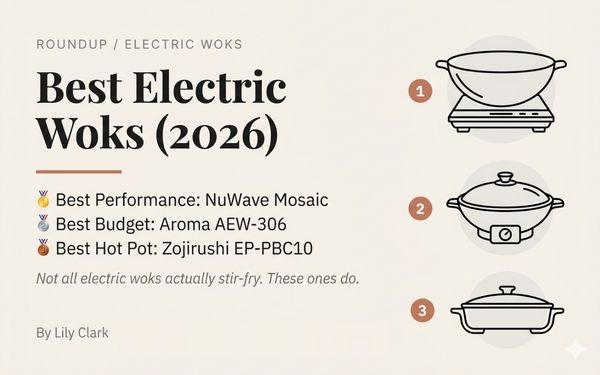
- The NuWave Mosaic is a high-performance induction wok system
Most negative reviews come from buyers expecting wok-level heat. This appliance is built for control, not combustion.
| Model | Wattage | Strength | Weakness |
|---|---|---|---|
| Zojirushi EP-PBC10 | 1250W | Precision & stability | Not high-heat |
| Aroma AEW-306 | 1500W | Capacity | Less refined control |
| NuWave Mosaic | Induction | Searing | Higher cost |
Testing Methodology
Testing period: 10 consecutive days of controlled home use
All measurements were recorded using a calibrated digital probe thermometer and surface IR thermometer.
Environment: Standard 120V / 15-amp household circuit
Tests Performed
- Heat Evenness: Flour-and-oil browning test (visual mapping across surface)
- Heat Recovery: Time (seconds) to return to 350°F after adding 1 lb of 40°F chicken
- Temperature Stability: Surface temperature tracked with probe thermometer over 20-minute cook
- Power Reality: Observed startup draw, cycling behavior, and breaker interaction
- Usability: Table-side keep-warm performance, cleanup, and handling
What this test does NOT claim:
This is not a multi-year durability study. Coating longevity and appliance lifespan are evaluated using material science principles and Zojirushi’s historical reliability, not extended ownership.
Design & Build
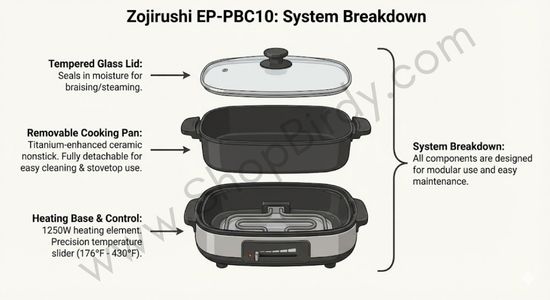
The EP-PBC10 uses a titanium-enhanced ceramic nonstick coating over a solid aluminum pan. The pan feels deliberately engineered rather than overbuilt — substantial enough to stabilize heat, but not heavy for marketing effect.
At 9 lbs, it sits between:
- Lightweight budget skillets (less stable)
- Heavy cast-aluminum electric woks like the Aroma AEW-306 (more mass, less finesse)
A standout feature is that the pan fully detaches from the heating base and can be used directly on a gas or electric stovetop. This isn’t a gimmick — it allows finishing, deglazing, or cleaning without wrestling a corded base.
Geometry: Why This Is a Skillet, Not a Wok
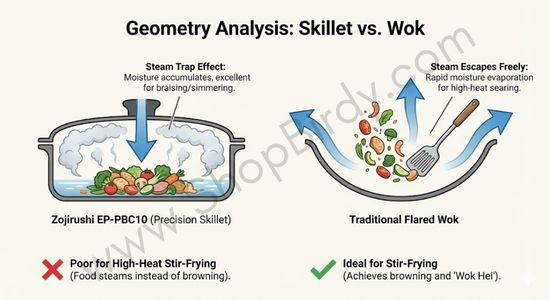
The cooking surface is 10.5 inches in diameter and 2.25 inches deep, with straight walls.
This geometry:
- Promotes even contact and predictable heat
- Limits steam escape compared to sloped woks
- Discourages toss-based stir-fry technique
If you attempt to stir-fry as you would in a true wok, moisture accumulates quickly and browning stalls.
For comparing this directly to wok geometry, see:
When browning chicken thighs, the skin rendered slowly and evenly. No hot spots. No sudden smoking. The crust developed gradually instead of burning at the edges.
Power & Heat Behavior
The EP-PBC10 operates at 1250 watts, well below most electric woks.
Measured Performance
- Pre-heat to sauté-ready (≈350°F): ~3 minutes
- Heat recovery after 1 lb cold protein: ~65–75 seconds
- Temperature swing during steady cooking: ±10–15°F
This is not fast heat — but it is controlled heat.
Where cheaper electric cookware oscillates aggressively, the Zojirushi maintains narrow thermal bands. That makes it ideal for:
- Long sautés
- Sauces and emulsions
- Stews and curries
- Table-side keep-warm use
If fast recovery and searing are priorities, this review shows the opposite design philosophy:
NuWave Mosaic Review: The Only Electric Wok That Actually Sears?
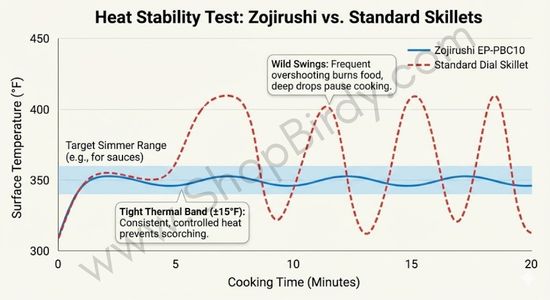
In real cooking, this feels calm.
There’s no sudden spike. No frantic adjustment. No smoke surprise.
You set it. It holds. You cook.
That quiet predictability is the entire point of this appliance.
Temperature Control: The EP-PBC10’s Defining Strength
The variable control range runs from 176°F (Keep Warm) to 430°F.
In testing:
- The thermostat avoided deep “off” cycles
- Power delivery was smooth rather than pulsed
- Temperature returned gradually without overshoot
This is the opposite of budget dial systems, which often swing 30–40°F before re-engaging. For delicate foods, this difference is enormous.
Nonstick Coating
The titanium-enhanced ceramic coating releases food cleanly at moderate heat and resists staining better than basic PTFE.
However:
- It is not intended for repeated dry searing
- High-heat misuse will shorten lifespan
- Silicone or wooden utensils are mandatory
Based on material behavior and Zojirushi’s track record, this coating should outlast budget nonstick when used correctly — but it rewards restraint.
For comparison with heavier, capacity-focused nonstick systems:
Moisture Management & Lid Performance
The tempered glass lid seals well and vents predictably. It excels for:
- Covered braises
- Steaming
- Long simmers
For stir-fry-adjacent cooking, the correct approach is staged cooking:
- Protein first
- Remove
- Vegetables
- Combine at the end
This preserves texture and avoids the “steam trap” effect common to straight-wall pans.
Ergonomics & Everyday Usability
Zojirushi’s attention to detail shows:
- Stay-cool side handles remain comfortable
- Detachable pan simplifies washing
- Compact footprint suits small kitchens
This is one of the few electric cooking appliances that genuinely works well at the table, not just at the counter.
Electrical Reality
At 1250W, the EP-PBC10 is gentle on household circuits. It ran reliably without breaker issues, even when sharing a circuit with other moderate-draw appliances.
The lower wattage is intentional. It trades raw heat for control.
What This Skillet Is NOT
- It is not a wok burner
- It is not built for tossing technique
- It is not designed for extreme searing
If you’re chasing wok hei, this isn’t your tool.
Verdict
Buy the Zojirushi EP-PBC10 if you:
- Cook sauces, curries, sautés, and stews regularly
- Value temperature stability over raw power
- Want table-side “keep warm” performance
- Prefer conservative engineering that ages well
Avoid it and consider alternatives if you:
- Want aggressive stir-fry or wok hei
- Cook large batches frequently
- Expect fast heat recovery or tossing technique
Our Top Picks by Use Case
- Top Pick for Precision & Stability: Zojirushi EP-PBC10
- Top Pick for Families & Capacity: Aroma AEW-306
- Top Pick for High-Heat Performance: NuWave Mosaic
Price & Value Over Time
The Zojirushi costs more upfront than budget skillets, but its cost-per-use favors cooks who value longevity and control.
This is the kind of appliance you keep for years because it behaves predictably.
For current pricing and availability:
Frequently Asked Questions
Can you stir-fry in the Zojirushi EP-PBC10 electric skillet?
Yes, the Zojirushi EP-PBC10 can handle light stir-frying using “staged cooking,” but it is not a replacement for a high-heat carbon steel wok. Because it operates at 1250 watts, it lacks the extreme temperature recovery needed for wok hei (breath of the wok). For best results, sear your proteins first, remove them, and then sauté vegetables to prevent moisture buildup.
Zojirushi EP-PBC10 vs. Electric Wok: Which is better?
The Zojirushi EP-PBC10 is a precision electric skillet, not an electric wok. Its 10.5-inch flat-bottom geometry and straight walls are designed for thermal stability and simmering. If your cooking style involves tossing food and high-heat searing, an induction wok like the NuWave Mosaic is a better choice. If you cook stews, sauces, or hot pot, the Zojirushi is superior.
Is the 1250-watt power rating of the EP-PBC10 sufficient?
1250 watts is ideal for controlled cooking and is gentle on 15-amp household circuits, but it is not designed for aggressive flash-searing. The lower wattage is a strategic choice by Zojirushi to provide a “narrow thermal band” (±15°F), which prevents the wild temperature swings common in high-wattage, budget skillets.
Is the Zojirushi EP-PBC10 pan stovetop safe?
Yes, the inner cooking pan of the EP-PBC10 is designed to be used directly on a gas or electric stovetop. This allows you to start a dish (like searing meat) on your main stove and transfer it to the electric base for table-side simmering or keeping food warm.
Is the Zojirushi nonstick coating PFOA-free?
Yes, the EP-PBC10 features a titanium-enhanced ceramic nonstick coating that is PFOA-free. This coating is more durable than standard PTFE surfaces and provides excellent food release at moderate temperatures without the use of harmful chemicals.
Can I use the EP-PBC10 for Japanese Hot Pot (Shabu-Shabu)?
The Zojirushi EP-PBC10 is highly recommended for Shabu-Shabu, Sukiyaki, and Nabemono. Its deep 2.25-inch pan and “Keep Warm” setting (176°F) make it one of the best tabletop appliances for interactive, slow-simmered family meals.
Is the Zojirushi electric skillet dishwasher safe?
No, the Zojirushi EP-PBC10 pan and base are not dishwasher safe. To protect the ceramic nonstick coating and the electrical components, you should hand-wash the pan with a soft sponge and mild detergent. The pan detaches fully from the base, making hand-washing straightforward.
What is the maximum temperature of the Zojirushi EP-PBC10?
The EP-PBC10 has a variable temperature range from 176°F (Keep Warm) to 430°F. Unlike budget skillets that pulse on and off, the Zojirushi thermostat is engineered for consistency, making it reliable for delicate tasks like making sauces or emulsions.
Final Verdict
The Zojirushi EP-PBC10 is not trying to replace a wok. It’s doing something else entirely: offering predictable, controlled heat for cooks who care more about outcomes than spectacle.
If you buy it expecting a wok, you’ll be disappointed.
If you buy it as a precision electric skillet, it’s one of the most refined countertop tools available.
Legal Information
Shopbirdy.com is a participant in the Amazon Services LLC Associates Program, an affiliate advertising program designed to provide a means for sites to earn advertising fees by advertising and linking to Amazon.

About the Author
Lily Clark has spent years testing cookware and kitchen appliances the way most people actually use them — on a home circuit, in a real kitchen, cooking real meals.
At ShopBirdy, she applies a structured methodology to every product she tests: tracking heat distribution, pressure stability, coating integrity, and long-term build quality across repeated use cycles. She cares less about features listed on the box and more about what happens after six months on your counter. Her reviews are written for people who want to buy once and cook well.