Updated February 2026 | By Lily Clark
Affiliate Disclosure: This article contains affiliate links. If you purchase through them, I may earn a small commission at no extra cost to you. I only recommend cookware I personally test and cook with in my kitchen
I didn’t set out to build a “system” for reviewing electric woks.
I set out to stop wasting money.
Years ago, I bought a highly rated electric wok that looked perfect on paper. Great reviews. Solid brand. Clean design. It browned vegetables well enough — until I tried to cook a real stir-fry. The heat collapsed, the sauce broke, and within three months the temperature probe drifted so badly the dial meant nothing. By month four, the coating was permanently sticky. By month six, it was dead.
That wok didn’t fail because I used it wrong.
It failed because no one had tested where it breaks.
Over time, I stopped asking how hot a wok gets. That’s a vanity metric. Instead, I started asking how much heat it loses the second food hits it, and whether the metal ‘remembers’ being flat after its hundredth heat cycle
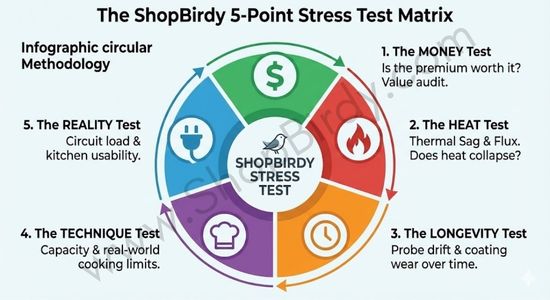
That experience is why ShopBirdy doesn’t do generic “best of” lists. Instead, I put every electric wok through what I now call the ShopBirdy Stress Test — a set of real cooking and hardware checks designed to surface failure, not hide it.
If you’re new here, start with the overview that maps the category:
Best Electric Woks: Reviews and Buying Guide
What follows explains how I break these tools, and why each type of article on the site exists.
Why I Don’t Trust Single Reviews Anymore
A wok can do one thing well and still be a terrible buy.
I’ve tested electric woks that:
- brown chicken beautifully but can’t hold a simmer
- steam dumplings perfectly but destroy nonstick in six months
- recover heat fast but trip breakers in older kitchens
That’s why I don’t just look at the box or cook one meal. I break the evaluation into five specific stress tests, because I know a wok that passes one can fail miserably at another.
Each “field manual” on ShopBirdy exists because I’ve personally seen a product pass one test and fail the rest.
Stress Test #1: The Money Test
This is where most people start — and where most reviews stop.
When someone asks, “Why does this wok cost $60 and that one $140?” they’re not asking about branding. They’re asking whether the upgrade changes the cooking outcome.
This is why I write direct head-to-head audit like:
This test exist because cheap woks don’t usually fail immediately — they fail quietly.
A good example is the OVENTE Electric Wok, which I’ve reviewed in detail:
Ovente Electric Wok Review: The Honest Budget 13-Inch Audit
It works — until you overload it, or expect it to behave like heavier hardware. The Money Test makes that tradeoff explicit.
Stress Test #2: The Heat Test
This is the part most manufacturers hope you won’t ask about.
I don’t care how many watts are on the box if the heat can’t get into the food. That’s why I spend so much time on:
- wattage density
- heat flux
- sensor placement
- recovery time
This stress test is also why induction behaves so differently — something I break down here:
Electric Wok vs. Induction Wok: The Thermal Efficiency Audit
Once you understand coupling efficiency, you stop blaming yourself for soggy stir-fries.
The Metric I Actually Care About: Thermal Sag
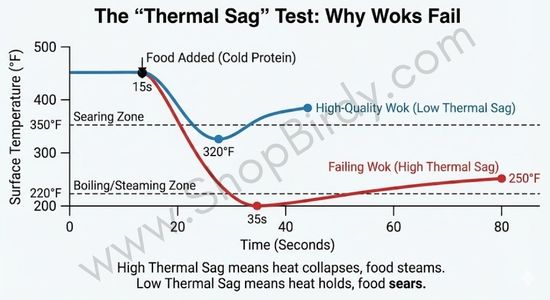
I don’t just measure peak heat. I measure Thermal Sag — how many degrees the pan loses when the thermostat “clicks off” before the system realizes it’s getting cold.
In cheaper electric woks, I routinely see 30–40°F drops before power re-engages. That gap is the difference between browning and boiling. It’s why a steak or chicken breast turns grey instead of seared, even though the dial claims you’re still at “high.”
A wok with low Thermal Sag recovers quickly and never lets the surface fall far enough to stall the Maillard reaction. A wok with high Thermal Sag feels powerful at first — then quietly betrays you the moment real food hits the pan.
Thermal Coupling & Contact Patch
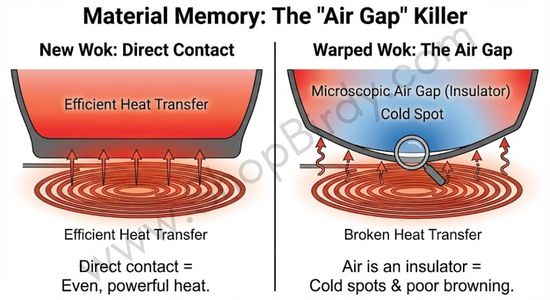
I don’t just look at the wattage; I look at the Interface. In cheaper woks, there is often a microscopic air gap between the heating coil and the pan base. Since air is a terrible conductor, your element might be red hot while your food is sitting in a cold puddle.
I look for the Bridge. If the heating element isn’t ‘brazed’ (physically fused) to the pan, the energy has to jump across a microscopic air gap. In the kitchen, that air gap acts like a wall, leaving your element red hot while your food stays cold
Stress Test #3: The Longevity Test
This test exists because of regret.
After that first failed wok, I started tracking what dies first:
- temperature probes drifting
- heating coils losing output
- nonstick carbonizing
- gaskets leaking steam
This test is also why I respect conservative designs more than flashy ones. The Zojirushi EP-PBC10, for example, isn’t exciting — but it’s honest about what it is:
Zojirushi EP-PBC10 Review: The Precision Skillet That Isn’t a Wok
Longevity isn’t sexy, but it’s expensive to ignore.
Material Memory: When a Wok Quietly Gives Up
Beyond electronics and coatings, I look for Material Memory — the point where a thin, stamped-aluminum base has warped so many times under heat that it no longer remembers flat.
Once that happens, the wok stops making full contact with its heating element. Heat concentrates in random zones, recovery slows, and no amount of technique can fix it. At that point, the wok isn’t “aging” — it’s effectively landfill.
This is why heavier cast aluminum and impact-bonded bases last longer. They don’t just resist warping once; they resist accumulated deformation over hundreds of heat cycles.
Oil Polymerization
I look for the Carbonization Threshold. Most electric woks have ‘hot spots’ directly above the coil that exceed the safe temperature of nonstick coatings.
This causes oil to polymerize (turn into a hard, sticky varnish) that you can’t scrub off. I use infrared mapping to find these ‘kill zones’ that turn a new wok into a sticky mess by month three.
Stress Test #4: The Technique Test
This is where I stop saying “the wok failed” and start asking “what technique does this hardware actually support?”
A wok that steams instead of sears when you cook for four isn’t broken — it’s undersized.
I once blamed myself for bad food when the real issue was overcrowding a pan that couldn’t recover heat.
When capacity matters, I point people directly to reviews like:
Aroma AEW-306 Review: The Honest 5-Quart Electric Wok Audit
Technique only works inside hardware limits. Pretending otherwise is dishonest.
Stress Test #5: The Reality TesT
This is the final filter — the stuff that doesn’t show up in specs:
- counter space
- cleanup friction
- accessory failure
- storage pain
These because I’ve owned tools that cooked fine but were miserable to live with.
Circuit Sharing and Voltage Sag.
Most reviewers test in professional studios with dedicated 20-amp circuits. I test in a real 2026 home kitchen. If you run a 1500W wok on a shared circuit with a toaster, your voltage drops, and your ‘high’ heat becomes ‘medium’ at best.
My ‘Reality Test’ includes a Simultaneous Load Audit to see which woks are sensitive to household power fluctuations.
Why This Isn’t “Optimized” — It’s Defensive
This system wasn’t designed to look smart.
It was designed to protect future me from past mistakes.
Every stress test exists because a wok once failed there:
- browned well but died early
- held heat but ruined coatings
- recovered fast but couldn’t simmer
- fit the recipe but not the household
If a product passes all five, I recommend it confidently.
If it fails one, I tell you exactly where — and why.
Final Thought
The biggest lie in cookware marketing is that one tool can do everything.
It can’t.
What it can do is be honest about its limits — and that’s what the ShopBirdy Stress Test is built to reveal.
If that occasionally means steering you away from the most popular option, that’s not a conflict. That’s the point.
Legal Information
Shopbirdy.com is a participant in the Amazon Services LLC Associates Program, an affiliate advertising program designed to provide a means for sites to earn advertising fees by advertising and linking to Amazon.

About the Author
Lily Clark has spent years testing cookware and kitchen appliances the way most people actually use them — on a home circuit, in a real kitchen, cooking real meals.
At ShopBirdy, she applies a structured methodology to every product she tests: tracking heat distribution, pressure stability, coating integrity, and long-term build quality across repeated use cycles. She cares less about features listed on the box and more about what happens after six months on your counter. Her reviews are written for people who want to buy once and cook well.