Updated January 2026 | By Lily Clark
Affiliate Disclosure: This article contains affiliate links. If you purchase through them, I may earn a small commission at no extra cost to you. I only recommend cookware I personally test and cook with in my kitchen
The air fryer lid is one of the most tempting accessories in the multi-cooker ecosystem.
On paper, it promises a kitchen miracle: pressure cook for speed, then snap on a lid and crisp the food without dirtying another appliance. No second machine. No extra counter footprint. One pot, start to finish.
But hybrid appliances always demand a harder question.
Not can it work?
But what breaks, degrades, or gets annoying over time.
Before we zoom in, it helps to zoom out.
If you’re still deciding where accessories like this even fit in your setup, start with Best Multi-Cookers & Pressure Cookers. That guide breaks down pressure cookers, hybrids, and smart systems as complete thermal systems, so this accessory makes sense in context.
With that foundation, let’s run a real audit of whether a multi cooker air fryer lid is worth the money—or whether it’s a convenience upgrade with physics-level trade-offs most buyers never see coming.
The Short Answer
A multi cooker air fryer lid is worth the money if:
- You want occasional crisping, not daily air frying
- You value one-pot workflow more than peak performance
- You mainly crisp proteins and vegetables, not baked goods
It’s far less compelling if:
- You expect true air-fryer performance
- You air fry multiple times per week
- You’re sensitive to cleaning friction and long-term wear
The reasons why have nothing to do with presets—and everything to do with heat flux, airflow geometry, and moisture physics.
What the Air Fryer Lid Is Actually Doing
Pressure cooking and air frying operate on opposite thermal principles.
- Pressure cooking uses moist heat, condensation, and vapor density.
- Air frying relies on dry heat, forced convection, and evaporation.
A multi cooker air fryer lid tries to convert a pressure vessel into a convection oven by:
- Heating air to roughly 350–450°F
- Forcing that air downward with a fan
- Driving moisture off the food surface
This can work—but only after the system resets from a steam-saturated state.
That reset is where most users misunderstand what’s happening.
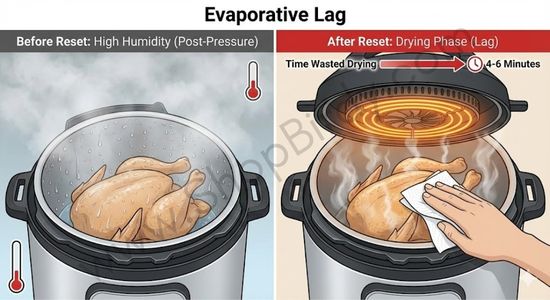
Evaporative Lag: Why Crisping Feels Slow
After a pressure cycle, the inner pot is a high-humidity environment:
- Steam coats the walls
- Condensation sits on the food
- The air inside is fully saturated
When you engage the air fryer lid, the heating element does not immediately begin browning food.
First, it must overcome the latent heat of vaporization.
In plain language:
- A large portion of energy is spent boiling off residual moisture
- That steam must be vented before surface temperatures can rise
- Until moisture is gone, Maillard reactions cannot begin
This creates Evaporative Lag.
In real kitchens, that means:
- The first 4–6 minutes of “air frying” are often just drying
- Food appears unchanged
- Users assume the lid is weak, when it’s actually fighting humidity
This is why dedicated air fryers—never exposed to pressure steam—feel dramatically faster.
They start bone dry.
The air fryer lid starts waterlogged.
The Reset Friction (Where Theory Meets Reality)
Marketing never shows the reset work.
To get reliable crisping after pressure cooking, most users must:
- Fully vent remaining steam
- Open the cooker
- Pat the food dry with paper towels
- Insert the rack or basket
- Attach the air fryer lid
That paper-towel step is not optional.
If surface moisture remains, Evaporative Lag wins every time. The heating element will spend its energy boiling water instead of browning food, regardless of fan speed or wattage.
This is the moment the air fryer lid reveals its true nature:
- It’s not “press a button and crisp”
- It’s reset, dry, reconfigure, then crisp
Accept that workflow, and results improve dramatically. Skip it, and the lid feels inconsistent or underpowered.
This hands-on reset is the price of combining steam and dry heat in one vessel.
Heat Flux & the “Cold Steel” Problem
Here’s an insight most reviews miss.
A multi cooker air fryer lid isn’t just drying food—it’s also heating the inner pot itself.
That stainless steel pot is a massive thermal sink.
Compared to a dedicated air fryer basket:
- The pot has far greater thermal mass
- It absorbs energy before food temperature rises
- The lid is effectively fighting cold steel on startup
This explains why standalone air fryers feel “snappier”:
- Their baskets are thin
- Their walls heat quickly
- More heat flux reaches the food immediately
This isn’t marketing—it’s physics.
The lid is doing extra work before crisping even begins.
Vertical Airflow vs. Basket Geometry
Once moisture is gone, geometry becomes the limiter.
Most 6-quart inner pots are about 8.5 inches in diameter. The heating element sits directly above that narrow column.
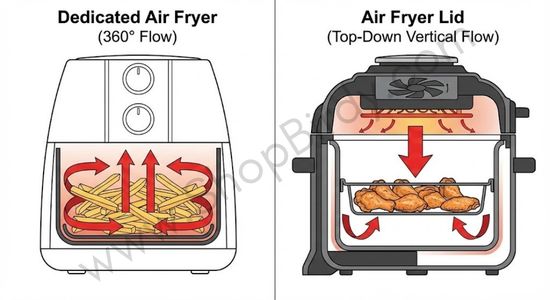
Airflow is mostly vertical:
- Hot air blasts down
- Rebounds upward along the walls
- Side surfaces receive weaker exposure
In drawer-style air fryers:
- Baskets are wider and shallower
- Air moves horizontally and diagonally
- Food is exposed on multiple planes
In a multi-cooker:
- The top browns first
- The sides lag
- Crowding magnifies unevenness
That’s why flipping and shaking are mandatory—not optional.
It’s not technique failure.
It’s airflow physics constrained by pot diameter.
The “Basket-in-a-Pot” Capacity Reality
This is the most brutally honest limitation.
When you insert an air fryer basket into a 6-quart pressure cooker, your effective air-fry volume collapses.
In practice:
- You can pressure cook a whole chicken
- But you can usually air fry 1–1.5 lbs of wings
Why?
- Food must be elevated
- Air needs clearance above and below
- Crowding destroys evaporation
So despite the “6-quart” label, usable air-fry capacity is closer to 2–3 quarts.
This isn’t a defect.
It’s geometry.
The lid works best as a finishing tool for small batches, not a family-size fryer.
Where the Air Fryer Lid Truly Shines
Crisp-Finishing Proteins
Chicken thighs, pork belly, short ribs:
- Pressure cook to tenderness
- Release pressure
- Air fry to render fat and crisp surfaces
Here, the lid excels—because crisping is the final step, not the primary cook.
One-Pot Workflow
If you hate transferring food:
- No second basket
- No extra appliance
- No added cleanup
That “finish where you started” flow is the lid’s strongest quality-of-life benefit.
Where It Falls Apart
Baked Goods & Structural Foods
Pizza, cakes, breads:
- Steam compromises structure
- Vertical airflow can’t brown evenly
- Bases stay pale or soggy
These foods demand geometry the lid simply can’t provide.
Daily Air Frying
If air frying is a daily habit:
- The lid feels slow
- Reset labor becomes annoying
- Cleaning friction compounds
At that point, a dedicated air fryer is the better tool.
Aerosolized Grease & Coil Contamination
This is the failure mode most buyers never anticipate.
Unlike drawer air fryers with splash guards, air fryer lids often have:
- Exposed heating coils
- Exposed fan blades
- Limited access for deep cleaning
During high-fat cooking (wings, skin-on chicken):
- Grease aerosolizes
- Fine droplets are pulled into the fan
- Residue coats coils and housings
Over months, that grease carbonizes.
The result:
- Acrid smoke
- Flavor cross-contamination
- Reduced heating efficiency
You can wipe surfaces—but you cannot truly deep-clean the internals.
This is the same long-term hygiene problem seen in complex hybrids, explored in Ninja Foodi vs Instant Pot: The Brutal Hardware Audit.
Gasket Stress: The Hidden Pressure Cooker Cost
Here’s a rarely discussed consequence.
An air fryer lid runs dry air at ~400°F directly above the silicone sealing ring.
That’s very different from moist steam exposure.
Repeated dry-heat cycles accelerate:
- Silicone elastomer fatigue
- Loss of rebound elasticity
- Earlier sealing failures
Over time, this can lead to:
- “Searching for seal” errors
- Micro-leaks
- More frequent gasket replacement
Using an air fryer lid doesn’t just affect crisping—it can shorten the life of your pressure cooker’s sealing system.
Counter Safety: The “Burn the Counter” Risk
These lids are not lightweight accessories.
They are heavy, top-mounted heating elements that can reach ~450°F internally and remain dangerously hot after use.
That’s why:
- A heat-resistant stand is mandatory
- You cannot set the lid directly on most counters
- The stand itself takes up space
In small kitchens, this becomes real friction:
- Heavy lid to move
- Limited safe resting zones
- One mistake can scorch a countertop
Dedicated air fryers are self-contained.
Air fryer lids demand space discipline.
Stainless Steel vs. Ceramic Pots
Pot material subtly affects performance.
With stainless steel:
- Reflective walls redirect infrared heat
- Crisping feels slightly faster and more even
With ceramic-coated pots:
- Heat is absorbed, not reflected
- Walls get hotter
- Crisping can feel slower
This interaction is explored more deeply in Stainless Steel vs. Ceramic Inner Pot Material: The Stick Test.
Quick Hardware Reality Check
Metric | Dedicated Air Fryer | Multi-Cooker Air Fryer Lid |
Airflow Pattern | 360° convection | Top-down vertical |
Initial Environment | Bone dry | High humidity |
Effective Capacity | 4–6 quarts | ~2–3 quarts |
Cleaning | Dishwasher-safe basket | Non-submersible coil/fan |
Best Use | Daily frying | Finishing proteins |
Should You Buy It?
The Batch Size Test
- Cook for 1–2 → Buy it
- Feed 4+ → Skip it
The Counter Space Test
- 10″ free space → Buy it
- Crowded counters → Skip it
The Texture Test
- Finishing food → Buy it
- Cooking frozen fries → Get a real air fryer
Final Reality Check
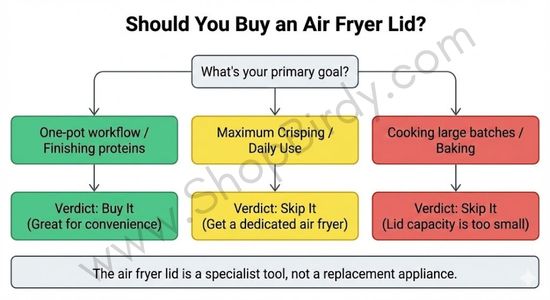
The air fryer lid is not a replacement appliance.
It’s a specialist tool.
Buy it if you want:
- One-pot workflow
- Occasional crisping
- Minimal appliance clutter
Skip it if you want:
- Maximum crisping power
- Large batches
- Zero workflow friction
Used correctly, it’s satisfying.
Used with the wrong expectations, it’s disappointing.
That clarity—not hype—is how you decide well.
Legal Information
Shopbirdy.com is a participant in the Amazon Services LLC Associates Program, an affiliate advertising program designed to provide a means for sites to earn advertising fees by advertising and linking to Amazon.

About the Author
Lily Clark has spent years testing cookware and kitchen appliances the way most people actually use them — on a home circuit, in a real kitchen, cooking real meals.
At ShopBirdy, she applies a structured methodology to every product she tests: tracking heat distribution, pressure stability, coating integrity, and long-term build quality across repeated use cycles. She cares less about features listed on the box and more about what happens after six months on your counter. Her reviews are written for people who want to buy once and cook well.