Updated January 2026 | By Lily Clark
Affiliate Disclosure: This article contains affiliate links. If you purchase through them, I may earn a small commission at no extra cost to you. I only recommend cookware I personally test and cook with in my kitchen
If food sticking is the only thing you care about, ceramic inner pots sound like the obvious choice.
If longevity, pressure stability, and predictable cooking matter, the answer is very different.
This guide looks at pressure cooker inner pot material through the only lens that actually survives real kitchens: the stick test—not as a complaint, but as a diagnostic tool. Why food sticks, when it sticks, and what that sticking tells you about heat, metal behavior, sealing reliability, and long-term durability.
Before we go deep, it’s worth anchoring this discussion in the bigger picture.
If you’re still deciding which cooker design even makes sense for your kitchen, start with our Best Multi-Cookers & Pressure Cookers pillar. It explains how pot material, size, and construction work together—and why inner pot choice isn’t a cosmetic decision.
With that context set, let’s talk about the two materials most people are choosing between—and why they age so differently.
The Stick Test: What We’re Actually Measuring
“Sticking” isn’t failure. In cookware science, sticking is feedback.
It tells us:
- Whether the surface reached thermal equilibrium
- Whether moisture had time to evaporate
- Whether proteins denatured gradually or instantly
- Whether sugars caramelized or burned
A good inner pot:
- Allows food to stick briefly
- Releases cleanly once browning is complete
- Deglazes smoothly before pressure builds
A bad one:
- Either grips permanently
- Or hides problems until failure is sudden
With that in mind, let’s break down stainless steel and ceramic—not as marketing categories, but as materials under pressure.
Stainless Steel Inner Pots: Honest, Durable, Unforgiving
Stainless steel is the default inner pot material on most serious electric pressure cookers—and there’s a reason.
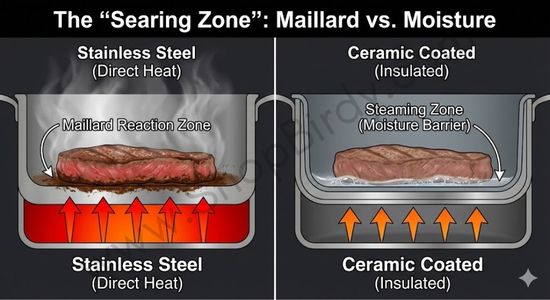
The Microscopic Reality (Why Sticking Is Feedback)
Stainless steel is not smooth.
At a microscopic level, it looks like a mountain range filled with tiny pores and valleys.
- When the pot is cold, those pores are open
- If you add protein to a cold surface, it sinks into those pores
- The protein literally locks into the metal
As the steel heats:
- The metal expands
- The pores contract and close
- Food releases naturally—if thermal equilibrium was reached
This is the core of the stick test.
👉 Sticking isn’t the problem.
👉 Adding food too early is.
If food sticks permanently, the pot didn’t reach equilibrium before fat and protein were introduced.
Stainless Steel Under Pressure Cooking Conditions
Pressure cooking is uniquely stressful:
- Rapid heat ramp-up
- Sustained high temperatures
- Repeated expansion and contraction cycles
Stainless steel handles this exceptionally well because:
- It’s a solid alloy, not a coating
- It tolerates extreme thermal cycling
- It doesn’t degrade structurally over time
This matters most during the sauté → pressure transition, where most failures happen.
Ceramic Inner Pots: Easy at First, Fragile Over Time
“Ceramic” inner pots are often marketed as:
- Naturally nonstick
- Gentle
- Health-forward
What’s rarely explained is what ceramic actually is in pressure cookers.
The Sol-Gel Reality (The Ceramic Lie)
Most so-called ceramic inner pots are not solid ceramic.
They are Sol-Gel coatings.
What Sol-Gel Actually Means
- A silica-based liquid (essentially thin glass)
- Sprayed onto aluminum or steel
- Cured at high heat to harden
Unlike stainless steel, which is a homogeneous metal, Sol-Gel is:
- A thin glass layer
- Bonded mechanically, not structurally
Why Sol-Gel Fails Under Pressure
Pressure cooking creates:
- Intense thermal expansion
- Rapid temperature cycling
- Steam pressure from below
Glass does not flex like metal.
Under repeated cycles:
- Micro-fissures form in the Sol-Gel layer
- Fats and proteins seep underneath
- Release properties fail suddenly
This is why ceramic pots often:
- Work beautifully for 3–6 months
- Then “mysteriously” start sticking everywhere
It’s not misuse. It’s physics.
Aluminum Core + Ceramic Coating: A Compounding Problem
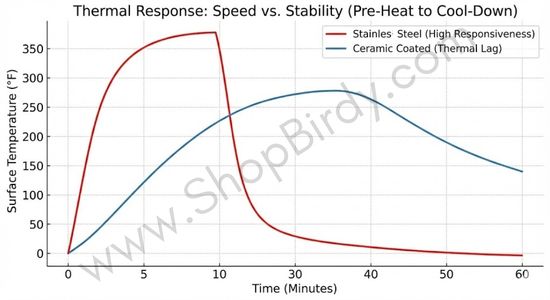
Most ceramic inner pots use thin aluminum bodies.
Aluminum:
- Heats quickly
- Expands aggressively
- Cools rapidly
When coated with Sol-Gel:
- The aluminum expands faster than the glass coating
- Stress concentrates at the interface
- Micro-cracks accelerate
Stainless steel expands more slowly and evenly, which is why it pairs better with pressure cooking.
Thermal Expansion & the Seal
Inner pot material doesn’t just affect food—it affects the seal.
Rim Geometry Matters
The sealing ring relies on:
- A stable rim
- Consistent geometry
- Predictable expansion
Stainless Steel Rims
- Typically rolled and polished
- Higher dimensional tolerance
- Expand modestly under heat
Ceramic-Coated Aluminum Rims
- Often stamped, not rolled
- Lower tolerance
- Aluminum expands more aggressively
Over time, this leads to:
- Slight rim distortion
- Increased stress on the sealing ring
- Steam leaks or “searching for seal” behavior
This is why aging ceramic pots are more likely to:
- Vent steam inconsistently
- Trigger pressure errors
- Require more frequent gasket replacement
Stainless steel isn’t just about durability—it’s about pressure stability.
The Acid & Pitting Nuance (Not All Stainless Is Equal)
Stainless steel is often described as “inert.” That’s mostly true—but quality matters.
Grade 304 vs Generic Stainless
High-quality inner pots use 304 stainless steel (18/8):
- ~18% chromium
- ~8% nickel
- Excellent corrosion resistance
Lower-grade stainless (common in budget pots):
- Reduced nickel content
- Less acid resistance
- More prone to pitting
Real-World Risk
If you:
- Leave salty or acidic food overnight
- Use aggressive cleaners
- Cook tomato-heavy dishes frequently
Lower-grade stainless can develop micro-pitting, which:
- Traps residue
- Reduces release performance
- Compromises longevity
For stainless steel to truly “win” long-term, it must be 304 grade.
This is especially important if you’re shopping at the lower end of the market—something we cover in detail in Best Budget Multi-Cookers Under $100 (The Longevity Audit).
Real Cooking Scenarios: Stick Test in Practice
Rice
- Stainless: Requires correct water ratio and equilibrium; consistent long-term
- Ceramic: Easy early; unreliable once coating degrades
Winner: Stainless (long-term)
Thick Curries & Chili
- Stainless: Deglaze properly; handles pressure cycles well
- Ceramic: Works until Sol-Gel fissures form—then scorches suddenly
Winner: Stainless
Eggs & Custards
- Stainless: Requires fat and patience
- Ceramic: Excellent gentle release
Winner: Ceramic (short-term use)
Sauté → Pressure Cooking
- Stainless: Designed for this transition
- Ceramic: Stress point for coating
Winner: Stainless
Cleaning Reality
Stainless Steel
- Dishwasher safe
- Abrasive-tolerant when needed
- Deglazing prevents buildup
Even badly scorched residue is usually recoverable.
Ceramic
- Easy while new
- Must avoid abrasives
- Stains accumulate as coating ages
Once Sol-Gel fails, cleaning doesn’t restore performance.
Size Changes the Equation
Inner pot behavior also depends on cooker size.
- Larger pots distribute heat differently
- Smaller pots concentrate wattage more aggressively
If you’re choosing between sizes, see 6-Quart vs. 8-Quart: The Technical Pressure Cooker Size Guide, which explains how diameter and wattage density interact with pot material.
For very small households, Best Small Electric Pressure Cooker for 1–2 People (The Physics Audit) shows why stainless steel becomes even more important as margins tighten.
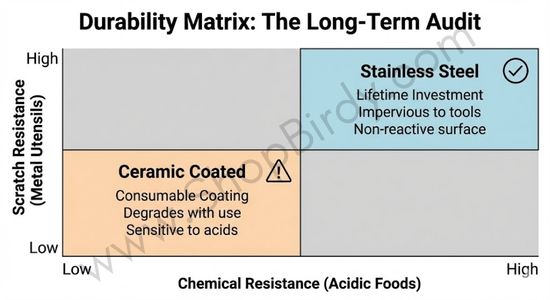
Frequently Asked Questions: Stainless Steel vs. Ceramic Inner Pots
Why does food stick so badly to my stainless steel pot? Am I doing something wrong?
Probably not. Stainless steel is not naturally non‑stick. Sticking happens when food forms a protein bond with the metal.
The trick is to use the stick test: heat the empty pot, add oil, and wait until the oil shimmers and flows like water. Then add your food. It will release naturally when properly seared. If you scrape too early, it tears. That’s physics, not a defect.
How long does a ceramic (sol‑gel) coating actually last with daily use?
In our testing and industry teardowns, ceramic coatings begin to show visible wear—scratches, dull patches, reduced release—within 8 to 14 months of regular (4–5x per week) use.
Unlike PTFE (Teflon), ceramic doesn’t flake into food, but its sol‑gel layer slowly hydrolyzes. Once water penetrates the coating, sticking becomes permanent. It’s a consumable, not a lifetime surface.
Can I use metal utensils on a ceramic inner pot?
No. Ceramic coatings are hard but brittle. Metal spatulas or spoons create micro‑cracks that allow steam and acids to undermine the coating from below.
Always use silicone, wood, or nylon. One accidental scrape with a metal whisk can create a failure point that spreads over weeks.
My stainless steel pot developed rainbow discoloration. Is it ruined?
That’s almost always harmless. The rainbow tint is heat tint – a thin oxide layer from overheating dry stainless steel. It doesn’t affect safety or cooking performance.
To remove it, simmer a mixture of water and white vinegar (1:1) for 10 minutes, then scrub with a baking soda paste. Avoid abrasive powders that scratch the passive layer.
Does acidic food (tomato sauce, lemon) damage ceramic coatings faster?
Yes. Sol‑gel coatings are porous at a microscopic level. Acidic liquids accelerate the hydrolysis reaction that breaks down the siloxane bonds. If you cook tomato sauce weekly in a ceramic pot, expect the non‑stick property to fade months earlier than if you used it for rice or eggs. For heavy acid cooking, stainless steel is the more durable choice.
What’s the safest way to clean a ceramic inner pot without destroying it?
Avoid the dishwasher. The combination of high heat, strong detergents, and water jets erodes the coating. Hand wash with a soft sponge, warm soapy water, and gentle pressure.
For stuck food, soak first – never use steel wool or abrasive scrubbing pads. Even “safe” scrubbers with hard nylon can polish off the hydrophobic top layer.
My stainless pot has tiny rust spots. Is it defective?
Usually not. Small rust speckles are often free iron contamination from manufacturing or from a steel wool scrubber. Stainless steel’s chromium oxide layer is non‑reactive, but embedded iron particles can oxidize.
Remove them with a stainless steel cleaner or a paste of baking soda and water. If the pot is 18/0 (magnetic, low nickel), it can rust more easily – that’s a material choice, not a failure.
Can I use an induction cooktop with both pot types?
Ceramic coated pots are usually aluminum or aluminum‑core, which are not induction compatible unless they have an added magnetic base plate. Most budget ceramic pots are induction‑unfriendly.
Stainless steel pots vary: 304/18/8 is often non‑magnetic and won’t work, while 430/18/0 is magnetic and works. Check with a magnet before buying for induction.
Accessories Matter More with Stainless Steel
Stainless steel rewards technique—but the right accessories make that easier.
- Trivets reduce hotspot contact
- Steamer baskets improve steam flow
- Pot-in-Pot containers reduce direct heat
We break this down in Best Pressure Cooker Accessories (A Technical Reliability Audit), which pairs especially well with stainless pots.
The Honest Verdict
Choose Stainless Steel if:
- You sauté before pressure cooking
- You cook rice, beans, or thick sauces often
- You want maximum lifespan
- You care about seal stability
Choose Ceramic if:
- You cook delicate foods occasionally
- You rarely sauté aggressively
- You accept eventual replacement
- You prioritize early-life ease
The Mistake to Avoid
Don’t choose ceramic because you’re afraid of sticking.
Sticking in stainless steel is information.
Once you learn to read it, stainless steel becomes:
- More predictable
- More durable
- More forgiving under pressure
Ceramic hides problems—until it can’t.
Final Take
When it comes to pressure cooker inner pot material, the stick test tells the truth.
- Stainless steel sticks, then releases—honestly.
- Ceramic releases, then fails—quietly.
If you want:
- Long-term reliability
- Stable pressure behavior
- A pot that survives years of thermal cycling
Stainless steel—specifically high-grade 304—is the long game.
Ceramic isn’t evil. It’s just finite.
Choose based on how you cook most days, not how cookware marketing makes you feel.
Legal Information
Shopbirdy.com is a participant in the Amazon Services LLC Associates Program, an affiliate advertising program designed to provide a means for sites to earn advertising fees by advertising and linking to Amazon.

About Me
Lily Clark has spent years testing cookware and kitchen appliances the way most people actually use them — on a home circuit, in a real kitchen, cooking real meals.
At ShopBirdy, she applies a structured methodology to every product she tests: tracking heat distribution, pressure stability, coating integrity, and long-term build quality across repeated use cycles. She cares less about features listed on the box and more about what happens after six months on your counter. Her reviews are written for people who want to buy once and cook well.