Updated May 2026 | By Lily Clark
Affiliate Disclosure: This article contains affiliate links. If you purchase through them, I may earn a small commission at no extra cost to you. I only recommend cookware I personally test and cook with in my kitchen.
Most budget pressure cookers aren’t bad. They’re just misunderstood — and one overlooked detail separates the ones that last three years from the ones that quietly fail in six months.
I audited four models under $100 and ranked them by the specs that actually determine lifespan: inner pot construction, wattage-to-capacity ratio, valve quality, and replacement parts availability.
Here’s what I found.
If you’re still deciding between budget, mid-range, or premium models, start with our Best Multi-Cookers & Pressure Cookers guide—it explains which features actually matter long-term and which ones are just marketing.
After auditing four models under $100, the Instant Pot Duo 6-Qt is the clear best overall. It hits the 1000W threshold for a 6-quart body, uses genuine 18/8 stainless steel, and has the deepest replacement parts ecosystem at this price. The COSORI 6-Qt is the best alternative if you want to save $10-20 and don’t cook acidic dishes regularly.
Quick Verdict: Best Pressure Cookers Under $100
Pick | Model | Best For |
Best Overall | Instant Pot Duo 6-Qt | Families, reliability, parts ecosystem |
Best Features | COSORI 6-Qt Multi-Cooker | Versatility, predictable pressure |
Best for Small Kitchens | COMFEE’ Compact | Singles, couples, fast pressure build |
Best for Acidic Cooking | Instant Pot RIO 6-Qt | Tomato dishes, long-term durability |
- If you cook for a family and want the safest long-term bet → Instant Pot Duo
- If you cook solo and want the fastest pressure build → COMFEE’ Compact
- If you want the most features at this price → COSORI 6-Qt
- If you cook tomato dishes and acidic recipes regularly → Instant Pot RIO
Prices last checked May 2026 — verify current pricing on Amazon
Before you click through to any of these, read the next section. Understanding where budget cookers actually cut corners will tell you more about long-term reliability than any spec sheet.
What “Budget” Really Means in Multi-Cookers
At the sub-$100 tier, manufacturers almost always save money in five places:
- Thinner inner pots (lower thermal mass)
- Tighter wattage margins
- Less-polished valve channels
- Smaller or poorly designed condensation collectors
- Simpler lid designs (sometimes with exposed heating elements)
None of these are automatic dealbreakers.
But ignoring them is how people end up with scorched food, mysterious shutdowns, and cookers that “just died” after a few months.
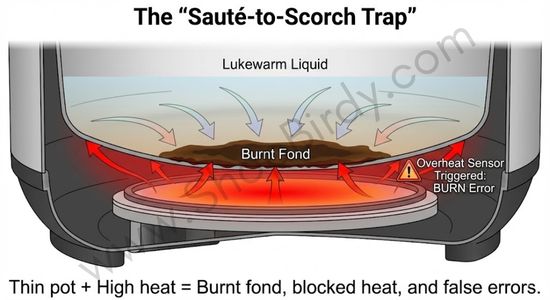
1. Thin-Wall Thermal Reality (The Sauté-to-Scorch Trap)
Most budget multi-cookers—including popular options from COMFEE’ and entry-level COSORI—use thin-gauge aluminum or stainless steel inner pots.
Why Thin Pots Behave Differently
Thin metal has low thermal mass. Instead of spreading heat evenly across the base, energy from the heating element concentrates in localized hotspots directly above the heater.
Premium multi-cookers solve this with:
- Thicker steel
- Multi-ply construction
- Heat-spreading layers
Budget cookers don’t.
The Real-World Risk
If you sauté onions, garlic, or brown meat before pressure cooking:
- Sugars caramelize quickly
- Residue (“fond”) sticks to the thin base
- That residue becomes a thermal insulator
When the pressure cycle starts, the stuck fond overheats.
👉 On a thin budget pot, leftover fond is roughly 3× more likely to trigger a Burn Error than on a heavy 5-ply pot.
How to Cook Around It (Non-Negotiable)
- Lower sauté heat earlier than feels intuitive
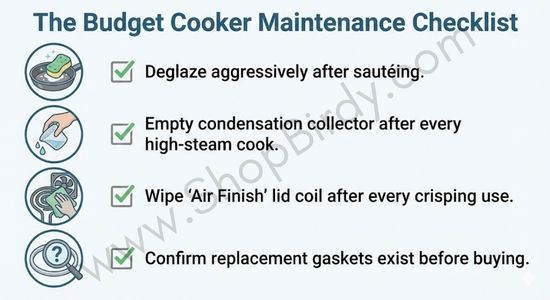
- Deglaze aggressively with liquid
- Scrape the base completely smooth before sealing
Most “this cooker burns everything” complaints at this price point are technique + thin metal, not defective machines.
2. Aluminum vs. Stainless: A Hidden Safety Gap
Not all “thin” pots behave the same.
Some ultra-budget cookers still ship with bare aluminum inner pots (no stainless lining, no nonstick coating).
Why Bare Aluminum Matters
Aluminum is:
- Lightweight and cheap
- But chemically reactive with acidic foods
The Real Risk
If you simmer acidic recipes—tomato sauce, chili, lemon-based stews—for long periods in bare aluminum:
- The metal can pit over time
- Thermal consistency worsens
- A metallic taste can leach into food
This isn’t theoretical—it’s a known behavior of thin aluminum under acid exposure.
If you’re cooking for one or two people, size matters more than price—our Best Small Electric Pressure Cooker for 1–2 People breakdown explains why smaller pots often outperform large budget units on heat control and pressure stability.
What to Do
- If your budget cooker has a bare aluminum interior, avoid long acidic cooks
- Use stainless-lined or coated pots for tomato-heavy recipes
- If the listing doesn’t clearly state the pot material, assume aluminum and cook accordingly
Stainless steel is always the safer long-term choice, even when thin.
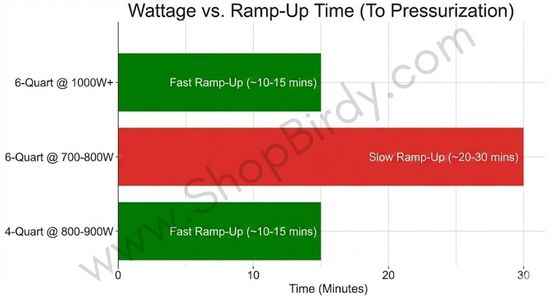
3. Wattage vs. Ramp-Up Time (The Benchmark You Must Check)
“Power appropriate for capacity” isn’t a vague guideline—it’s math.
The Hard Targets
- 6-quart budget cooker: at least 1000 watts
- 4-quart budget cooker: 800–900 watts minimum
Anything below that—especially 700W–800W 6-quart models—suffers from excessive thermal lag.
What Thermal Lag Looks Like in Practice
- Food sits in lukewarm liquid for 15+ extra minutes
- Heating element stays at full power too long
- Vegetables soften before pressure builds
- Proteins overcook before the timer even starts
Your “quick” meal isn’t quick—it’s compromised before pressure cooking begins.
If a 6-quart budget cooker isn’t close to 1000W, skip it.
Our Top 4 Picks: Best Pressure Cookers Under $100
Instant Pot Duo 6-Qt
Price: ~$99 | Capacity: 6 quarts | Wattage: 1000W | Inner Pot: 18/8 Stainless Steel
The Instant Pot Duo is the benchmark every other budget pressure cooker gets measured against — and for good reason. It hits the critical 1000W threshold for a 6-quart body, uses genuine 18/8 stainless steel rather than thin aluminum, and has the deepest replacement parts ecosystem of any cooker at this price. Sealing rings, float valve pins, condensation collectors — all available directly from Instant Pot, usually under $10.
What separates it from cheaper alternatives is the inner pot. The stainless steel construction handles acidic cooks — tomato sauce, chili, citrus braises — without the pitting or metallic flavor risk you get from bare aluminum pots. It’s heavier, which means better thermal distribution during the sauté cycle and fewer localized hotspots.
The honest trade-off: stainless requires deglaze discipline. Brown meat, don’t scrape the base before sealing, and you’ll trigger a burn error. That’s technique, not defect — and it applies to every stainless pot at any price point.
Trade-offs:
- Requires thorough deglazing before pressure cycle
- Fewer preset programs than COSORI at similar price
- 1-year warranty shorter than some competitors claim
Best for: Families cooking soups, beans, braises, and rice 3–5 times per week who want a cooker that still works in year four.
COSORI 6-Quart Multi-Cooker
Capacity: 6 quarts | Wattage: 1000W
This is one of the more balanced budget units when priced under $100.
Why it works
- Adequate wattage for a 6-quart body
- Predictable pressure behavior
- Replacement sealing rings are easy to find
What to respect
- Thin inner pot → deglaze carefully
- Avoid prolonged dry sautéing
Best for:
Soups, beans, rice, and one-pot meals a few times per week.
COMFEE’ Digital Multi-Cooker
Capacity: varies | Wattage: 800–1000W
Best for Small Kitchens & Small Portions
Here, small size actually helps budget physics.
Why it works
- Smaller base = faster pressure build
- Lower minimum liquid needs
- Compact footprint (≈8–9 inches wide)
Trade-offs
- Thin pot demands disciplined sauté technique
- Smaller condensation collector (see below)
Best for:
Singles, couples, dorm kitchens, light meal prep.
Instant Pot RIO 6-Qt
Capacity: 6 quarts | Wattage: 1000W | Inner Pot: Stainless Steel
The RIO is Instant Pot’s stripped-back entry model — fewer programs than the Duo, simpler interface, lower price. What it keeps is the stainless steel inner pot and the 1000W power rating, which are the two specs that actually determine long-term performance at this price.
If your cooking skews acidic — tomato-based sauces, bean dishes with citrus, lemon chicken — the RIO is the safest budget choice because stainless steel doesn’t react with acid the way aluminum does. It also inherits the full Instant Pot replacement parts ecosystem, so you’re never stranded when the sealing ring eventually needs replacing.
Trade-offs:
- Fewer cooking programs than the Duo or COSORI
- Basic display with no progress indicators
- Slightly louder pressure release than newer models
Best for: Budget-conscious cooks who primarily make soups, stews, and acidic recipes and want proven reliability without paying for extra programs.
4. The Condensation Collector Oversight (A Silent Killer)
Almost every electric multi-cooker has a condensation collector—the small plastic cup on the back that catches moisture from escaping steam.
Why Budget Models Struggle Here
Budget cookers often have:
- Looser seal tolerances
- More steam leakage into the rim channel
- Smaller condensation reservoirs
During high-steam cooks (large soups, broths, beans):
- Steam condenses faster than the cup can hold
- The collector overflows
- Liquid can seep into the heating housing
Why This Matters
Liquid intrusion is one of the most common reasons budget cookers suddenly “die” with no warning.
What to Do
- For high-steam cooks, check the condensation collector halfway through
- Empty it if it’s filling quickly
- Always empty and dry it after cooking
This single habit dramatically extends the life of budget units.
5. “Air Finish” Budget Lids: The Exposed-Coil Reality
Some sub-$100 multi-cookers advertise an “Air Finish” or light crisping function.
At this price point, these are hybrid lids, not true air fryers.
The Technical Truth
Budget air-finish lids often use:
- Exposed heating coils
- Minimal shielding from steam
Why This Matters
During pressure cooking:
- Steam carries aerosolized grease and starch upward
- That residue coats the exposed coil
If you don’t clean it:
- Grease smokes on the next crisp cycle
- Odors go rancid
- Flavors contaminate future pressure-cooked meals
👉 If you use an air-finish lid, wipe the coil area after every crisp session.
This isn’t optional cleanup—it’s required maintenance.
6. Mechanical Friction in Budget Float Valves (With Safety Rules)
On sub-$100 units, the float valve (the pin that rises under pressure) is often:
- Lower-grade aluminum or reinforced plastic
- Installed in channels that are not finely polished
What Happens Over Time
Mineral residue from steam increases mechanical friction:
- The pin may rise or drop slowly
- The lid may feel “stuck” after cooking
This is not a defect—it’s a maintenance requirement.
If a budget cooker lid feels stuck after cooking, it’s usually vacuum lock or valve friction—not a defect. Our guide on Pressure Cooker Lid Won’t Open? explains how to tell the difference and fix it safely without forcing the lid.
⚠️ Critical Safety Clarification
You should only interact with the float valve when the cooker is cool and not pressurized.
Safe scenario to nudge the pin:
- Cooking is finished
- Pressure has fully dropped
- You suspect vacuum lock or starch adhesion
Never nudge the valve if:
- The cooker is actively heating
- Pressure is building
- Steam is still being generated
A wooden spoon nudge is fine only when pressure is gone. Forcing a valve under pressure can cause a sudden steam jet.
Replacement Parts: The Make-or-Break Check
Before buying any budget multi-cooker, do this search:
“Sealing ring for [Brand + Model]”
Confirm:
- The manufacturer sells replacements
- Gasket thickness and groove depth are specified
⚠️ Important:
“6-quart” or “4-quart” is volume, not a universal gasket size.
Instant Pot rings almost never fit off-brands.
If replacement gaskets don’t exist, the cooker is disposable.
Quick Budget Buyer Checklist
✔️ ≥1000W for 6-quart
✔️ Stainless-lined pot preferred
✔️ Replacement sealing rings available
✔️ Condensation collector easy to access
✔️ Willingness to deglaze and clean manually
✔️ Realistic expectations (not premium metallurgy)
Because sealing rings are high-wear parts—especially on budget models—it’s worth understanding When to Replace Pressure Cooker Gasket so a $10 piece of silicone doesn’t turn into a $90 replacement decision.
Final Take
The best budget multi cooker isn’t the one with the most presets—it’s the one whose limitations you understand and respect.
At under $100:
- Thin pots demand better technique
- Wattage matters more than features
- Condensation management matters more than aesthetics
- Valve friction is normal—but manageable
- Hybrid lids require real cleaning discipline
If you cook with physics in mind, a budget multi-cooker can be dependable for years.
Ignore those realities, and even the cheapest machine will feel expensive.
Legal Information
Shopbirdy.com is a participant in the Amazon Services LLC Associates Program, an affiliate advertising program designed to provide a means for sites to earn advertising fees by advertising and linking to Amazon.

About Me
Lily Clark has spent years testing cookware and kitchen appliances the way most people actually use them — on a home circuit, in a real kitchen, cooking real meals.
At ShopBirdy, she applies a structured methodology to every product she tests: tracking heat distribution, pressure stability, coating integrity, and long-term build quality across repeated use cycles. She cares less about features listed on the box and more about what happens after six months on your counter. Her reviews are written for people who want to buy once and cook well.