Updated January 2026 | By Lily Clark
Affiliate Disclosure: This article contains affiliate links. If you purchase through them, I may earn a small commission at no extra cost to you.
If there’s one decision that quietly determines whether you’ll love your pressure cooker—or slowly stop using it—it’s size.
Not brand.
Not presets.
Not price.
The difference between a 6-quart and an 8-quart pressure cooker isn’t subtle once you start cooking. It shows up in how fast pressure builds, how forgiving recipes feel, and how often you run into errors or texture problems.
This pressure cooker size guide goes beyond “family size” marketing and explains what actually changes when you move from 6 to 8 quarts—using physics, real recipes, and long-term ownership behavior.
The Short Answer (Before We Go Deep)
- Choose a 6-quart if you cook for 1–4 people, value speed and flexibility, and make rice, beans, curries, or weeknight meals often.
- Choose an 8-quart if you cook for 5+ people regularly, batch cook large volumes, use Pot-in-Pot (PIP) frequently, or pressure-cook big cuts of meat.
If you’re still unsure, default to 6-quart. It’s the most forgiving size ever made.
Now let’s talk about why.
If you’re still deciding between budget, mid-range, or premium models, start with our Best Multi-Cookers & Pressure Cookers guide—it explains which features actually matter long-term and which ones don’t.
What Quart Size Really Means (And What It Doesn’t)
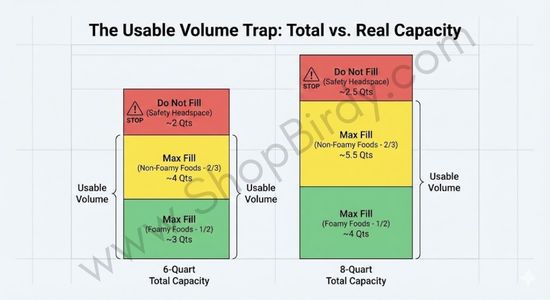
A pressure cooker’s quart rating is total internal volume, not usable cooking volume.
For safety reasons, pressure cookers must never be filled completely:
- ½ full for foamy foods (beans, grains, pasta)
- ⅔ full for most meats and stews
Real Usable Capacity
Labeled Size | Practical Usable Volume |
6-Quart | ~3.5–4 quarts |
8-Quart | ~5–5.5 quarts |
So yes—an 8-quart does give you more usable space.
But that space comes with thermal and vapor costs.
Headspace, Vapor Density, and Why Size Changes Everything
Pressure cooking works because liquid turns into steam, and that steam builds pressure in the empty space above the food (called headspace).
Bigger Pot = More Empty Space to Fill
An 8-quart cooker has:
- A wider base
- Taller walls
- Much more headspace
To reach pressure, it must:
- Heat liquid to boiling
- Generate enough steam to fill that larger space
- Maintain pressure without scorching the base
This is where many people run into problems with small recipes in large pots.
If cost is part of the decision, size matters even more—our Best Budget Multi-Cookers Under $100 audit shows why oversized budget models often fail sooner than properly sized ones.
Wattage Density: Why 6-Quart Cookers Feel Faster
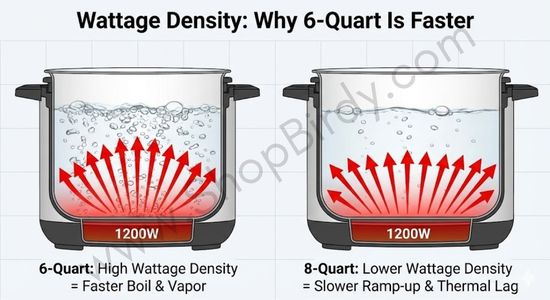
Most 6-quart and 8-quart electric pressure cookers run at similar wattage—often around 1000–1200 watts.
This leads to a common misunderstanding:
“If they have the same power, they should cook the same.”
They don’t.
The Missing Concept: Wattage Density
Think of wattage as energy, and volume as space.
- 1200 watts in a 6-quart vessel
→ Energy is concentrated
→ Faster boil
→ Faster vapor generation - 1200 watts in an 8-quart vessel
→ Energy is spread across more metal and air
→ Slower boil
→ Longer ramp-up time
This is wattage density—energy per cubic inch.
What This Means in Practice
A 6-quart cooker:
- Reaches pressure faster
- Produces a more aggressive boil
- Feels more responsive
An 8-quart cooker:
- Takes longer to ramp up
- Keeps the heating element at full power longer
- Is more prone to thermal lag with small meals
This is why people often say, “My 6-quart feels faster.”
It literally is.
If you mostly cook for one or two people, even a 6-quart can feel large—our Best Small Electric Pressure Cooker for 1–2 People guide explains why downsizing often improves pressure stability and texture.
Thermal Lag: Where Texture Problems Begin
Because an 8-quart takes longer to reach pressure:
- Vegetables sit in hot liquid longer before pressure cooking begins
- Proteins can overcook during ramp-up
- Thick sauces are exposed to high heat for longer
This is one reason:
- Mushy vegetables
- Split lentils
- Burn warnings
show up more often in oversized pots cooking small portions.
Minimum Liquid Requirements
Every electric pressure cooker requires a minimum amount of liquid to:
- Generate steam
- Protect the heating plate
Practical Minimums (Real-World)
Size | Practical Minimum Liquid |
6-Quart | ~1–1.5 cups |
8-Quart | ~2–2.5 cups |
If you cook:
- Rice for two
- Thick chili
- Small curries
An 8-quart forces you to add liquid you don’t want—changing texture and flavor.
This is a core reason most pressure cooker size guides quietly favor 6-quart models for everyday cooking.
Real-World Cooking Scenarios
Scenario 1: Weeknight Dinner (2–3 People)
Chicken thighs, vegetables, sauce.
- 6-Quart:
Fast pressure build, predictable texture, no fuss. - 8-Quart:
Longer ramp-up, extra liquid needed, sauce often thinner.
✅ Winner: 6-Quart
Scenario 2: Big Soup or Bone Broth
Large volumes, long pressure holds.
- 6-Quart:
You’ll hit max fill quickly. - 8-Quart:
Designed for this. Safer headspace, better circulation.
✅ Winner: 8-Quart
Scenario 3: Rice for One or Two
- 6-Quart:
Works directly or with Pot-in-Pot. - 8-Quart:
Often finicky unless you always use PIP.
✅ Winner: 6-Quart
The Pot-in-Pot (PIP) Factor — Where 8-Quart Shines
Here’s where the conversation shifts.
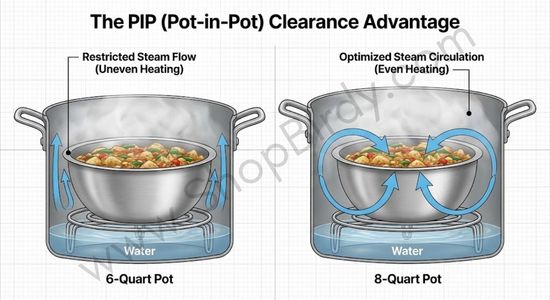
If you frequently use Pot-in-Pot (PIP) cooking—placing a smaller bowl or pan inside the cooker—the 8-quart gains a real advantage.
Why Size Changes the PIP Experience
An 8-quart cooker offers:
- A wider diameter, allowing larger glass or steel inserts
- More vertical clearance for taller molds
- Better steam circulation around the secondary vessel
This matters more than most people realize.
Real-World PIP Examples
- Nested rice bowls
- Cheesecakes
- Custards
- Steamed cakes
- Meal prep containers cooked together
In a 6-quart:
- Inserts fit tightly
- Steam circulation can be uneven
- Centers may undercook unless timing is adjusted
In an 8-quart:
- Steam flows freely around the insert
- Heat is more even
- PIP results are more consistent
👉 If you’re a PIP devotee, the 8-quart is genuinely easier to live with.
This is one of the strongest technical arguments for the 8-quart size.
Large Cuts of Meat: Clearance Matters
Whole chickens, brisket chunks, pork shoulders.
- 6-Quart:
Often fits—but tightly. Positioning matters. - 8-Quart:
Comfortable clearance, better liquid circulation.
If large cuts are a weekly habit, the 8-quart earns its space.
Counter Space & Ergonomics
Size doesn’t just affect cooking—it affects where the cooker lives.
Typical Footprints
Size | Diameter | Height |
6-Quart | ~12–13 in | ~12 in |
8-Quart | ~14–15 in | ~14 in |
Those extra inches:
- Reduce clearance under cabinets
- Push steam closer to woodwork
- Often turn the cooker into a permanent counter resident
If your kitchen is small, this matters every day.
Energy Efficiency
For the same recipe:
- A 6-quart generally uses less energy
- An 8-quart wastes heat warming unused space
It’s not dramatic—but over hundreds of cooks, it adds up.
The “Future-Proofing” Myth
Many people buy an 8-quart “just in case.”
In practice:
- They cook small meals most days
- The cooker feels slow and finicky
- They use it less often
Pressure cookers reward honest sizing, not hypothetical holidays.
Safety & Forgiveness
Larger cookers:
- Produce stronger venting
- Require more attention to condensation collectors
- Are less forgiving of low liquid errors
Smaller cookers:
- Build pressure faster
- Recover heat quicker
- Are easier to manage in tight kitchens
Neither is unsafe—but the margin for error is wider with a 6-quart.
Larger cookers create stronger pressure differentials, which can make lid behavior feel unpredictable—if this happens, our guide on Pressure Cooker Lid Won’t Open? explains whether you’re dealing with vacuum lock or residual pressure.
Decision Guide
Choose 6-Quart if:
- You cook for 1–4 people
- You want speed and flexibility
- You cook rice, beans, curries often
- Counter space matters
Choose 8-Quart if:
- You cook for 5+ people regularly
- You batch cook weekly
- You use Pot-in-Pot often
- You pressure-cook large cuts of meat
If you’re unsure, default to 6-quart.
Final Take
This pressure cooker size guide isn’t about which size is “better.”
It’s about which size matches your thermal reality.
A 6-quart cooker:
- Has higher wattage density
- Builds pressure faster
- Handles small meals gracefully
An 8-quart cooker:
- Excels at volume
- Shines with Pot-in-Pot cooking
- Rewards batch cooks and big families
Choose the size that matches how you cook most days, not once a year.
That’s how a pressure cooker becomes a staple—not a regret.
Legal Information
Shopbirdy.com is a participant in the Amazon Services LLC Associates Program, an affiliate advertising program designed to provide a means for sites to earn advertising fees by advertising and linking to Amazon.