Updated January 2026 | By Lily Clark
Affiliate Disclosure: This article contains affiliate links. If you purchase through them, I may earn a small commission at no extra cost to you. I only recommend cookware I personally test and cook with in my kitchen.
Pressure cookers don’t need many accessories—but they do need the right ones.
Over the years, I’ve tested just about every add-on that claims to “unlock” new pressure cooker features. Most of them don’t. They clutter drawers, complicate cleaning, or quietly interfere with the physics that make pressure cooking work in the first place.
The best pressure cooker accessories aren’t flashy. They manage steam, heat transfer, pressure stability, and wear—the real forces inside the pot.
Before we get into the list, it helps to understand where accessories actually fit in the bigger picture of pressure cooking.
If you’re still choosing the right cooker size or model, start with our Best Multi-Cookers & Pressure Cookers pillar—it explains how size, wattage, and construction determine which accessories will actually work well in your kitchen.
That context matters, because accessories don’t exist in isolation. They succeed or fail based on the cooker they’re paired with.
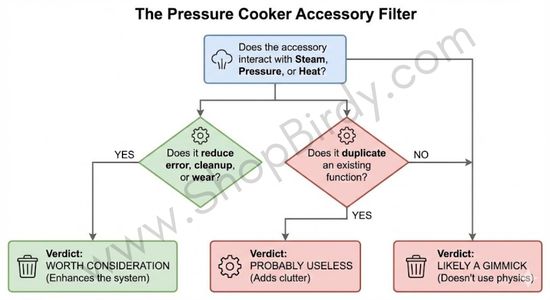
A Rule That Filters Out 80% of Useless Accessories
If an accessory:
- Doesn’t interact with steam, pressure, or heat
- Doesn’t reduce error risk, cleanup, or part wear
- Or duplicates something the cooker already does
You probably don’t need it.
Pressure cookers are sealed systems. The best accessories respect that system instead of fighting it.
1. Extra Sealing Rings (The Only Mandatory Accessory)
If you buy one pressure cooker accessory, make it this.
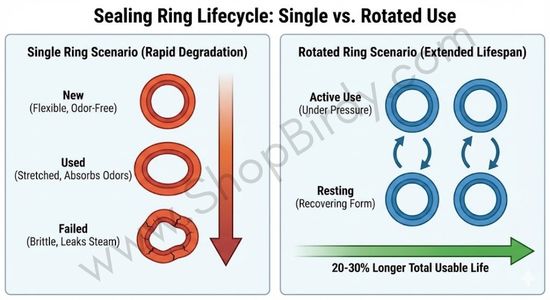
The sealing ring is a consumable component. It flexes, expands, contracts, absorbs oils, and degrades with every heat cycle.
Why Extra Rings Matter
- Prevents odor transfer (savory vs sweet)
- Reduces emergency failures mid-week
- Extends total gasket lifespan through rotation
Rotating two sealing rings can increase usable life by 20–30% by allowing the silicone polymer chains to relax between heat cycles.
What to Check Before Buying
- Exact diameter (quart size alone is not enough)
- Groove depth compatibility
- Availability of replacements
If replacement rings are hard to find, that’s not a minor inconvenience—it’s a lifecycle problem.
2. Stainless Steel Steamer Basket (Skip Silicone)
A steamer basket isn’t just for vegetables. It’s a heat-control tool.
Why Stainless Steel Wins
Silicone baskets:
- Insulate food
- Slow heat transfer
- Can flex and block steam circulation
Rigid stainless baskets:
- Allow unrestricted steam flow
- Keep food out of boiling liquid
- Prevent scorching during pressure ramp-up
Real-World Uses
- Potatoes that don’t waterlog
- Fish that flakes instead of shredding
- Dumplings and bao
- Reheating leftovers without texture collapse
This accessory improves consistency more than most people realize.
3. Trivet with Handles (A Safety Upgrade)
Most cookers include a basic trivet. Many people ignore it.
That’s a mistake.
Why the Trivet Matters
- Elevates food away from direct base heat
- Improves steam circulation
- Reduces hotspot scorching—especially in thin pots
Why Handles Matter
- Safe lifting during release
- Less tipping risk
- Easier Pot-in-Pot (PIP) removal
If your trivet doesn’t have handles, upgrading is a low-cost, high-safety improvement.
4. Stackable Pot-in-Pot (PIP) Containers
Pot-in-Pot cooking isn’t a gimmick—it’s a pressure management strategy.
What PIP Actually Solves
- Prevents scorching in thick sauces
- Makes small portions predictable
- Allows multi-dish cooking in one cycle
Best Materials
- Stainless steel (best heat transfer)
- Oven-safe glass (for custards and cakes)
Size Matters Here
Larger cookers allow:
- Bigger inserts
- Better steam circulation
- More even cooking in nested dishes
That’s why PIP works differently depending on cooker size. If you want the technical breakdown, see 6-Quart vs. 8-Quart: The Technical Pressure Cooker Size Guide, which explains how diameter and headspace affect PIP performance.
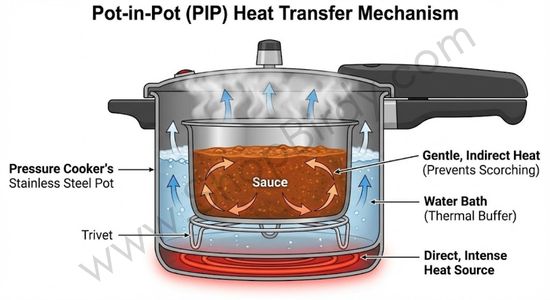
5. Glass Lid (For Non-Pressure Cooking)
This is the accessory most people don’t realize they need—until they own one.
Why a Glass Lid Is Useful
Pressure cookers are often used for:
- Sautéing
- Simmering
- Reducing sauces
- Slow cooking
The pressure lid is awkward for all of that.
A glass lid:
- Allows moisture to escape
- Prevents condensation drip-back
- Turns the cooker into a normal pot
Real-World Effect
People who own a glass lid use their pressure cooker more often, because they’re not forced into pressure mode every time.
That alone makes this accessory worth it.
6. Silicone Egg Bite & Custard Molds (With Limits)
These are useful—but only for specific jobs.
Where Silicone Works
- Egg bites
- Custards
- Cheesecake portions
Silicone insulates, which is helpful for gentle, even cooking.
Where Silicone Fails
- Rice
- Starches
- Anything requiring aggressive heat transfer
Silicone slows cooking and can cause uneven centers in dense foods. Use it intentionally, not by default.
7. Probe Thermometer (With a Critical Safety Rule)
A probe thermometer is invaluable—but it must be used correctly.
What a Probe Thermometer Actually Does
Pressure cookers measure environmental pressure, not food temperature.
A probe thermometer:
- Confirms doneness of large cuts
- Verifies carryover cooking during rest
- Prevents over- or under-cooking roasts
🚨 Critical Safety Correction (Read This Carefully)
You cannot use a wired probe thermometer while the cooker is pressurized.
Never attempt to thread a thermometer wire under the gasket or through the lid seal.
Doing so will cause a seal failure or create a dangerous steam jet.
Correct Way to Use a Probe Thermometer
- Wait until pressure has fully dropped
- Open the lid safely
- Insert the probe after pressurization
- Use it as a Post-Pressurization Diagnostic
This is especially important during Natural Release, where the food continues cooking from retained heat. The thermometer confirms whether the thermal mass of the meat finished cooking internally.
Used this way, a probe thermometer adds precision without compromising safety.
Accessories That Sound Useful—but Usually Aren’t
❌ Nonstick Inner Pots
- Scratch easily
- Wear quickly under pressure
- Rarely worth replacement cost
Stainless steel is more durable and predictable.
❌ Generic “Pressure Cooker Dividers”
- Block steam flow
- Create uneven zones
- Increase error risk
Use proper PIP containers instead.
❌ Silicone Main-Pot Liners
- Interfere with heat transfer
- Trap residue
- Increase sealing inconsistency
They solve cleanup problems by creating cooking problems.
Budget Reality Check: Accessories Matter More on Cheap Cookers
Lower-cost cookers:
- Have thinner inner pots
- Are more prone to scorching
- Benefit disproportionately from good accessories
If you’re using a lower-priced model, see Best Budget Multi-Cookers Under $100 (The Longevity Audit) to understand which accessories actually extend lifespan instead of stressing the system further.
Small Cookers, Smaller Margins
Compact pressure cookers:
- Heat faster
- Have less thermal buffer
- Require tighter control
That’s why accessories like trivets, steamer baskets, and PIP containers matter more on small units. For a deeper dive, Best Small Electric Pressure Cooker for 1–2 People (The Physics Audit) explains why scale changes accessory effectiveness.
The Minimalist Accessory Kit (What I’d Buy Again)
If I were starting from scratch, I’d buy:
- Two extra sealing rings
- Stainless steel steamer basket
- Handled trivet
- Stackable PIP containers
- Glass lid
- External probe thermometer
That’s it.
Everything else is optional—or situational.
Why Fewer Accessories Lead to Better Pressure Cooking
Pressure cooking is about control, not customization.
Every extra object inside the pot:
- Changes heat transfer
- Alters steam dynamics
- Adds a failure point
The best pressure cooker accessories:
- Simplify physics
- Reduce user error
- Protect high-wear components
That’s why this list is short—and deliberate.
Final Take
The best pressure cooker accessories don’t add features.
They add consistency, safety, and longevity.
If an accessory:
- Improves steam flow
- Manages heat better
- Reduces wear on critical parts
It earns its place.
Everything else is clutter.
Legal Information
Shopbirdy.com is a participant in the Amazon Services LLC Associates Program, an affiliate advertising program designed to provide a means for sites to earn advertising fees by advertising and linking to Amazon.

About the Author
Lily Clark has spent years testing cookware and kitchen appliances the way most people actually use them — on a home circuit, in a real kitchen, cooking real meals.
At ShopBirdy, she applies a structured methodology to every product she tests: tracking heat distribution, pressure stability, coating integrity, and long-term build quality across repeated use cycles. She cares less about features listed on the box and more about what happens after six months on your counter. Her reviews are written for people who want to buy once and cook well.