Affiliate Disclosure: This article contains affiliate links. If you purchase through them, I may earn a small commission at no extra cost to you. I only recommend cookware I personally test and cook with in my kitchen.
Updated January 2026 | By Lily Clark
Cookware set vs open stock
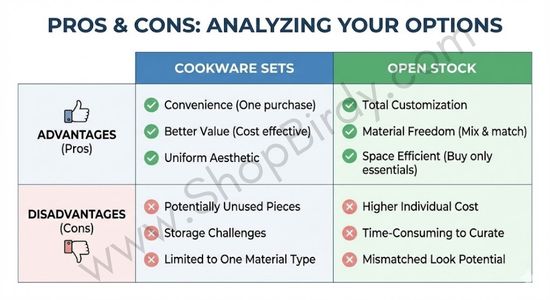
Cookware sets look like value.
Open stock looks like restraint.
And for most home cooks—especially anyone buying nonstick—the restraint usually wins.
The mistake isn’t buying the wrong pan.
It’s buying too many pans that all fail on the same timeline.
Understanding when to buy a cookware set versus a single open-stock nonstick skillet is the difference between a calm kitchen and one that quietly bleeds money.
The Core Difference
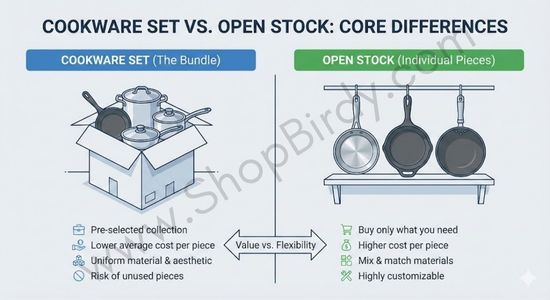
A cookware set sells you:
- Coverage (“you have everything”)
- Matching aesthetics
- A lower price per piece
Open stock sells you:
- Precision (you buy only what you use)
- Upgrade flexibility
- Replacement without waste
Neither is inherently bad.
But they solve very different problems.
The Nonstick Reality Sets Don’t Advertise
Nonstick pans are consumables.
Even the best coatings:
- Wear faster than stainless or cast iron
- Are sensitive to heat and abrasion
- Should be replaced on a shorter cycle
When a cookware set includes multiple nonstick pans, you lock all of them into the same aging curve.
That’s the hidden cost.
Why Cookware Sets Fail First at Nonstick
Here’s the predictable pattern:
- The 10–12″ nonstick skillet gets daily use
- The smaller nonstick sees occasional duty
- The saucepan barely moves
The hardest-working pan fails first.
But because it’s part of a set, replacing it cleanly means:
- Breaking visual uniformity
- Living with mismatched cookware
- Or replacing everything prematurely
This is why sets feel economical upfront—and wasteful later.
The ShopBirdy Modular Trio (The 10/10 Open-Stock Kitchen)
If you want the benefit of a set without the downside, this is the fix—designed by physics, not aesthetics.
1. 12″ Nonstick Skillet — The Disposable Workhorse
Why this material here:
Nonstick excels at low-to-moderate heat where release matters more than browning. Eggs, delicate fish, and quick reheats all benefit from low friction and minimal sticking.
This pan:
- Takes the most abuse
- Handles the most repetitive tasks
- Should be replaced on your schedule
Treat it like a tire, not an engine.
If eggs are your daily driver, this is the one place to buy quality—my testing-based guide to the best nonstick pan for eggs breaks down which surfaces actually release cleanly without overheating.
2. 10″ Stainless Steel (Fully Cladded 3-Ply) — The Indestructible Searer
Why stainless works:
Stainless steel has excellent emissivity at high temperatures. It can absorb and radiate intense heat without any coating vaporizing or degrading. This allows true searing.
Even more important: stainless develops fond—those brown bits stuck to the surface that dissolve into sauces and pan reductions. Nonstick can’t do this by design.
This pan:
- Handles aggressive heat
- Builds flavor instead of protecting coatings
- Lasts forever
Stainless scares people because of sticking, but it’s entirely technique—not magic. I break it down step by step in my guide on how to cook eggs in stainless steel without sticking.
3. 5-Quart Dutch Oven or Thick Stainless Pot — The Liquid Master
Why mass matters here:
For soups, stews, and braises, you want thermal momentum. Heavy cast iron or thick steel stores enormous heat energy.
Once the pot reaches a simmer:
- The mass resists temperature swings
- Cold ingredients don’t crash the cook
- Gentle bubbling stays consistent
Light pots spike and stall. Heavy pots stay calm.
Together, these three pieces cover 90% of real cooking—with zero redundancy and zero forced replacement cycles.
When Buying a Cookware Set Actually Makes Sense
A cookware set has merit if:
- You’re furnishing a brand-new kitchen
- You cook infrequently
- The set contains no nonstick pieces
- The construction is fully cladded 3-ply stainless steel
That last point is non-negotiable.
The 3-Ply Exception (Be Precise)
If a cookware set is fully cladded 3-ply stainless steel—steel–aluminum–steel across every piece—the set has real value.
Why?
- Uniform gauge across all pans
- Identical heat behavior throughout
- No “weakest link” coating to fail
In this case, the set ages together, which is exactly what you want.
Add nonstick separately. Always.
This only works because fully cladded cookware maintains a uniform pan gauge across every piece—if you’re unsure why that matters, my breakdown of what pan gauge actually means explains why uneven thickness is where most cookware fails.
Why Open Stock Wins for Nonstick (Most Kitchens)
Buying nonstick open stock is smarter when:
- One pan does 80% of the work
- You cook eggs often
- You want to upgrade quality over time
- You don’t want multiple pans aging simultaneously
This is why professional kitchens buy by function, not by matching SKU.
The Economics: Cost per Year (Real Math)
Typical Set Scenario
- $300 cookware set
- 2 nonstick pans fail in ~3 years
- Effective cost: $100/year
Open-Stock Strategy
- $100 high-quality nonstick skillet (5-year lifespan)
- Stainless elsewhere
- Effective cost: ~$20/year for nonstick
Open stock isn’t just flexible.
It’s financially rational.
This replacement math is exactly why the price gap between a cheap vs expensive pan matters—my full $30 vs $100 nonstick pan breakdown shows where that money actually goes.
Torque & Balance: The Silent Red Flag in Sets
To save money, many cookware sets use identical handles across every pan size.
This creates a problem.
The Diagnostic Test
Pick up the largest pan in the set.
Ask:
- Does the handle feel too thin for the pan’s weight?
- Does the pan want to tip forward?
If yes, the manufacturer used size-agnostic parts.
That imbalance leads to:
- Wrist fatigue
- Jerky movements
- Less precise cooking
Pro-Tip: The Leverage Arm Test
If the rivets on a large skillet are placed too close together on a narrow handle base, the leverage arm is too long.
This creates rotational torque—meaning when the pan is full of food, it will try to rotate or flip in your hand. Good pans spread load over a wider base to neutralize this force.
Storage & Clutter (The Unspoken Cost)
Cookware sets assume you want:
- Redundant sizes
- Overlapping functions
- Maximum cabinet density
Open stock lets you:
- Skip pans you never reach for
- Choose stackable shapes
- Keep only what earns its space
Less clutter means more cooking.
Final Verdict: Cookware Set vs Open Stock
If nonstick is involved, default to open stock.
Cookware sets make sense for:
- Fully cladded 3-ply stainless foundations
- Low-use kitchens
- Aesthetic uniformity
Single nonstick skillets make sense for:
- Daily cooking
- Eggs and delicate foods
- Long-term cost control
Buy sets for structure.
Buy nonstick one pan at a time.

The ShopBirdy Rule
Never lock a disposable pan into a permanent purchase.
Nonstick should be replaceable by design, not trapped in a matching box.
Legal Information
Shopbirdy.com is a participant in the Amazon Services LLC Associates Program, an affiliate advertising program designed to provide a means for sites to earn advertising fees by advertising and linking to Amazon.
About the Author

Lily Clark has spent years testing cookware and kitchen appliances the way most people actually use them — on a home circuit, in a real kitchen, cooking real meals.
At ShopBirdy, she applies a structured methodology to every product she tests: tracking heat distribution, pressure stability, coating integrity, and long-term build quality across repeated use cycles. She cares less about features listed on the box and more about what happens after six months on your counter. Her reviews are written for people who want to buy once and cook well.