Affiliate Disclosure: This article contains affiliate links. If you purchase through them, I may earn a small commission at no extra cost to you. I only recommend cookware I personally test and cook with in my kitchen.
Updated January 2026 | By Lily Clark
Most people shopping for cookware never hear the word gauge.
They hear:
- “Professional”
- “Heavy-duty”
- “Diamond reinforced”
- “Induction ready”
But when a pan warps, scorches food, or kills its nonstick coating early, the failure almost always comes back to one quiet variable:
Pan gauge.
If you understand what pan gauge is—and how it affects heat—you’ll immediately know why some pans feel jumpy and others feel calm.
What Is Pan Gauge?
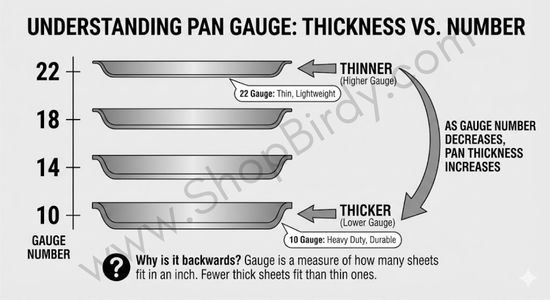
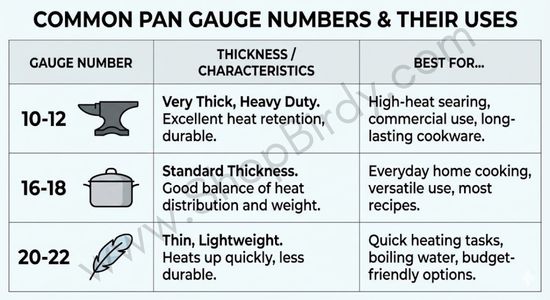
Pan gauge refers to the thickness of the metal used to make the pan body.
- Lower gauge number → thicker metal
- Higher gauge number → thinner metal
Manufacturers rarely publish exact gauge numbers because thickness is one of the most expensive parts of cookware to improve.
Instead, they use vague language like “heavy,” “professional,” or “reinforced.”
Ignore the adjectives.
Gauge is the physics.
Why Thin Pans Warp
Warping isn’t caused by “mistreating” a pan.
It’s caused by uneven thermal expansion.
Here’s what happens in a thin pan:
- The center heats faster than the edges
- Metal expands unevenly
- Stress builds
- The pan bows—usually upward in the center
Once this happens, it’s permanent.
That slight dome is why:
- Oil runs away from the center
- Eggs brown unevenly
- Nonstick coatings fail faster
Warping isn’t cosmetic.
It breaks heat control.
The Oil Pooling Test
You can see gauge problems instantly.
Try this:
- Put the pan on medium heat
- Add one teaspoon of oil
In a thin pan, the oil rushes outward as the center bows upward.
In a thicker pan, the oil stays centered and shimmers calmly.
That calm shimmer is even heat.
That’s gauge at work.
Why Thicker Pans Heat Better (And Slower Is Good)
Thicker metal doesn’t just spread heat—it stores it.
1. Thermal Mass (The Missing Concept)
Thicker metal provides more thermal mass. This acts like a battery for heat.
When you drop a cold egg into a thin pan, the temperature crashes. In a thick-gauge pan, the metal has enough stored energy to maintain a steady sizzle.
This is why thicker pans feel more forgiving—and why thin pans feel chaotic.
Thermal mass is the only way to maintain the steady sizzle required for our Perfect Fried Egg Technique. Without it, the temperature crashes the moment the egg hits the metal.
2. Lateral Heat Distribution
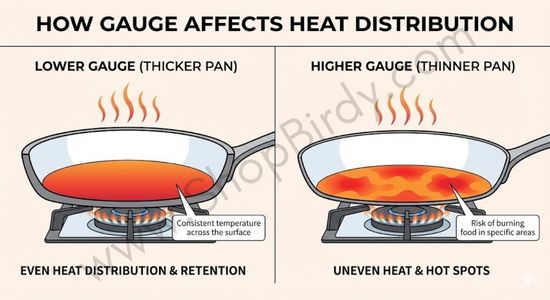
Instead of heat racing straight up from the burner, thicker metal spreads energy sideways first.
This reduces:
- Hot spots
- Scorching
- Patchy browning
Food cooks evenly because the metal evens things out before the heat reaches your food.
3. Temperature Stability During Adjustments
When you lower the burner:
- Thin pans overreact
- Thick pans respond smoothly
This matters for eggs, sauces, and nonstick coatings that hate thermal shock.
A good pan doesn’t just heat—it settles.
4. Coating Protection (Especially Nonstick)
Nonstick coatings fail fastest where heat spikes.
Thicker pans:
- Reduce peak temperatures
- Minimize expansion stress
- Extend coating lifespan
This is why premium coatings fail early on cheap pans—and last years on thicker ones.
While thick gauge metal protects the coating from thermal spikes, your cleaning habits matter just as much. Avoid these 7 Habits That Kill Nonstick Pans to keep your surface slick.
⚠️ Induction Alert: Gauge Is Non-Negotiable
If you cook on induction, pan gauge matters even more.
Induction heats the metal directly and instantly, not the air or the pan surface. Thin pans cannot absorb or distribute this energy fast enough.
What happens with thin pans on induction:
- Immediate hot spots
- Audible vibration or “screaming”
- Rapid warping from magnetic torque
High-gauge or bonded construction is required to survive induction cooking. Thin stamped pans will deform almost immediately—even at moderate settings.
On induction, gauge isn’t a preference.
It’s a requirement.
Gauge vs Construction (Important Distinction)
Gauge is thickness.
Construction is how layers are assembled.
Thin, Single-Layer Aluminum
- Cheapest to make
- Warps easily
- Heats unevenly
Thick Hard-Anodized Aluminum
- Much more warp-resistant
- Excellent stability on gas and electric
- Best mid-price option
3-Ply / Bonded Construction
- Aluminum core sandwiched in steel
- Very stable
- Induction compatible
- Expensive—but calm and durable
Gauge tells you how much metal.
Construction tells you how that metal behaves.
You need both working together.
Why Expensive Pans Feel “Calmer”
People often say expensive pans feel:
- Smoother
- Easier
- More forgiving
That’s not imagination.
It’s because thicker gauge pans:
- Don’t spike temperature
- Don’t warp under normal cooking
- Don’t force constant micro-adjustments
Control reduces stress—on you and the pan.
The Handle Connection (Gauge You Can Feel)
Gauge doesn’t just affect cooking—it affects balance.
Thin pans:
- Feel nose-heavy
- Rock during tilting
- Require tighter grip
Thicker pans:
- Sit flat
- Move predictably
- Feel planted on the burner
This is why better gauge pairs naturally with better handles. Control compounds.
Common Myths About Pan Thickness
“Thinner pans heat faster.”
True—and that’s the problem. Speed without control leads to scorching.
“Warping only happens if you abuse the pan.”
False. Normal heating cycles warp thin pans.
“Gauge doesn’t matter for nonstick.”
False. Nonstick coatings are more sensitive to uneven heat.
When Thin Pans Are Acceptable
Thin gauge pans can make sense if:
- You cook occasionally
- You accept short lifespan
- You prioritize low upfront cost
They’re disposable tools—not long-term cookware.
The Cost-Per-Year Reality
- Thin $30 pan lasting 1 year → $30/year
- Thick $100 pan lasting 5 years → $20/year
Gauge quietly determines value.
This math is exactly why gauge is the primary factor we analyze in our deep dive: $30 vs. $100 Nonstick Pan: Where Does Your Money Actually Go?
How to Judge Pan Gauge in a Store (No Tools Needed)
- Lift the pan
- Hold it by the handle
- Gently twist
- Thin pan → flex, vibration
- Thick pan → solid, dead-still
Your hands can feel gauge even when labels hide it.
Final Verdict: Why Pan Gauge Matters
Pan gauge determines:
- Whether heat spreads or spikes
- Whether pans warp or stay flat
- Whether coatings survive or fail
- Whether cooking feels chaotic or controlled
Most cookware problems blamed on “bad pans” are really thin-metal problems.
If you remember one thing:
Calm cooking starts with thick metal.
That’s why pan gauge isn’t trivia—it’s the foundation.
Ready to see which high-gauge pans survived our physics-based audits? Check out our top-tier recommendations in the Best Nonstick Pans for Eggs: Tested & Reviewed.
The ShopBirdy Rule
If the pan feels jumpy, it is jumpy.
If the pan feels calm, it will cook calmly.
Gauge is the difference.
Legal Information
Shopbirdy.com is a participant in the Amazon Services LLC Associates Program, an affiliate advertising program designed to provide a means for sites to earn advertising fees by advertising and linking to Amazon.
About the Author

Lily Clark has spent years testing cookware and kitchen appliances the way most people actually use them — on a home circuit, in a real kitchen, cooking real meals.
At ShopBirdy, she applies a structured methodology to every product she tests: tracking heat distribution, pressure stability, coating integrity, and long-term build quality across repeated use cycles. She cares less about features listed on the box and more about what happens after six months on your counter. Her reviews are written for people who want to buy once and cook well.