Updated January 2026 | By Lily Clark
Affiliate Disclosure: This article contains affiliate links. If you purchase through them, I may earn a small commission at no extra cost to you. I only recommend cookware I personally test and cook with in my kitchen.
If pan size were just about diameter, choosing a nonstick pan would be easy.
It isn’t.
The real decision is about surface area vs. volume, heat recovery, and how quickly your pan can stabilize after food hits the surface. Size influences all of that—but so does sidewall geometry, which most reviews completely ignore.
I’ve cooked the same foods—eggs, fish, vegetables, and proteins—across 8-inch, 10-inch, and 12-inch nonstick pans, often on the same burner, back to back. Once you look at pan size through a thermal lens, the “best size” becomes obvious.
First: What Pan Size Really Measures (And Why Diameter Is Misleading)
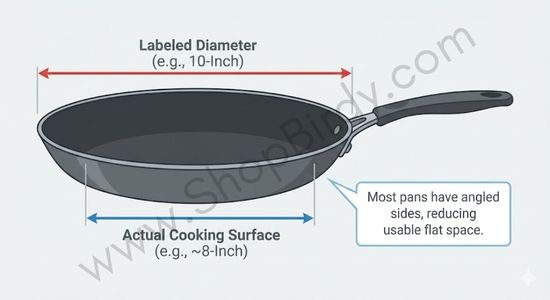
When a pan is labeled “10 inches,” that measurement is taken rim to rim, not across the flat cooking surface.
What actually matters is:
- The flat contact area (where heat enters the food)
- The pan’s mass
- The volume created by the sidewalls
Two pans with the same diameter can behave very differently depending on their shape and construction.
That’s why people buy “the same size” pan twice—and still get different results.
The Missing Variable: Sidewall Geometry (Volume vs. Surface Area)
Pan size discussions usually stop at diameter. That’s a mistake.
Flared sides vs. straight sides change everything.
- A flared omelet pan slopes outward.
- Less internal volume
- Less thermal mass
- Faster heat response
- Easier food release
- A straight-sided everyday pan holds more volume.
- More metal
- More thermal mass
- Slower temperature changes
- Better moisture control for sautéing
This means a 10-inch straight-sided pan can outperform a 12-inch flared pan for certain tasks—not because it’s wider, but because it stores and redistributes heat more effectively.
When people say a pan feels “weak” or “unstable,” they’re often reacting to geometry, not coating quality.
8-Inch Nonstick Pan: Precision Over Power
An 8-inch pan is not a beginner pan.
It’s a precision instrument.
Why it works
- Small surface heats quickly
- Minimal energy required to reach target temp
- Excellent control for low-fat cooking
This is why egg specialists love it. The pan responds instantly to heat changes, which is ideal for delicate proteins.
Where it breaks down
- Extremely limited surface area
- Crowding happens fast
- Steam buildup overwhelms the coating
Once food touches food, moisture dominates. At that point, even the best nonstick coating looks like it’s “failing.”
It isn’t. The pan is just too small.
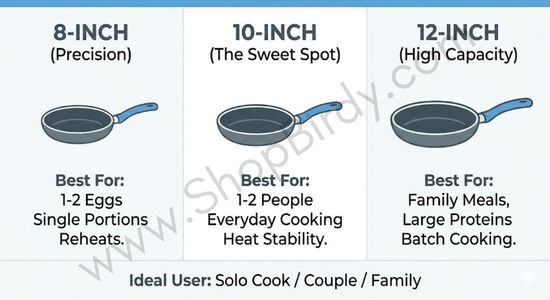
Best use:
Eggs, single portions, reheats
Worst use:
Vegetables, proteins, batch cooking
10-Inch Nonstick Pan: The Thermal Sweet Spot
If I had to name the best size nonstick pan for most kitchens, it’s 10 inches—and the reason has nothing to do with versatility marketing.
It’s about thermal balance.
Why 10 inches works so consistently
- Enough surface area to avoid crowding
- Enough mass to resist temperature crashes
- Still light enough for control and tossing
- Matches standard home burner output
A 10-inch pan recovers temperature quickly without overshooting. That matters because nonstick coatings degrade fastest when overheated—not when they’re used gently.
This is also why we test most nonstick pans for egg performance in the 10-inch size. Eggs demand stable heat, clean release, and predictable recovery — exactly what this diameter does best.
If you’ve landed on 10 inches as your sweet spot, the next decision isn’t size — it’s coating quality and heat behavior.
Geometry matters here
A 10-inch straight-sided pan behaves very differently than a flared omelet pan:
- Straighter sides = more mass + volume
- Better heat retention
- More even sautéing
This is the size where system balance—pan, burner, food—finally aligns.
This is why, for most people, the best size nonstick pan is 10 inches.
12-Inch Nonstick Pan: Surface Area Solves Problems—Until Heat Runs Out
A 12-inch pan promises freedom from crowding. And when supported properly, it delivers.
Where it excels
- Family-sized portions
- Large proteins
- Moisture-heavy foods
- One-pan meals
The expanded surface area allows evaporation instead of steaming—which is critical for browning.
The real limitation
A 12-inch pan requires significantly more energy to heat evenly.
On most home stoves, the center overheats while the edges lag behind. That edge-cooling problem gets worse as pan diameter increases.
This is why pan gauge matters more at 12 inches than at any other size. A thin pan simply can’t store or redistribute enough energy to keep the perimeter hot once food is added. Thicker, higher-gauge pans resist temperature collapse and reduce the hot-center / cold-edge effect.
If you’re considering a large pan, understanding gauge isn’t optional — it’s the difference between stable browning and chronic frustration
This is why people complain that big nonstick pans “don’t heat evenly.” The pan isn’t defective—the burner is underpowered.
A 12-inch pan also demands longer preheating and more patience. Skip either, and performance collapses.
Thermal Recovery: Why Mass Changes Everything
Once food hits the pan, temperature drops.
The question is: how fast does the pan recover?
That’s where mass matters more than diameter.
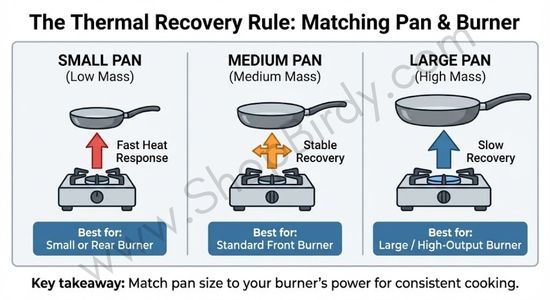
Thermal Recovery Comparison Table
Pan Size | Relative Mass | Thermal Recovery Behavior | Best Burner Match |
8-Inch | Low | Fast response, high spike | Small or rear burner |
10-Inch | Medium | Stable recovery (sweet spot) | Standard front burner |
12-Inch | High | Slow recovery, requires preheat | Large / high-output burner |
Light pans react fast—but spike easily.
Heavy pans stabilize—but need energy.
The best pan is the one whose mass matches your burner’s output.
The Crowding Rule (The Nonstick Killer)
Here’s the rule I follow religiously:
If food touches food, the pan is too small.
Crowding causes:
- Steam accumulation
- Temperature collapse
- Pale food
- Excess stirring
- Accelerated coating wear
Most people blame coatings for failures that are actually geometry and size mismatches.
So, What Is the Best Size Nonstick Pan?
Choose 8-inch if:
- You cook mostly eggs
- You value precision
- You cook solo
- You already own a larger pan
Choose 10-inch if:
- You want one pan that works reliably
- You cook for 1–2 people
- You use a standard home burner
- You care about heat stability
Choose 12-inch if:
- You cook for families
- You have a strong burner
- You preheat properly
- You prioritize surface area over agility
Final Verdict
Pan size isn’t about preference.
It’s about matching surface area, mass, and geometry to your stove and food.
If someone asked me for one recommendation:
- Start with a 10-inch straight-sided nonstick pan
- Add an 8-inch if you’re serious about eggs
- Only buy a 12-inch if your burner earns it
When pan size is right, nonstick pans stop feeling disposable—and start behaving predictably.
Legal Information
Shopbirdy.com is a participant in the Amazon Services LLC Associates Program, an affiliate advertising program designed to provide a means for sites to earn advertising fees by advertising and linking to Amazon.
About the Author

Lily Clark has spent years testing cookware and kitchen appliances the way most people actually use them — on a home circuit, in a real kitchen, cooking real meals.
At ShopBirdy, she applies a structured methodology to every product she tests: tracking heat distribution, pressure stability, coating integrity, and long-term build quality across repeated use cycles. She cares less about features listed on the box and more about what happens after six months on your counter. Her reviews are written for people who want to buy once and cook well.