Affiliate Disclosure: This article contains affiliate links. If you purchase through them, I may earn a small commission at no extra cost to you. I only recommend cookware I personally test and cook with in my kitchen.
Updated January 2026 | By Lily Clark
When a $30 nonstick pan and a $100 nonstick pan sit side by side, they look nearly identical. Same black coating. Same shape. Same promises on the label.
So the real question isn’t “Is the expensive one better?”
It’s:
What are you actually paying for—and does it change how the pan cooks?
The answer lives in places most shoppers never check: construction, gauge, and handle engineering.
The Biggest Myth in Nonstick Pricing
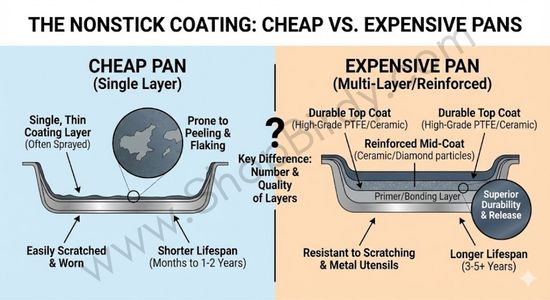
Most people assume expensive nonstick pans last longer because they have “better coating.”
That’s backwards.
Nonstick coatings usually fail because the metal underneath them is unstable. When a pan warps, flexes, or overheats unevenly, the coating breaks down—no matter how premium it claims to be.
You’re not paying for slickness.
You’re paying for structural control.
Construction: Winners vs. Losers
This is where the price gap actually shows up.
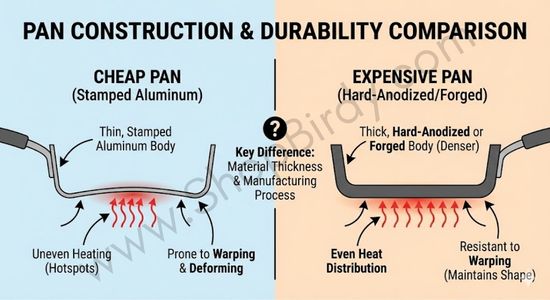
❌ Loser: Stamped Aluminum ($30 Range)
Pressed from a single thin sheet of aluminum.
The risk:
Over time, repeated heating causes the center to bow upward. Oil starts pooling toward the edges, heat concentrates unevenly, and the coating degrades faster.
This is why cheap pans feel fine early—and frustrating later.
✅ Winner: 3-Ply Bonded Construction ($90–$120 Range)
A sandwich of metals—usually stainless steel / aluminum / stainless steel.
The benefit:
The stainless layers act like an exoskeleton, keeping the aluminum core flat and stable. Heat spreads evenly, and the pan stays that way for years.
Bonus: induction compatibility comes naturally with this build.
Smart Middle Ground: Hard-Anodized Aluminum ($50–$80 Range)
Electrochemically hardened aluminum, thicker and far more warp-resistant than stamped pans.
Why it matters:
Hard-anodized pans deliver much of the thermal stability of premium cookware without the full price. For gas and electric stoves, this is often the best value tier.
Gauge Still Matters (But It’s Not Just Thickness)
Thicker metal:
- Distributes heat more evenly
- Resists warping
- Protects the coating from hot spots
Thin metal:
- Heats fast, but unevenly
- Reacts aggressively to burner changes
- Shortens coating lifespan
A high-gauge pan doesn’t feel hotter—it feels calmer.
Visual Authority: The Hot Spot Test (Try This at Home)
Here’s how to see thermal stability on your own stove.
The Test:
Put a pan on medium heat. Add one teaspoon of oil.
- In a cheap pan, the oil often races outward as the center bows and overheats.
- In a high-gauge or bonded pan, the oil stays centered and shimmers calmly.
That calmness is even heat.
That’s what you’re paying for.
Handle Engineering: The Silent Differentiator
Handles reveal cost-cutting faster than coatings.
Cheap Handles
- Thin, hollow steel
- Minimal reinforcement
- Heat creeps toward your hand
- Balance feels off during tilting
This leads to jerky movements—and jerky movements destroy nonstick coatings.
Better Handles
- Thicker stainless steel
- Reinforced rivets
- Better balance and control
- Less wrist fatigue
This isn’t comfort—it’s mechanical reliability.
Specs at a Glance
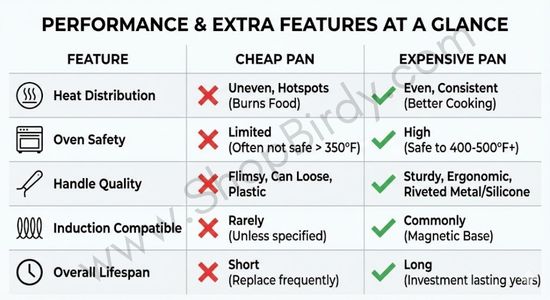
Feature | $30 Stamped Pan | $100 Forged / 3-Ply Pan |
Weight | Very light | Substantial |
Construction | Single-layer aluminum | Bonded / forged |
Heat Behavior | Spiky, uneven | Smooth, predictable |
Handle Feel | Hollow, flexible | Solid, rigid |
Typical Lifespan | ~1 year | 4–6 years |
The Replacement Cycle Math (Cost-Per-Year Reality)
This is where expensive pans quietly win.
- $30 pan × 1 year lifespan = $30/year
- $100 pan × 5 year lifespan = $20/year
If you cook eggs daily, the “expensive” pan is actually cheaper—and far less frustrating.
If you think your current pan is reaching its limit but aren’t sure, check our guide on When to Replace a Nonstick Pan: Toxicity, Coating Flaws & Safety Signs
ShopBirdy Picks
Best for Induction Users (Budget)
T-fal Professional Nonstick (Induction Base)
Why we picked it: The stainless base stabilizes an otherwise thin pan, making it the only budget option that doesn’t feel like a toy on induction burners.
Best Value for Gas & Electric
Anolon Nouvelle Copper Hard-Anodized Nonstick
Why we picked it: The copper layer and thick hard-anodized body deliver the thermal stability discussed in the gauge section—at roughly half the cost of premium brands.
Buy It Once Choice
All-Clad HA1 Hard-Anodized Nonstick Set
Why we picked it: Built like a tank. The thick-gauge aluminum body and rigid handle design are the best insurance policy for long coating life.
Safety & Coating Reality
Price does not equal safety.
Most modern pans—cheap or expensive—use PTFE coatings that are safe when used correctly. The real danger is overheating thin, unstable pans.
Metal quality matters more than marketing claims.
For a deeper dive into the health and durability differences between the two main coating types, read our PTFE vs Ceramic Nonstick: Honest Review & 1-Year Durability Test.
The “Pounce” Paragraph
If you cook eggs most mornings, skip the $30 aisle.
The frustration of jumpy heat, uneven browning, and yearly replacement will cost you more—in food and sanity—than the price difference ever will.
Spend once. Cook calmly.
Ready to upgrade? We put the industry’s top contenders to the test in our roundup of the Best Nonstick Pans for Eggs: Tested & Reviewed
Pro Tip: The Handle Stress Test (In-Store Trick)
Next time you’re in a store:
- Grab a $30 pan by the end of the handle
- Squeeze gently
- Repeat with a $100 pan
Cheap pan: flex, vibration, hollowness
Better pan: feels like an extension of your arm
That sensation is structural control.
Note: High-quality rivets are essential for stability, but they are also magnets for burnt-on oil. If your rivets are looking dark, here is How to Clean Sticky Residue From a Nonstick Pan without damaging the coating.
Final Verdict: Cheap vs Expensive Nonstick Pan
The real difference isn’t coating or branding.
It’s:
- Construction that keeps metal flat
- Gauge that controls heat
- Handles that give you precision
Spend less if you accept replacement.
Spend more if you value control.
That’s where your money actually goes.
Legal Information
Shopbirdy.com is a participant in the Amazon Services LLC Associates Program, an affiliate advertising program designed to provide a means for sites to earn advertising fees by advertising and linking to Amazon.
About the Author
Lily Clark has spent years testing cookware and kitchen appliances the way most people actually use them — on a home circuit, in a real kitchen, cooking real meals.
At ShopBirdy, she applies a structured methodology to every product she tests: tracking heat distribution, pressure stability, coating integrity, and long-term build quality across repeated use cycles. She cares less about features listed on the box and more about what happens after six months on your counter. Her reviews are written for people who want to buy once and cook well.