Affiliate Disclosure: This article contains affiliate links. If you purchase through them, I may earn a small commission at no extra cost to you. I only recommend cookware I personally test and cook with in my kitchen.
Updated December 2025 | By Lily Clark
When cast iron eggs go wrong, they go really wrong.
Whites weld themselves to the pan. Yolks tear. Cleanup turns into a scraping session that makes you wonder why anyone ever recommends cast iron for eggs.
But when cast iron eggs go right?
They’re exceptional.
Soft whites. Clean release. Crisp edges if you want them. The kind of eggs you get at a diner that’s been using the same skillet for decades.
The difference isn’t luck, and it isn’t nostalgia. It’s seasoning maturity, heat discipline, the right tool, and patience at exactly the right moment.
First, the Honest Truth About Cast Iron and Eggs
Cast iron is not forgiving.
It’s thick, slow to respond, and brutally honest about mistakes. If you rush the preheat, use the wrong fat, move the egg too early, or use the wrong spatula, it will punish you.
But that same thermal mass is what makes restaurant-level eggs possible—once the skillet is properly seasoned and evenly heated.
Cast iron doesn’t cook eggs well by default.
It cooks eggs well once it’s earned the right.
If this sounds like more work than you want for a Tuesday morning, don’t worry. You can get the same clean release with a high-quality nonstick pan without the preheat. Check out our tested picks for the [best nonstick pan for eggs].
What “Well-Seasoned” Really Means (Not Instagram Black)
A well-seasoned cast iron skillet is not:
- jet black
- glossy like lacquer
- perfectly uniform
It is:
- smooth to the touch
- matte, not sticky
- built from many layers of polymerized oil
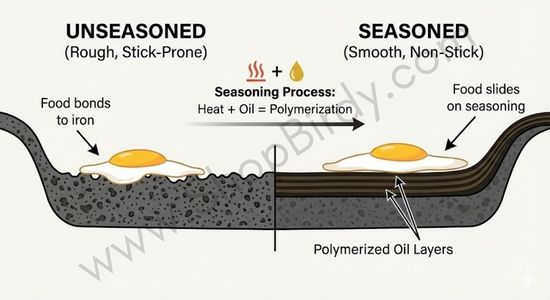
Seasoning isn’t a coating sitting on top of the pan—it’s oil that has filled the microscopic texture of the iron over time.
Unlike carbon steel, cast iron is porous and thirsty. It needs more oil and more patience to reach egg-ready status.
The Surface Texture Problem (Why New Cast Iron Struggles)
Most modern cast iron is sand-cast, which leaves a pebbled surface.
That texture:
- traps egg whites
- delays release
- demands deeper seasoning
This is why:
- new cast iron sticks
- old cast iron slides
Time matters here. There is no true shortcut. If you love the idea of a ‘forever’ pan but want a surface that is smooth from day one, you should look into carbon steel. It’s lighter and responds faster to heat. I’ve broken down exactly how to get that glass-like finish in my guide on [how to season carbon steel]
Heat Management: Where Eggs Are Won or Lost
Cast iron’s biggest strength—thermal mass—is also its biggest trap.
Once it’s hot, it stays hot.
That means:
- you must preheat slowly
- and cook at lower heat than your instincts suggest
If you crank the burner early, the pan overshoots and never recovers in time for eggs.
Step-by-Step: Restaurant-Level Eggs in Cast Iron
Step 1: Preheat Slowly
- Medium-low heat
- 5–7 minutes
- No oil yet
Cast iron needs time for heat to move through the metal, not just sit on the surface.
Step 2: Use the Water Drop Test (Leidenfrost Effect)
Flick a drop of water into the pan:
- If it sits and sizzles → too cold
- If it evaporates instantly → too hot
- If it beads up and dances across the surface → you’ve reached the Leidenfrost Effect
That dancing droplet means the pan is evenly heated.
👉 Once you see this, pull the pan off the heat for about 20 seconds. This keeps the surface nonstick while preventing butter from burning instantly.
Step 3: Add Fat Generously
Cast iron requires more fat than stainless steel or carbon steel.
Best choices:
- butter
- bacon fat
- ghee
Add fat only after the pan is ready.
Why “Quiet Foam” Matters
Butter foams because the water inside it is evaporating.
Aggressive bubbling means steam is still escaping.
If you add eggs during that stage, the steam can interfere with the initial set of the egg whites, increasing the chance of sticking.
When the foam calms:
- the water is gone
- you’re cooking in fat and milk solids
- the surface becomes stable
That’s your moment.
🔥 STEP 4: LOWER THE HEAT (THIS IS THE MOST IMPORTANT STEP)
Once the fat is in the pan:
Lower the heat.
This is where most people fail.
Cast iron already holds a massive amount of energy. Keeping the heat high doesn’t help—it overcooks the bottom of the egg before the top sets.
Think control, not power.
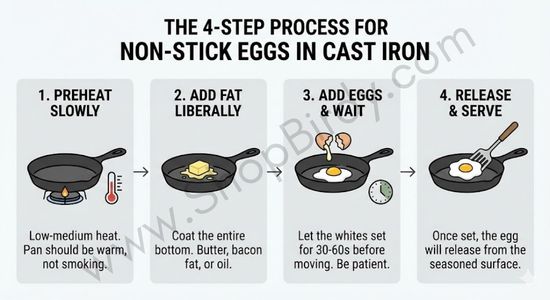
Step 5: Add Eggs and Walk Away
Place the eggs gently.
Do not:
- poke them
- scrape under them
- test release early
After 30–60 seconds, the egg will release naturally.
If you try to move it early, it will tear.
The Missing Link: Use the Right Spatula
This detail alone fixes a lot of “everything was right but it still tore” complaints.
Use a Thin Metal Fish Spatula
- ultra-thin edge
- flexible
- slides under eggs cleanly
Cast iron is durable. You do not need to baby it with thick silicone spatulas that can’t get under delicate whites.
A fish spatula can sneak under the egg the moment it releases—without tearing the yolk.
This is a restaurant trick most home cooks never learn.
Fried Eggs vs. Scrambled Eggs (Cast Iron Reality)
Fried Eggs
This is where cast iron shines:
- crisp edges
- stable whites
- rich flavor
This is the easiest win.
Scrambled Eggs
Much harder.
Constant stirring repeatedly breaks the release barrier, and cast iron’s heat retention works against you.
If scrambling:
- use more fat
- cook lower than you think
- stir gently and less often
Even then, scrambled eggs in cast iron take practice.
While cast iron is the king of the crispy fried egg, it is rarely the best choice for creamy scrambles. For perfect, low-effort scrambled eggs every time, we recommend using one of the top-rated pans from our [best nonstick pan for eggs] roundup.
Cleanup Without Killing Seasoning (Soap Science)
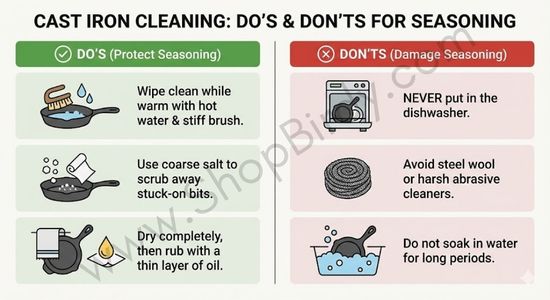
After cooking:
- Wipe out residue
- Rinse with warm water
- Use a brush if needed
- Dry over heat
- Rub one drop of oil into the surface
Why Modern Soap Is Okay
Old advice to avoid soap comes from the days when soap contained lye, which actually eats through seasoning.
Modern dish soaps (like Dawn) are detergents, not lye-based soaps. They remove grease but leave polymerized oil (seasoning) intact.
Soap won’t kill your seasoning.
Soaking will.
Never soak cast iron.
When Cast Iron Is (and Isn’t) the Right Tool
Cast iron is right if:
- you cook eggs often
- you enjoy technique
- you want crisp edges and depth of flavor
It’s not ideal if:
- you want instant results
- you cook eggs once a week
- you’re rushing weekday breakfasts
There’s no shame in choosing another pan.
If you want the ease of nonstick but are tired of pans wearing out in six months, you need a reinforced coating. We dug into the marketing hype to find out if [titanium vs. diamond nonstick coatings] actually last longer.
Final Verdict
Restaurant-level eggs in a cast iron skillet are absolutely achievable—but they’re earned, not automatic.
With:
- mature seasoning
- disciplined heat
- generous fat
- a proper metal spatula
- and patience at release
Cast iron delivers eggs that few other pans can match.
But it never pretends to be easy—and that honesty is part of the deal.
One-Line Takeaway
Great eggs in a cast iron skillet come from seasoning maturity, disciplined heat, the right spatula, and waiting for the release.
Legal Information
Shopbirdy.com is a participant in the Amazon Services LLC Associates Program, an affiliate advertising program designed to provide a means for sites to earn advertising fees by advertising and linking to Amazon.
About the Author

Lily Clark has spent years testing cookware and kitchen appliances the way most people actually use them — on a home circuit, in a real kitchen, cooking real meals.
At ShopBirdy, she applies a structured methodology to every product she tests: tracking heat distribution, pressure stability, coating integrity, and long-term build quality across repeated use cycles. She cares less about features listed on the box and more about what happens after six months on your counter. Her reviews are written for people who want to buy once and cook well.