Affiliate Disclosure: This article contains affiliate links. If you purchase through them, I may earn a small commission at no extra cost to you. I only recommend cookware I personally test and cook with in my kitchen.
Updated December 2025 | By Lily Clark
If there’s one mistake I see again and again in home kitchens, it’s this: the heat is too high.
People blame the pan. The eggs. The spatula.
But scrambled eggs fail for one reason more than any other:
Temperature mismanagement.
After cooking eggs on everything from cheap nonstick to heavy cast iron, the conclusion is boring—but powerful:
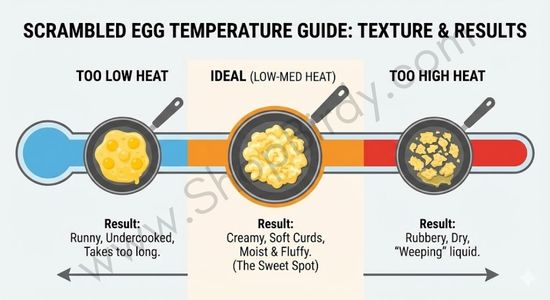
Medium-low heat is the best temperature for scrambled eggs, every single time.
Not low. Not medium. Definitely not high.
Let’s break down why this works, what’s happening inside the eggs, and how to get soft, creamy curds on demand.
Why Scrambled Eggs Are So Sensitive to Heat
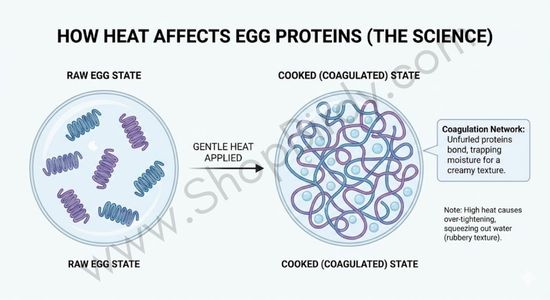
Eggs are mostly water and protein. When heat hits them, the proteins unfold and bond—a process called coagulation.
The problem is speed:
- Too fast → tight protein bonds → dry, crumbly eggs
- Too slow → water leaks out → thin, weepy eggs
Scrambled eggs need gentle, controlled heat so proteins set gradually and trap moisture instead of squeezing it out.
That’s why temperature—not ingredients—is the real skill.
The Science Behind Medium-Low Heat (The Gold Zone)
Medium-low heat gives you something high heat never will: time.
It allows you to:
- Control curd size
- Preserve moisture
- Prevent browning and sulfur smells
- Stop cooking before damage is done
On most home stoves, medium-low means:
- The pan warms evenly
- Butter melts quietly, without browning
- Eggs begin setting after 10–15 seconds, not instantly
If your eggs sizzle loudly when they hit the pan, the heat is already too high.
Keeping the heat low isn’t just about taste; it’s about pan longevity and safety. We break down the real science of coatings in our report on titanium vs. diamond nonstick.
The Missing Variable Most Guides Ignore: Thermal Mass
Here’s where many good cooks still get tripped up.
Thermal mass is a pan’s ability to store and retain heat. Heavy cookware doesn’t cool down just because you turn the knob.
Thick aluminum-core pans and cast iron are especially guilty here.
Pro Tip (This Saves Eggs):
If you’re using a heavy pan, turn the burner off earlier—when the eggs look about 80% done.
Why?
That pan is still holding a huge amount of energy. For the next 30–90 seconds, it will continue to push heat into the eggs, tightening proteins and drying them out.
Light pans forgive late timing.
Heavy pans punish it.
This single adjustment explains why some people say “scrambled eggs never work” in good cookware. The pan isn’t the problem—the exit timing is.
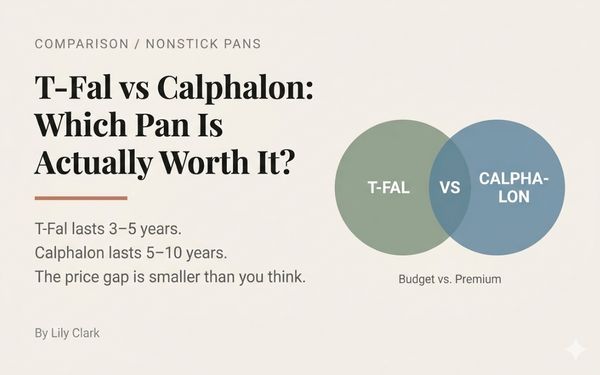
If your eggs cook unevenly even when your technique feels right, pan construction is usually the culprit. Our comparison of T-Fal vs. Calphalon shows how thickness and heat retention change the scramble.
American vs. French Scrambled Eggs (A Quick Reality Check)
To be precise: medium-low heat is style-specific.
- American-style scrambled eggs
- Medium-low heat
- Gentle stirring
- Larger, fluffy curds
- This guide is optimized for this style
- French-style scrambled eggs
- Low heat
- Constant stirring
- Custard-like, spoonable texture
French scrambles rely on agitation to prevent curds from forming.
American scrambles rely on temperature control to let curds form gently.
Different goals. Same rule: never rush the heat.
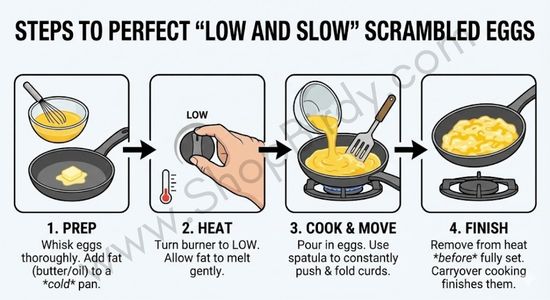
The Best Temperature for Scrambled Eggs (Step-by-Step)
- Preheat the pan on medium-low for 30–60 seconds
Warm—not aggressive. - Add butter or oil
It should melt smoothly with no browning. - Pour in beaten eggs
No sizzling. Silence is correct. - Let curds form naturally
Stir slowly with a silicone or wooden spatula. - Turn off heat early
When eggs look soft and glossy (or ~80% done in heavy pans).
Critical rule: Eggs continue cooking after leaving the burner. Always stop early.
Visual Cue Cheat Sheet (Trust Your Eyes)
Look & Texture | The Diagnosis | The Fix |
Glossy & Soft | Perfect | Remove from heat immediately; plate now. |
Matte & Crumbly | Overcooked | Lower heat next time; pull 30 seconds earlier. |
Watery Pooling | Too Low | Increase heat slightly; stop stirring so much. |
Browned Edges | Too Hot | Your preheat was too aggressive. |
Your eyes are a better timer than your phone.
Scrambled Egg Temperature Troubleshooting
Eggs dry and crumbly?
→ Heat too high or you stayed on the burner too long (common with heavy pans).
Eggs watery or thin?
→ Heat too low, or you stirred constantly like a French scramble without committing to it.
Eggs browning?
→ Pan was overheated before eggs went in.
Eggs unevenly cooked?
→ Thin pan with hot spots—or poor temperature control.
Pan Choice Matters (But Less Than You Think)
Technique is about 90% of the result—but cookware still plays a role.
- Nonstick: Most forgiving for medium-low heat
- Stainless steel: Requires precise heat control
- Cast iron: Excellent only with disciplined timing
While technique is the priority, the right surface reduces your margin for error. If you want the most forgiving option for medium-low heat, see our deep dive into the best nonstick pan for eggs.
If your eggs cook unevenly even when your technique feels right, pan construction is usually the culprit. Our comparison of T-Fal vs. Calphalon shows how thickness and heat retention change the scramble.
And yes—scrambled eggs can work in seasoned metal, but it demands absolute respect for heat. My guide on eggs in a cast iron skillet explains why temperature is the make-or-break factor with iron.
Final Verdict: The Best Temperature for Scrambled Eggs
- Medium-low heat
- Gentle curd formation
- Early heat cut-off
- Residual heat finishes the job
Scrambled eggs aren’t about speed or power.
They’re about restraint.
Once you master temperature, everything else—pan choice, fat, seasoning—falls into place.
Legal Information
Shopbirdy.com is a participant in the Amazon Services LLC Associates Program, an affiliate advertising program designed to provide a means for sites to earn advertising fees by advertising and linking to Amazon.
About the Author

Lily Clark has spent years testing cookware and kitchen appliances the way most people actually use them — on a home circuit, in a real kitchen, cooking real meals.
At ShopBirdy, she applies a structured methodology to every product she tests: tracking heat distribution, pressure stability, coating integrity, and long-term build quality across repeated use cycles. She cares less about features listed on the box and more about what happens after six months on your counter. Her reviews are written for people who want to buy once and cook well.