Affiliate Disclosure: This article contains affiliate links. If you purchase through them, I may earn a small commission at no extra cost to you. I only recommend cookware I personally test and cook with in my kitchen.
Updated December 2025 | By Lily Clark
If you’ve ever flipped over a nonstick pan box and noticed the word “Titanium” or “Diamond” printed in bold—while the word Teflon is nowhere to be found—that’s not an accident.
That’s the dirty little secret of modern nonstick cookware.
These pans aren’t scams. But the way they’re marketed is deliberately confusing, especially for shoppers trying to avoid certain chemicals or buy something that actually lasts longer.
Let’s slow this down and talk honestly about what titanium and diamond nonstick coatings really are, what they’re not, and when—if ever—they’re worth paying extra for.
If eggs are your priority, reinforced PTFE usually performs better. For a list of the specific models that passed our stress tests, see our guide to the [best nonstick pan for eggs]
The Industry’s Dirty Little Secret: The Name Game
Here’s the rule I use when reviewing nonstick pans:
If a pan proudly says “PFOA-free” but never says “PTFE-free,” it is still a Teflon pan. Period.
This matters because:
- PFOA was phased out of cookware by law over a decade ago
- Saying “PFOA-free” tells you nothing about the coating type
- PTFE is the actual nonstick material people are concerned about
Brands know “Teflon” has a PR problem. So instead of leading with the base material, they lead with the reinforcement.
Titanium.
Diamond.
Mineral-infused.
Those words are used as shields, not disclosures.
What Titanium & Diamond Nonstick Actually Are
Let’s strip away the hype.
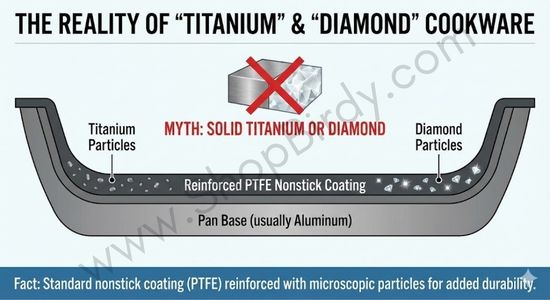
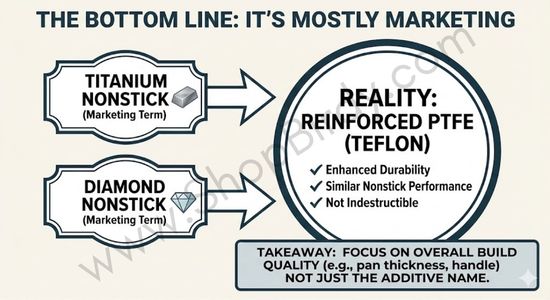
Titanium and diamond nonstick pans are still PTFE-based coatings. The cooking surface you touch is PTFE—the same polymer used in traditional nonstick pans.
The difference is what’s underneath.
Think of it like reinforced concrete:
- PTFE = concrete
- Titanium or diamond particles = rebar
The reinforcement is there to slow wear, not replace the surface.
You are not cooking on titanium.
You are not cooking on diamond.
You are cooking on plastic, reinforced with hard particles.
Why Reinforcement Exists (The Real Benefit)
PTFE is incredibly slick—but it’s soft.
Over time:
- spatulas scrape it
- heat stresses it
- micro-abrasions form
Reinforcement helps by:
- creating microscopic “peaks” of hard material
- protecting the softer PTFE “valleys” underneath
Your utensil hits the peaks first instead of gouging straight into the coating.
The Reality Check
Eventually:
- the peaks wear down
- or the valleys clog with carbonized oil
The rebar stays.
The concrete fails.
This is why reinforced pans last longer, not forever.
The Diamond Heat Myth (This One Really Needs Calling Out)
You’ve probably seen claims like:
“Diamonds conduct heat 4x better than copper!”
That statement is technically true—for a solid diamond.
It is meaningless in cookware.
Here’s why:
- the “diamonds” are microscopic dust
- they’re suspended inside PTFE (plastic)
- plastic is an insulator
Putting diamond dust in PTFE is like putting a silver coin inside a thermos. The insulation still wins.
A diamond nonstick pan:
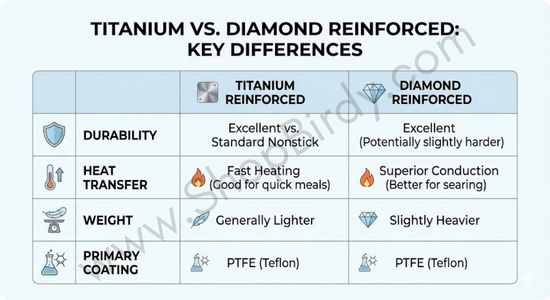
- will not heat like copper
- will not sear like cast iron
- will not distribute heat better than standard PTFE
Heat performance comes from the pan body, not the coating.
Truth vs. Hype (Quick Reality Table)
Marketing Claim | The Reality |
“Titanium nonstick” | PTFE coating with titanium reinforcement |
“Diamond infused” | PTFE with microscopic diamond dust |
“Metal utensil safe” | More resistant, not immune |
“Cooks hotter” | No change—base metal controls heat |
“Lasts forever” | Still a consumable surface |
Are These Coatings Safer Than Regular PTFE?
No.
They are chemically the same when used correctly:
- stable below ~500°F
- PFOA-free (like all modern PTFE)
- unsafe only when severely overheated
Reinforcement does not:
- raise the safe temperature
- eliminate PTFE
- make the pan “toxin-free”
If someone buys a titanium pan thinking they avoided Teflon entirely, they were misled.
Longevity: The Only Place Reinforcement Helps
Here’s the honest range I see in real kitchens:
Coating Type | Realistic Lifespan |
Basic PTFE | ~12–18 months |
Reinforced PTFE | ~24–36 months |
Ceramic (sol-gel) | ~6–12 months |
Reinforcement buys you time, not permanence.
Ceramic vs Reinforced PTFE (Common Confusion)
Ceramic pans:
- are PTFE-free
- handle higher heat
- lose slickness suddenly
Reinforced PTFE:
- stays slick longer
- wears gradually
- is easier for eggs
If eggs are your priority, reinforced PTFE usually performs better.
The “Metal Utensil Safe” Lie
“Metal-safe” is a marketing term, not a physical reality.
Using a metal fork on a diamond-reinforced pan is like taking a 4×4 off-roading:
- yes, it can handle more abuse
- no, that doesn’t mean it isn’t taking damage
You may not see scratches immediately—but you’re shortening the pan’s prime.
Pro Tip: If a pan says metal-safe, stick to rounded spoons and never use a sharp metal knife or a fork with pointed tines.
The Dishwasher Reality (Still a Hard No)
Reinforcement doesn’t change chemistry.
Dishwashers:
- use alkaline detergents
- run high heat cycles
- oxidize exposed aluminum bases
That black residue you get on your hands? That’s oxidation—not dirt.
Reinforcement won’t fix bad metallurgy or harsh cleaning.
What I Tell People Who Ask Me Directly
If someone asks:
“Should I buy a titanium or diamond nonstick pan?”
My honest answer is:
- Yes, if you already like PTFE nonstick and want it to last longer
- No, if you’re trying to avoid PTFE entirely
- Only, if the price increase is reasonable
My Price Rule
- If the reinforced version costs $20 more, buy it
- If it costs $100 more, you’re paying for marketing copy
Checklist for the Skeptical Buyer
Before buying, ask:
- Does it say PTFE-free or just PFOA-free?
- Is the base thick enough to manage heat?
- Is the price increase proportional to lifespan?
- Am I okay replacing this pan in ~3 years?
If the answers line up, reinforced nonstick can make sense.
Final Verdict
Titanium and diamond nonstick coatings are incremental upgrades, not breakthroughs.
They:
- resist scratches better
- last longer than basic PTFE
- still rely on PTFE
- still wear out
They’re not scams—but they’re not miracles either.
If you are tired of the 3-year replacement cycle entirely, it’s time to switch to a ‘forever’ pan. Our guide on [how to season carbon steel] shows you how to get nonstick performance that never wears out.
One-Line Takeaway
Titanium and diamond nonstick pans aren’t better than PTFE—they are PTFE, just reinforced to wear out more slowly.
Legal Information
Shopbirdy.com is a participant in the Amazon Services LLC Associates Program, an affiliate advertising program designed to provide a means for sites to earn advertising fees by advertising and linking to Amazon.
About Me
Hi, I’m Lily and I created Shopbirdy.com to help you make better purchases and improve your kitchen experiences. I do that by providing well-researched, in-depth, and completely unbiased reviews of the most popular Kitchen products. I like cooking that’s why I decided to share my views on various kitchen subjects.

About the Author
Lily Clark has spent years testing cookware and kitchen appliances the way most people actually use them — on a home circuit, in a real kitchen, cooking real meals.
At ShopBirdy, she applies a structured methodology to every product she tests: tracking heat distribution, pressure stability, coating integrity, and long-term build quality across repeated use cycles. She cares less about features listed on the box and more about what happens after six months on your counter. Her reviews are written for people who want to buy once and cook well.