
Updated January 2026 | By Lily Clark
Affiliate Disclosure: This article contains affiliate links. If you purchase through them, I may earn a small commission at no extra cost to you. I only recommend cookware I personally test and cook with in my kitchen.
The OVENTE Electric Wok isn’t trying to be a professional tool. It doesn’t promise restaurant-level heat, precision sensors, or induction wizardry. What it offers instead is simplicity: a lightweight electric wok with dial controls, a nonstick surface, and just enough power to make weeknight stir-fry approachable for beginners and small households.
Judged against premium systems, it falls short. Judged against its intended role — quick, low-stress cooking with minimal setup — it performs exactly as designed. The key is understanding where its limits are, and how to cook within them.
Where the OVENTE Fits in the Electric Wok Landscape
Before evaluating this wok on its own, it’s important to place it correctly in the category.
If you’re comparing different electric wok styles — lightweight skillets, family-scale probe systems, and induction-based setups — start with our full overview here:
Best Electric Woks: Reviews and Buying Guide
The OVENTE sits at the entry level of that spectrum. It is smaller, lighter, and less thermally stable than family-focused models like the Aroma AEW-306, and far simpler than induction systems such as the NuWave Mosaic. That positioning shapes both its strengths and its constraints.
Testing Note (Methodology & Scope)
Testing period: 7 days of home cooking
Primary tests performed:
- Vegetable-forward stir-fry (broccoli, peppers, onions)
- Fried rice (small batch)
- Chicken stir-fry heat recovery test (1 lb)
- Covered steaming / braising using the glass lid
All testing was done on a standard 120V household circuit.
Important limitation:
A one-week test can evaluate performance, heat behavior, and usability, but it cannot predict long-term nonstick durability or appliance lifespan. Observations on longevity below are based on material type and historical behavior of similar designs, not multi-year use.
Design & Build
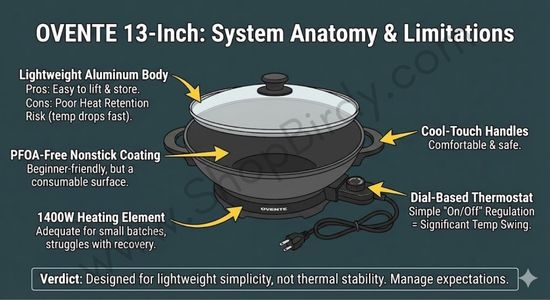
The OVENTE uses an aluminum cooking body, which keeps overall weight low and makes the wok easy to lift, clean, and store. That lightweight construction is intentional — this is a wok meant to feel unintimidating.
However, it does not have the thermal mass or rigidity of cast-aluminum systems like the Aroma AEW-306. Over time, heavier cast bodies tend to maintain more consistent contact with their heating elements, which improves heat stability under load.
If you are interested in how that difference plays out in practice, see:
Aroma AEW-306 Electric Wok Review
Size & Geometry
With a 13-inch diameter, the OVENTE is best suited for:
- Stir-fry for 1–2 people
- Fried rice in modest portions
- Sautéed vegetables and proteins
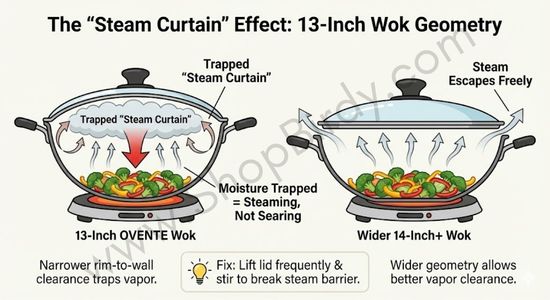
This is not a capacity-driven wok. Compared to 14-inch and 5-quart designs, it has less rim-to-wall clearance, which affects how steam escapes during cooking.
The “Steam Curtain” Risk
At 13 inches, the OVENTE has a narrower vapor exit path than larger woks. When too much cold or wet food is added, steam can rise faster than it can escape, forming a steam curtain that traps moisture against the food.
A practical cue:
If the glass lid fogs instantly the moment vegetables hit the pan, you’ve exceeded the wok’s vapor clearance.
Technique fix
Lift the lid immediately and stir aggressively for 10–15 seconds to break the steam barrier and allow moisture to escape.
This behavior is geometry-driven, not a defect — but it rewards attentiveness.
Power & Heat-Up
The OVENTE runs at 1400 watts, slightly below the 1500W ceiling common to many electric woks. From a cold start, it reached a cooking-ready temperature (oil shimmering) in just under 3 minutes.
For small meals, that’s perfectly adequate.
Where the limitation appears is not in heat-up, but in heat retention and recovery — especially once food is added.
Temperature Control and the Thermostat Swing
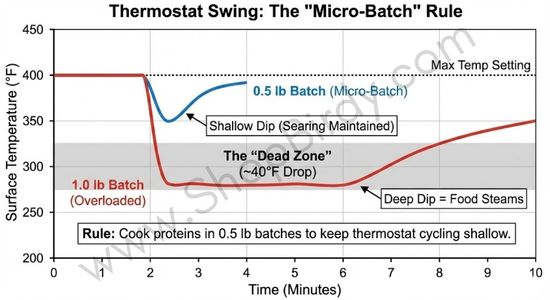
Temperature is controlled via a dial-based thermostat, with a maximum setting of 400°F. There’s no digital readout and no fine increments — just a mechanical on/off regulation system.
Because the OVENTE has less thermal mass, the thermostat swing is more pronounced than on heavier electric woks.
Quantifying the Swing
In testing, the surface temperature would often drop up to ~40°F before the heating element clicked back on. This “click-off / click-on” behavior is typical of lightweight, dial-controlled electric cookware.
What This Means for Cooking
If you overload the pan, the thermostat can fall into a deep “off” cycle, where food steams rather than fries.
Technique recommendation:
Cook in micro-batches — no more than 0.5 lbs of protein at a time. This keeps the thermostat cycling shallow and preserves surface heat for browning.
For comparing this behavior to more stable systems, the difference is clear here:
NuWave Mosaic Induction Wok Review
Nonstick Coating
The OVENTE uses a PFOA-free nonstick coating, which makes it beginner-friendly and easy to clean. Food release is good, oil usage can be minimal, and cleanup is quick.
That convenience comes with a tradeoff: nonstick coatings are consumable surfaces. Especially on lightweight aluminum, longevity depends heavily on:
- Avoiding prolonged max-heat use
- Gradual preheating
- Silicone or wooden utensils
A 7-day test cannot predict how the coating will look after two years. Historically, woks in this class perform best when treated gently and replaced when coating performance declines.
Lid Performance & Moisture Control
The borosilicate glass lid with a steam vent adds versatility beyond basic stir-fry.
In testing:
- Light steaming and braising worked well
- Condensation escaped through the vent without excessive drip-back
- Texture remained acceptable when vapor was actively managed
The lid is useful — but for stir-fry, it should be treated as a temporary moisture tool, not a default state.
Ergonomics & Safety
At its weight, the OVENTE is easy to handle. Cool-touch handles remain comfortable, and the detachable temperature probe allows table-side serving.
Safety features are basic but effective:
- Indicator light
- Automatic temperature regulation
- No exposed heating elements
Electrical Reality
At 1400W, the OVENTE is slightly easier on household circuits than full-power electric woks. During testing, it ran reliably without tripping breakers, though it’s still best not to share a circuit with other high-draw appliances.
Who the OVENTE Electric Wok Is — and Isn’t — For
A good fit if you:
- Cook for one or two people
- Want a lightweight, low-stress electric wok
- Prefer simple dial controls
- Value easy cleanup over raw performance
You may want to look elsewhere if you:
- Cook family-size portions regularly
- Want fast heat recovery and aggressive searing
- Prefer long-term durability over convenience
(for that, see induction-based systems like the NuWave Mosaic, or heavier cast-aluminum designs like the Aroma AEW-306)
Price & Value Context
The OVENTE Electric Wok is priced for accessibility. You’re paying for:
- Simplicity
- Lightweight handling
- Beginner-friendly nonstick cooking
Not for:
- Thermal stability
- Precision control
- Large-batch performance
For current pricing and availability, see the product here:
Final Verdict
The OVENTE Electric Wok doesn’t fail because it’s underpowered — it fails only when it’s asked to behave like a larger or heavier system. Used within its limits, and with attention to batch size and moisture management, it delivers consistent, approachable results.
For beginners, small households, or anyone who wants an easy entry into electric wok cooking, it’s a sensible choice. Just don’t mistake simplicity for versatility — and it will meet expectations honestly.
Legal Information
Shopbirdy.com is a participant in the Amazon Services LLC Associates Program, an affiliate advertising program designed to provide a means for sites to earn advertising fees by advertising and linking to Amazon.

About the Author
Lily Clark has spent years testing cookware and kitchen appliances the way most people actually use them — on a home circuit, in a real kitchen, cooking real meals.
At ShopBirdy, she applies a structured methodology to every product she tests: tracking heat distribution, pressure stability, coating integrity, and long-term build quality across repeated use cycles. She cares less about features listed on the box and more about what happens after six months on your counter. Her reviews are written for people who want to buy once and cook well.