Updated January 2026 | By Lily Clark
Affiliate Disclosure: This article contains affiliate links. If you purchase through them, I may earn a small commission at no extra cost to you. I only recommend cookware I personally test and cook with in my kitchen
The Aroma AEW-306 is one of the most recommended budget electric woks online. At roughly $60–70, it promises 5-quart capacity, 1500 watts of power, and the ability to feed an entire family in one batch.
But wattage and capacity don’t automatically equal performance clarity.
This is not a precision appliance.
It is not designed for tight ±10°F thermal control.
It does not behave like a high-heat induction wok system.
What it is built for is volume — dependable, affordable, family-scale cooking.
This review evaluates the AEW-306 under controlled home testing conditions and places it accurately within the electric wok ecosystem.
Quick Verdict
Price Range: ≈ $60–70
Best For: Large family stir-fries, fried rice, batch cooking, casual deep frying
Not For: Precision simmering, delicate sauces, true wok hei
Heat Profile: Strong mass retention, moderate recovery
Wattage: 1500W
Overall Rating: 8.4 / 10
The Aroma AEW-306 delivers high cooking volume at a low price.
If you cook for 4–6 people regularly, it offers strong value per dollar.
If you want refined thermal precision, this isn’t your tool.
Where the Aroma AEW-306 Fits in the Electric Wok Category
Before reviewing this model in isolation, it helps to place it correctly within the broader electric wok landscape.
If you’re still deciding between traditional electric woks, probe-controlled systems, and induction-based designs, start with our full category breakdown here:
Best Electric Woks: Reviews and Buying Guide
The AEW-306 represents a classic probe-controlled electric wok — a design that prioritizes stability and capacity over extreme responsiveness. That context matters, because many perceived “flaws” are simply tradeoffs of this category.
Within that ecosystem:
- Aroma AEW-306 → Family capacity, value-driven
- OVENTE Electric Wok → Lightweight entry-level
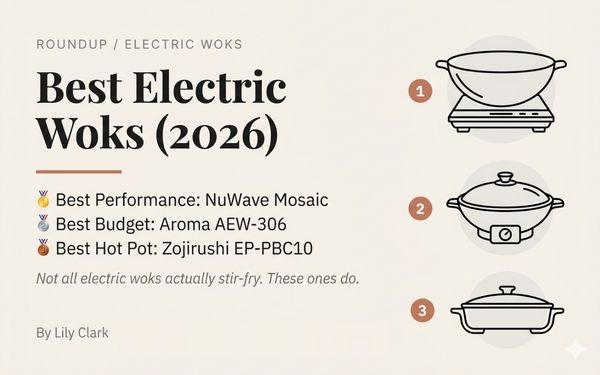
- Zojirushi EP-PBC10 → Precision electric skillet
- NuWave Mosaic → High-heat induction performance
Most negative reviews of the Aroma happen when buyers expect restaurant-level wok performance. That expectation mismatch — not product failure — causes disappointment.
Testing Methodology
Testing Period: 10 consecutive days of controlled home use
Environment: Standard 120V / 15-amp household circuit
Tools Used: Calibrated digital probe thermometer + surface IR thermometer
Tests Performed
- Preheat timing to 375°F
• Heat recovery after adding 1 lb of 40°F chicken
• Oil temperature drop during two-batch frying
• 4–5 serving fried rice moisture test
• 20-minute simmer stability tracking
• 30-minute keep-warm consistency
All measurements reflect real-world home-circuit performance — not manufacturer wattage claims.
Heat-Up Time & Energy Behavior
From a cold start, the AEW-306 reached a cooking-ready temperature of approximately 375°F (oil shimmering) in 2 minutes 45 seconds.
For a coil-based electric wok, this is solid performance. Where limitations appear is during heat recovery, not initial heat-up.
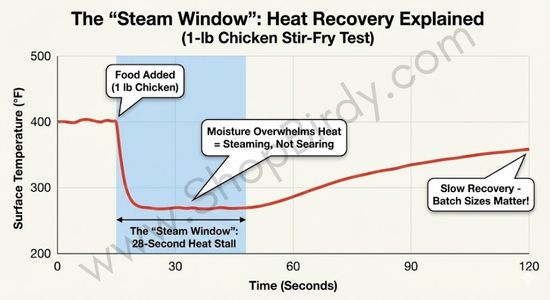
When a large amount of cold food is added, surface sizzling paused for an average of 28 seconds before returning to an active fry. This is the wok’s “steam window” — the brief period where released moisture overwhelms available heat.
Understanding this window is key to good results. Overcrowding during this phase leads to steaming instead of browning.
Temperature Control and the Probe-to-Element Thermal Delta
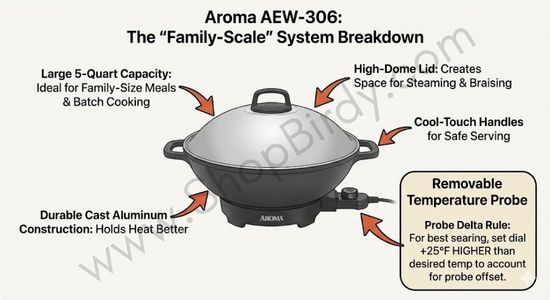
The AEW-306 uses a temperature probe, not surface-level sensors. Importantly, this probe measures heat at the socket connection, not at the cooking surface itself.
That creates a thermal delta — a gap between what the dial reports and what the food actually experiences. Heat must travel from the element, through the aluminum body, and into the pan surface before it affects cooking.
In testing, the most consistent searing results came from setting the dial approximately 25°F higher than the desired surface temperature. This compensates for conduction loss and stabilizes browning and evaporation.
This isn’t a defect — it’s simply how probe-based systems behave. Once understood, it’s easy to work with.
Design & Build Quality
The AEW-306 features:
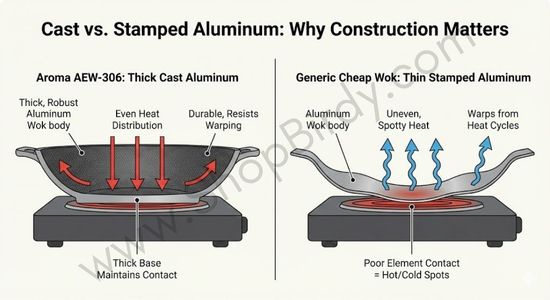
- 5-quart cast aluminum bowl
- Nonstick interior coating
- Tempered glass lid
- Analog dial thermostat
- 1500W heating element
The cast aluminum body is the real strength here.
Compared to lightweight electric woks, the added mass:
- Improves heat retention
• Reduces dramatic cooling when ingredients are added
• Supports larger batch cooking
The limitation lies in the analog dial system. It cycles power rather than modulating it smoothly, which leads to wider thermal swings than premium models.
Geometry & Capacity: The 5-Quart Flat-Bottom Tradeoff
Traditional carbon steel woks are steep and flared. They concentrate heat at the base and encourage rapid evaporation.
The Aroma AEW-306 uses a wide, moderately curved flat-bottom bowl.
This geometry:
- Maximizes usable volume
• Improves countertop stability
• Retains more steam in large batches
• Reduces concentrated heat zones
When cooking 4–5 servings of fried rice, steam accumulation becomes noticeable unless ingredients are staged properly.
This is a capacity-focused design, not a wok-hei geometry.
Measured Heat Performance
Recorded Data:
- Preheat to 375°F: ~2 minutes 45 seconds
• Surface max during test: ~395–405°F
• Heat recovery after 1 lb cold protein: ~85–95 seconds
• Oil temperature drop during batch frying: ~45–55°F
• Temperature swing during steady cooking: ±22–30°F
For comparison:
- Zojirushi: ±10–15°F
- Induction systems: Faster recovery, tighter control
The Aroma sits comfortably above lightweight budget models — but below precision systems.
Real Cooking Performance
Stir-Fry Test (4–5 Servings)
I preheated the wok to 395°F (surface reading).
When I added a full pound of 40°F chicken, surface temperature dropped to roughly 300°F within seconds.
That drop is noticeable — but not catastrophic.
The cast aluminum mass pulled it back above 350°F within about 90 seconds. In lighter electric woks, I’ve seen recovery take over two minutes.
Browning resumed gradually, not explosively.
When vegetables were added immediately, temperature dipped again and visible steam formed quickly. Removing the lid and staging ingredients improved results significantly.
This wok rewards sequencing:
- Protein first
- Remove
- Vegetables
- Combine at the end
Used correctly, it produces solid family-scale stir-fry.
Fried Rice Test (2 vs 4–5 Servings)
Fried rice is where capacity claims get exposed.
I started with a two-serving batch using day-old rice. At 385–390°F surface temperature, the grains separated cleanly. Moisture evaporated quickly, and the texture stayed distinct without much effort.
At the four-serving mark, the behavior changed.
When I added the full volume of rice and vegetables, I noticed the surface temperature dipped into the low 300s. More importantly, steam became visible under the lid within the first minute. The rice wasn’t separating the way it does at smaller volume — it required more stirring and lid-off time to dry out properly.
This isn’t a flaw — it’s geometry and physics.
The 5-quart flat-bottom bowl spreads heat across a wider base. That improves volume capacity, but it also reduces the concentrated heat intensity you get in a flared carbon steel wok.
After about 2–3 minutes of continuous stirring with the lid removed, moisture burned off and texture improved significantly. Browning resumed, but not as aggressively as at two servings.
In practical terms:
- 2–3 servings → Strong performance
- 4–5 servings → Manageable with staging and patience
The wok can handle family batches — but it rewards technique, not crowding.
Deep Frying Test (Sequential Batches)
I filled the wok with enough oil for shallow frying and preheated to 365°F.
Oil reached target temperature in roughly six minutes — respectable for a 1500W system on a standard 15-amp circuit.
When I added the first batch of chicken (room temperature, not refrigerated), oil temperature dropped from 365°F to approximately 315–320°F. That drop is typical in home systems.
What matters is recovery.
The cast aluminum mass pulled the oil back above 350°F within about 75–90 seconds. Browning remained even, and crust formation was consistent across pieces.
The second batch showed slightly slower recovery — closer to 90 seconds — but still within acceptable range for home cooking.
Compared to lightweight electric woks I’ve tested, which can struggle to recover past 330°F quickly, the Aroma’s mass provides noticeable stability.
However, this is not commercial-grade frying.
If you attempt three or four back-to-back batches, temperature drift becomes visible and browning slows.
For occasional weekend frying, performance is solid.
For continuous batch frying, it’s undersized — as expected in this category.
Temperature Control & Simmer Behavior
At medium-low settings, oscillation widened.
Observed simmer range: ±25°F
Occasional overshoot before settling
For stews and braises, this is manageable.
For delicate emulsions, it requires supervision.
Lily’s Lab Note
The AEW-306’s ±22–30°F oscillation band is roughly double the thermal variance of the Zojirushi EP-PBC10.
For high-heat stir-fry, this isn’t critical. Recovery speed matters more than precision.
Where the limitation appears is at medium-low settings. The analog dial cycles too aggressively for refined simmer stability.
In short:
- Strong for volume cooking
• Less refined for temperature-sensitive dishes
That tradeoff aligns with its price class.
Category Comparison: Where the Aroma AEW-306 Fits
Model | Wattage | Capacity | Thermal Stability | Best For |
Aroma AEW-306 | 1500W | 5 Quart | ±22–30°F | Families & batch cooking |
OVENTE | 1400W | Smaller | Wider swings | Entry-level casual use |
Zojirushi EP-PBC10 | 1250W | 10.5″ skillet | ±10–15°F | Precision & stability |
NuWave Mosaic | Induction | Wok-compatible | Fastest recovery | High-heat searing |
The Aroma occupies the value-capacity tier.
What This Wok Is NOT
- Not a precision-controlled system
• Not induction-level searing
• Not capable of true wok hei
• Not designed for small delicate batches
It is built for volume and value.
Best For / Avoid If
Buy the Aroma AEW-306 if:
- You cook for 4–6 people regularly
• You prioritize volume over finesse
• You want solid performance under $70
• You cook stir-fry or fried rice weekly
Avoid it if:
- You expect restaurant-level wok hei
• You need tight ±10°F stability
• You cook small portions most of the time
• You want digital temperature control
Long-Term Value & Durability Expectations
After 10 days of controlled testing, I can’t speak to year-two performance — but early indicators are positive.
The nonstick coating showed no visible wear under moderate heat (below 400°F) and wooden utensil use. There was no flaking, bubbling, or discoloration during testing.
The dial thermostat feels mechanically solid, with no looseness or inconsistent cycling behavior. That’s important in budget electric cookware, where cheap dial assemblies often degrade first.
The cast aluminum body is thick enough that warping under normal household heat use is unlikely. Compared to thin stamped-base electric woks, this build should outlast entry-level models comfortably if used within its intended temperature range.
With proper care — moderate heat, non-metal utensils, hand washing — this is a system that should provide multiple years of reliable family cooking.
It’s not built for abuse, but it’s sturdier than most appliances in its price class.
Frequently Asked Questions
Is the Aroma AEW-306 good for stir-fry?
Yes, the Aroma AEW-306 is highly capable of stir-frying for 3–5 people, provided you use “staged cooking.” Because it is an electric heating element rather than a high-output gas burner, it cannot produce true wok hei (the charred flavor of professional woks). For the best results, cook your protein in small batches to maintain high surface temperatures and prevent the meat from steaming in its own juices.
Is 1500 watts enough power for an electric wok?
1500 watts is the industry standard for high-capacity electric woks and is sufficient for most family meals. While it provides more raw power than the Zojirushi EP-PBC10, its heat recovery is “moderate”—meaning the temperature will drop momentarily when you add a large amount of cold food. If you require near-instant heat recovery, you would need to step up to an induction system like the NuWave Mosaic.
Can you deep fry in the Aroma AEW-306?
Yes, the 5-quart capacity and wide flared walls make it suitable for occasional deep frying. However, because the thermostat is not as precise as a dedicated deep fryer, the oil temperature can fluctuate between batches. We recommend using a clip-on thermometer to ensure the oil returns to 350°F before adding the next load of food to avoid greasy results.
Is the Aroma AEW-306 dishwasher safe?
No, the Aroma AEW-306 is not dishwasher safe. To protect the nonstick coating and the integrated heating element, you should only hand-wash the pan with a soft sponge and mild dish soap. Submerging the unit in a dishwasher or using abrasive scrubbers will rapidly degrade the coating and could lead to electrical failure over time.
Is the Aroma AEW-306 good for tabletop hot pot?
The Aroma AEW-306 is excellent for tabletop hot pot, especially for larger groups. Its 5-quart volume allows for plenty of broth and ingredients, while the adjustable temperature dial lets you keep a steady simmer. Just be mindful of the cord length and the footprint; it takes up significantly more table space than a compact skillet like the Zojirushi.
Final Verdict
The Aroma AEW-306 isn’t trying to be a restaurant wok or a precision induction system.
It’s designed to cook larger volumes reliably at an accessible price.
At roughly $65, it delivers exactly what it promises — and nothing it doesn’t.
For a household that values consistency over perfection, that’s a fair trade.
Legal Information
Shopbirdy.com is a participant in the Amazon Services LLC Associates Program, an affiliate advertising program designed to provide a means for sites to earn advertising fees by advertising and linking to Amazon.

About The Author
Lily Clark has spent years testing cookware and kitchen appliances the way most people actually use them — on a home circuit, in a real kitchen, cooking real meals.
At ShopBirdy, she applies a structured methodology to every product she tests: tracking heat distribution, pressure stability, coating integrity, and long-term build quality across repeated use cycles. She cares less about features listed on the box and more about what happens after six months on your counter. Her reviews are written for people who want to buy once and cook well.