
Updated January 2026 | By Lily Clark
Affiliate Disclosure: This article contains affiliate links. If you purchase through them, I may earn a small commission at no extra cost to you. I only recommend cookware I personally test and cook with in my kitchen
Electric woks have always promised convenience, but rarely control. Most are designed around a simple idea — plug in, get hot — without much consideration for how heat behaves once food actually hits the pan. The result is familiar to anyone who has used one: temperature spikes, long recovery times, and food that steams before it ever browns.
The Nuwave Mosaic Induction Wok approaches the problem differently. Instead of treating the wok as a heated bowl, it treats cooking as an energy-transfer problem — one solved through induction, sensor logic, and precise wattage management. On paper, that sounds impressive. In the kitchen, it raises a more important question: does this level of control actually change how food cooks?
Before getting into results, it helps to frame where the Mosaic fits in the broader category. If you’re still deciding between traditional electric woks, coil-based models, and induction systems, start with our full breakdown here:
Testing Note (Methodology)
Testing Method: I evaluated the Nuwave Mosaic over two weeks of daily cooking using three repeatable tests:
- 1-lb chicken stir-fry recovery test (cold protein added at high heat)
- Fried rice moisture test (day-old rice, high surface evaporation)
- Precision simmer test (aromatics and sauce held below boil)
All comparisons were run against a standard coil-based electric wok and a portable induction plate using the same carbon steel wok where possible.
What You’re Actually Buying: A Cooking System, Not an Appliance
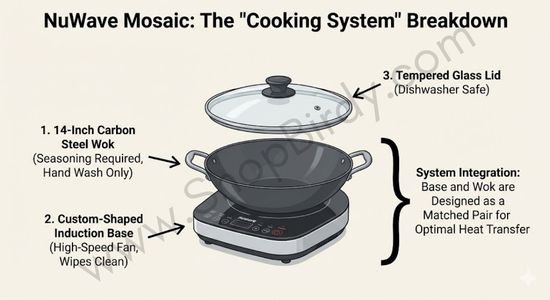
Calling the Mosaic an “electric wok” undersells what it is. This is a dedicated induction base paired with a carbon steel wok, engineered to work as a single unit. The induction coils are positioned closer to the wok than on generic induction plates, and the included metal stand maintains airflow and coil alignment.
That system-level design matters. Induction doesn’t heat air or a buried element — it excites the metal itself. When that metal is carbon steel, heat response becomes immediate and highly dependent on how energy is delivered.
This is where the Mosaic separates itself from conventional electric woks.
Temperature Control Is Only Meaningful If Heat Is Delivered Correctly
The Mosaic offers temperature control from 100°F to 575°F in 5°F increments, adjustable at any point during cooking. But precision isn’t about the number on the display — it’s about how energy is modulated to hold that number under load.
The PWM Problem (and Why It Ruins Food)
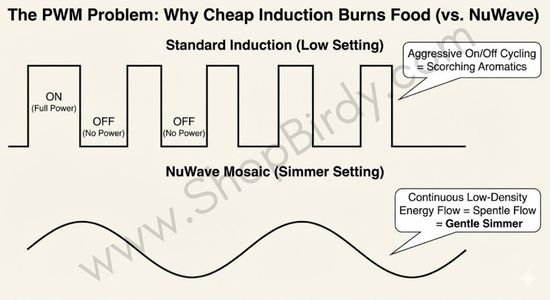
Most inexpensive induction plates rely on Pulse-Width Modulation (PWM) at lower temperatures. Instead of delivering steady low heat, they cycle full power on and off — similar to how a microwave operates. In practice, this creates a boil-then-stop pattern that scorches aromatics, breaks emulsions, and makes gentle simmering unpredictable.
The Mosaic’s lower-temperature “Gourmet” modes are tuned differently. Rather than aggressive cycling, the system delivers a more continuous, lower-density energy stream at reduced wattages. That means oil stays just below smoke, sauces hold without breaking, and aromatics bloom instead of burning.
This distinction becomes obvious below 300°F, where cheaper induction units feel chaotic and the Mosaic feels calm.
Real-World Responsiveness
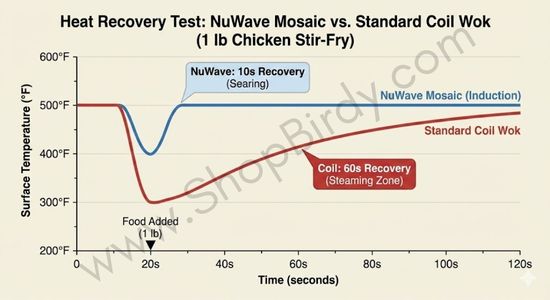
Precision is meaningless without recovery speed. To test this, I used a standard benchmark: adding 1 pound of cold chicken to a fully preheated wok.
- Nuwave Mosaic: resumed a vigorous sizzle in under 10 seconds
- Coil-based electric wok: 45–60 seconds on average
That difference shows up on the plate. Faster recovery means less moisture release, better browning, and shorter cook times. It’s the difference between stir-fry and sauté.
Wattage Flexibility
The Mosaic allows switching between 600W, 900W, and 1500W modes. This isn’t just about portability — it’s about energy density.
- 600W: controlled simmering, dorms, RVs
- 900W: everyday stir-fry for one or two
- 1500W: high-heat searing and rapid evaporation
Because induction is efficient, lower wattage settings remain usable instead of anemic. This makes the Mosaic one of the few high-performance countertop systems that can function reliably on limited circuits.
The Carbon Steel Wok: Performance With Responsibility
The included 14-inch carbon steel wok is not a convenience feature — it’s a performance decision. Carbon steel responds quickly, develops seasoning over time, and handles high surface temperatures without degrading.
It also demands proper care. This is not nonstick cookware. You must season it, dry it thoroughly, and respect heat transitions. In return, you get superior browning and longevity.
Induction Reality: The Pan-Sensing Delay That Makes Tossing Possible
One of induction cooking’s biggest frustrations is pan detection. Most induction burners shut off instantly when a pan is lifted, killing momentum mid-toss.
The Mosaic includes a short pan-sensing delay, allowing roughly 10–15 seconds of lift time before full disengagement. During that window, the magnetic field remains primed and reactivates immediately when the wok returns to the base.
This doesn’t turn induction into gas — but it does allow practical lift-and-return wok movements without fighting the electronics.
Safety and Efficiency
Induction eliminates exposed heating elements and open flame. The Mosaic automatically shuts off when cooking time ends and will not activate without the wok present. Energy efficiency is also high, with most electromagnetic energy transferred directly into the pan rather than wasted as ambient heat.
Who This System Makes Sense For
Best suited for:
- Apartment, dorm, and RV cooks
- Home cooks who value precision over theatrics
- Anyone comfortable maintaining carbon steel
Not ideal for:
- Those expecting commercial flame wok hei
- Toss-heavy restaurant-style technique
- Zero-maintenance cookware preferences
For current pricing and availability, see the product here:
Final Verdict
The Nuwave Mosaic doesn’t compete with traditional electric woks on convenience alone. It redefines the category — not as a single appliance, but as a high-performance countertop cooking system designed around heat behavior, not marketing claims.
It won’t replace a gas burner in a restaurant kitchen. What it does offer is control, responsiveness, and consistency that most electric woks simply cannot approach. For discerning home cooks who understand that heat management matters more than flame imagery, the Mosaic stands apart.
Legal Information
Shopbirdy.com is a participant in the Amazon Services LLC Associates Program, an affiliate advertising program designed to provide a means for sites to earn advertising fees by advertising and linking to Amazon.

About the Author
Lily Clark has spent years testing cookware and kitchen appliances the way most people actually use them — on a home circuit, in a real kitchen, cooking real meals.
At ShopBirdy, she applies a structured methodology to every product she tests: tracking heat distribution, pressure stability, coating integrity, and long-term build quality across repeated use cycles. She cares less about features listed on the box and more about what happens after six months on your counter. Her reviews are written for people who want to buy once and cook well.