Updated January 2026 | By Lily Clark
Affiliate Disclosure: This article contains affiliate links. If you purchase through them, I may earn a small commission at no extra cost to you. I only recommend cookware I personally test and cook with in my kitchen
On paper, the Ninja Foodi and the Instant Pot look like they’re solving the same problem: fewer appliances, faster meals, and more flexibility in a single countertop machine.
In real kitchens, they behave very differently.
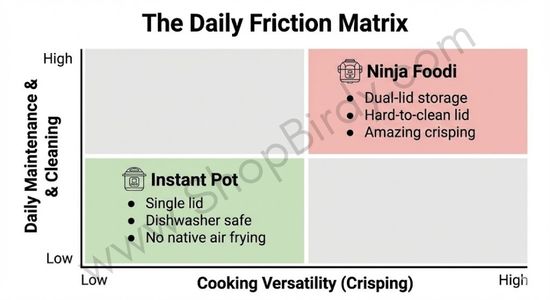
This ninja foodi vs instant pot comparison isn’t about features lists or presets. It’s about daily friction—what happens after the novelty fades and you’re cooking on a Tuesday night, tired, hungry, and not interested in wrestling with your appliances.
Before we go deep, it’s worth anchoring this comparison inside the bigger landscape of modern cookers.
If you’re still deciding which type of cooker belongs in your kitchen, start with our Best Multi-Cookers & Pressure Cookers pillar. It explains how pressure cookers, hybrid ovens, and multi-cookers differ at a system level—so this comparison makes more sense.
With that context, let’s talk about why these two machines feel so different to live with.
The Fundamental Difference
The Ninja Foodi and the Instant Pot are built around opposite thermal priorities.
- Instant Pot is a pressure cooker first. Everything else is secondary.
- Ninja Foodi is a dry-heat appliance first that happens to pressure cook.
That single distinction explains nearly every trade-off below.
Pressure Cooking: Calm vs Complicated
Instant Pot Under Pressure
Instant Pot models—especially the core lineup from Instant Pot—are engineered around pressure stability.
What that means in practice:
- Consistent ramp-up behavior
- Predictable sealing
- Simple lid mechanics
- Fewer failure points
For soups, stews, beans, rice, and braises, the Instant Pot feels boringly reliable. Once you learn deglazing and liquid minimums, it fades into the background.
That’s a compliment.
Ninja Foodi Under Pressure
The Ninja Foodi can pressure cook, but it’s not its native state.
Why?
- Heavier lid assemblies
- More seals and moving parts
- Taller body with more internal air volume
Pressure cooking works—but it feels more like one mode among many, not the machine’s core identity. Ramp-up is often slower, and pressure release requires more patience.
It’s capable, but not elegant.
Thermal Recovery Audit: Cold Start vs. Post-Sauté Pressure
Claims about which machine “heats faster” only make sense if we specify the starting thermal state.
Pressure cookers don’t reset to zero between steps. The pot retains thermal memory, and how a machine recovers from that matters more than raw wattage.
Below is the distinction most comparisons miss.
Scenario A: Cold Start (Water Only)
- Instant Pot:
Bottom heating plate brings liquid to a boil steadily. Pressure build is predictable and repeatable. - Ninja Foodi:
Slightly faster initial ramp due to more aggressive heating elements, but the difference is modest.
In cold-start tests, both machines perform similarly enough that speed differences are rarely decisive.
Scenario B: After Sautéing (Hot Pot, Fond Present)
This is where behavior diverges.
- Instant Pot:
After sautéing, the stainless steel pot retains heat evenly. When pressure mode begins, the cooker transitions smoothly from stored thermal energy to steam generation. Deglazing is critical, but recovery is controlled. - Ninja Foodi:
The ceramic-coated pot cools faster during the mode switch, while the system simultaneously prepares top-mounted heating components. Pressure ramp-up can take longer than expected, and hotspots from residual fond increase scorch risk if liquid distribution isn’t perfect.
In other words:
- The Foodi may start hot
- But its thermal recovery curve is less predictable after sautéing
This explains why some users report inconsistent “time to pressure” on the Foodi depending on what happened before pressure cooking, while Instant Pot behavior remains more uniform.
For an appliance used daily, predictable thermal recovery matters more than peak heating speed.
The Air-Fry Advantage
This is the Foodi’s headline feature—and it’s real.
After pressure cooking, the Foodi can:
- Immediately switch to dry heat
- Evaporate surface moisture
- Brown, roast, or crisp without moving food
Chicken thighs with crisp skin.
Pot roast with real edge browning.
Wings without a second appliance.
Instant Pot cannot do this without:
- A separate air fryer
- Or transferring food to an oven
If crispy texture matters often, this is the Foodi’s strongest argument.
The Dual-Lid Storage Nightmare
Here’s the flaw that doesn’t show up in spec sheets.
The Storage Paradox
The Ninja Foodi has:
- A permanent, hinged air-fry lid
- A second, removable pressure lid
This creates an immediate question:
Where does that pressure lid live when you’re air-frying?
In real kitchens:
- It clogs a drawer
- Sits awkwardly on the counter
- Or gets shoved somewhere inconvenient
Instant Pot has one lid.
The Foodi has one permanent lid and one homeless lid.
This seems minor—until you cook daily.
The Starch–Grease Hygiene Loop
Cleaning isn’t just about effort. It’s about cross-contamination physics.
Ninja Foodi Lid Reality
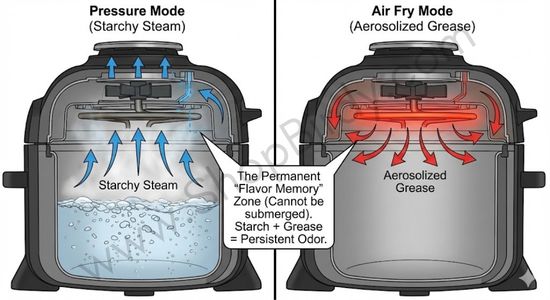
The Foodi’s permanent lid houses:
- A fan
- A heating coil
- Vents and crevices you can’t submerge
During pressure cooking:
- Starchy steam is forced upward into those cavities
During air frying:
- Grease is aerosolized and blown into the same spaces
Over months, this creates a starch–grease feedback loop:
- Starch dries and hardens
- Grease polymerizes
- Odors become permanent
You can wipe what you can reach—but you can’t deep-clean the internals.
Instant Pot Lid Advantage
Instant Pot lids:
- Detach completely
- Can be soaked, boiled, or dishwashed
- Don’t house heating elements
If you’ve ever wondered why some Foodi meals start tasting like “everything you’ve cooked before,” this is why.
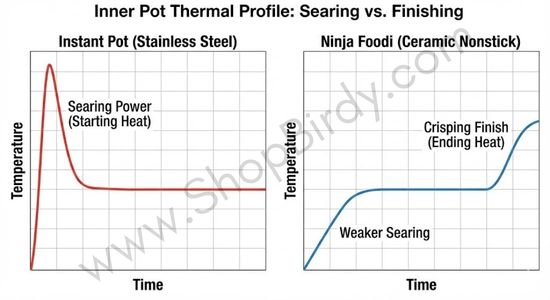
Inner Pot Geometry & Searing Power
Default inner pots matter more than people think.
Instant Pot: Stainless Steel by Default
Most Instant Pots ship with:
- 3-ply stainless steel inner pots
- Higher thermal mass
- Better heat retention
This makes them excellent for:
- Searing meat
- Building fond
- Developing Maillard reaction before pressure cooking
Stainless steel gives you starting heat authority.
Ninja Foodi: Ceramic-Coated Nonstick
Standard Ninja Foodis ship with:
- Ceramic-coated nonstick pots
- Faster release
- Lower thermal mass
These are great for:
- Eggs
- Delicate foods
- Easy cleanup
But they are weaker at:
- High-energy searing
- Fond development
- Aggressive pre-pressure browning
In short:
- Instant Pot is better at starting heat
- Ninja Foodi is better at finishing heat
If you want the deeper science behind this, see Stainless Steel vs. Ceramic Inner Pot Material: The Stick Test, which breaks down why these materials behave so differently under pressure.
Steam-Vent Safety & Cabinet Reality
Steam doesn’t just disappear—it goes somewhere.
Ninja Foodi Vent Trajectory
Because the Foodi lid is hinged:
- Residual steam vents upward and forward
- Opening the lid releases a curtain of steam
- That steam often hits your face or upper cabinets
In kitchens with low cabinets, this becomes a long-term issue:
- Moisture damage
- Warping wood
- Discolored finishes
Instant Pot Control
Instant Pot lids can be:
- Lifted
- Tilted away
- Removed entirely before opening
You control where the steam goes.
This matters more over years than most buyers expect.
Ergonomic Torque: Why the Hinged Lid Needs Counter Clearance
When people complain that the Ninja Foodi lid is “heavy,” they’re describing a symptom, not the problem.
The real issue is ergonomic torque.
Because the Foodi’s air-fryer lid is permanently hinged at the back, opening it isn’t a vertical lift—it’s a rotational movement. That lid acts as a lever arm. The farther the lid swings back, the more torque is applied at the hinge point.
Why this matters in real kitchens:
The lid doesn’t just go up — it goes up and backward
That motion requires rear counter clearance, not just vertical space
In standard U.S. kitchens with 12–13 inch upper cabinets, the hinge arc often places the steam exhaust directly under woodwork
When you open the lid after pressure cooking or air frying, residual steam is released along that arc. Over time, that repeated exposure can:
Warp cabinet veneers
Discolor finishes
Loosen laminate seams
By contrast, an Instant Pot lid lifts straight off. You can:
Tilt it away from cabinets
Redirect steam safely
Remove it entirely from the cooking zone
This isn’t about convenience—it’s about kitchen geometry compatibility.
If your counter depth or cabinet clearance is limited, the Foodi’s hinged-lid torque becomes a long-term friction point, not just a momentary annoyance.
Rice Performance
Rice exposes system weaknesses quickly.
- Instant Pot rice is fast, but pressure-based
- Ninja Foodi rice behaves similarly under pressure
- Neither is optimized for rice perfection
If rice quality is a priority, this deserves its own decision tree. We cover it fully in Zojirushi vs Instant Pot: Which Is Better for Rice?, where pressure physics vs thermal precision becomes unavoidable.
Accessories: More Important for the Foodi
Because the Ninja Foodi is more complex, accessories matter more.
- Trivets to manage hotspots
- PIP containers to avoid scorching
- Careful cleaning tools for the lid interior
If you want to understand which add-ons actually improve reliability (and which just add clutter), see Best Pressure Cooker Accessories (A Technical Reliability Audit).
Instant Pot needs fewer crutches. The Foodi benefits from them.
The Correct Product Picks (To Avoid These Flaws)
If you want to choose smarter within each brand, these are the versions that reduce the pain points above.
Best Instant Pot Choice
Instant Pot Duo Crisp with Ultimate Lid
Why it’s the fix:
- Single integrated lid
- No “homeless” pressure lid
- Easier storage
- Retains Instant Pot pressure stability
This model directly addresses the Foodi’s dual-lid problem.
Best Ninja Alternative
Ninja Foodi PossibleCooker PRO
Why it makes sense:
- Focuses on oven, slow-cook, and stovetop-style cooking
- Avoids pressure + air-fry lid complexity
- Keeps Ninja’s dry-heat strengths without the hygiene trap
If you like Ninja’s food results but hate the lid chaos, this is the calmer option.
Final Verdict: Which One Fits Your Kitchen?
Choose Instant Pot if:
- Pressure cooking is your primary use
- You value simplicity and predictability
- You batch cook soups, beans, rice, and stews
- You want minimal storage and cleaning friction
Instant Pot is a system you can forget about.
Choose Ninja Foodi if:
- You care deeply about crisp finishes
- You hate transferring food between appliances
- You’re disciplined about cleaning
- You have counter space and cabinet clearance
The Foodi is powerful—but it demands attention.
The Honest Take
The ninja foodi vs instant pot decision isn’t about which one cooks better food.
It’s about where you want the complexity to live.
- Instant Pot puts complexity in the food.
- Ninja Foodi puts complexity in the machine.
Six months in, when habits replace excitement, one of those will feel right—and the other will feel exhausting.
Choose accordingly.
Legal Information
Shopbirdy.com is a participant in the Amazon Services LLC Associates Program, an affiliate advertising program designed to provide a means for sites to earn advertising fees by advertising and linking to Amazon.

About the Author
Lily Clark has spent years testing cookware and kitchen appliances the way most people actually use them — on a home circuit, in a real kitchen, cooking real meals.
At ShopBirdy, she applies a structured methodology to every product she tests: tracking heat distribution, pressure stability, coating integrity, and long-term build quality across repeated use cycles. She cares less about features listed on the box and more about what happens after six months on your counter. Her reviews are written for people who want to buy once and cook well.