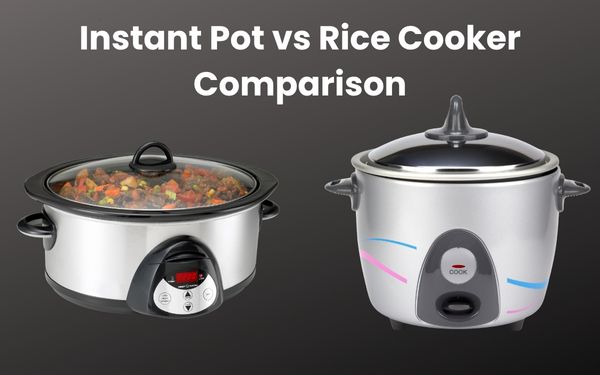
Rice looks simple. It isn’t.
Once you move past “edible” and start caring about grain integrity, aroma, texture, and repeatability, rice becomes one of the most technically demanding foods in the kitchen. That’s why the debate between Instant Pot and Zojirushi never really goes away.
These two machines are built on entirely different cooking philosophies:
- Instant Pot treats rice as one job among many.
- Zojirushi treats rice as the job.
Before we get deep into the mechanics, it helps to anchor this comparison inside the bigger ecosystem of modern cookers.
If you’re still deciding which type of appliance belongs on your counter at all, start with our Best Multi-Cookers & Pressure Cookers pillar. It explains where single-purpose tools like rice cookers outperform multi-cookers—and where they don’t.
With that context set, let’s talk about why zojirushi vs instant pot isn’t a fight between “good” and “bad,” but between pressure physics and thermal control.
The Short Verdict
- Zojirushi is better for rice specifically—especially if you cook it often and care about grain-level perfection.
- Instant Pot is better if rice is just one item in a broader cooking rotation and you value speed and versatility.
If rice is a side dish, Instant Pot is fine.
If rice is the foundation of your meals, Zojirushi earns its keep.
Now let’s explain why.
How These Two Machines Actually Cook Rice
Instant Pot: Pressure as the Primary Tool
Instant Pot cooks rice using:
- A bottom heating plate
- Pressurized steam
- Fixed time presets
Water is heated aggressively, pressure builds quickly, and the rice cooks fast. This approach is efficient—but blunt.
Zojirushi: Heat Management as a System
Zojirushi rice cookers are thermal systems, not timers.
They use:
- Gradual heat ramping
- Pre-soak phases
- Steam finishing
- Active keep-warm control
Rice isn’t rushed. It’s guided.
The Hidden Difference You Taste First: Starch Shear
This is the missing explanation in most comparisons.
What Is Starch Shear?
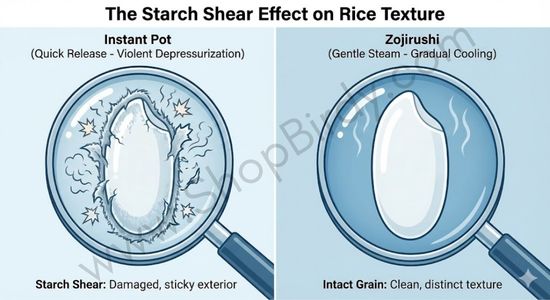
Rice grains absorb water during cooking. Under pressure, that water is trapped inside the kernel.
When you perform a Quick Release on an Instant Pot:
- Internal pressure drops instantly
- Moisture inside the grain expands violently
- The outer starch layer ruptures microscopically
This is called Starch Shear.
What It Feels Like on the Plate
- Slightly fuzzy or sticky exterior
- Grains cling together more easily
- Texture feels less polished
The rice isn’t ruined—but it’s different.
Zojirushi avoids this because:
- It doesn’t use pressure
- Steam dissipates gradually
- Grains cool without shock
👉 This is why Zojirushi rice often tastes cleaner and more distinct, even when water ratios are identical.
Why Whisper-Quiet Release Matters
Not all Instant Pots behave the same.
The Instant Pot Duo Plus improves rice quality because:
- It uses a Whisper-Quiet steam release
- Pressure drops more gently
- Starch shear is reduced (not eliminated, but softened)
If you’re serious about rice in an Instant Pot, this model is the correct starting point.
Heat Source Geometry: Induction Heating vs Heating Plate
This is where the two machines diverge permanently.
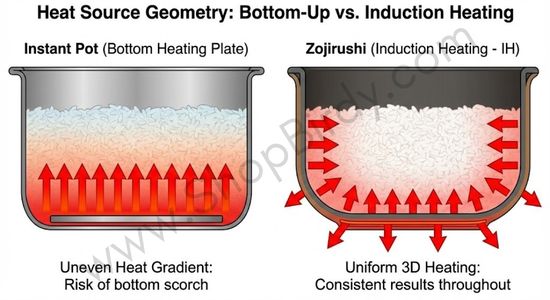
Instant Pot: Bottom-Up Heat Gradient
- Heat enters from a single plate at the bottom
- The bottom layer is always hotter
- Convection is limited
This creates a vertical thermal gradient:
- Bottom grains cook harder
- Top grains rely on steam transfer
Zojirushi IH: The Pot Becomes the Heater
Mid-to-high-end Zojirushis (including the gold-standard Zojirushi NP‑HCC10/18) use Induction Heating (IH).
IH turns the entire inner pot into the heating element.
That means:
- Heat is uniform across all surfaces
- Water circulates naturally
- Grains stay in motion instead of settling
This eliminates:
- Bottom scorching
- Dense lower layers
- Texture gradients
This is why IH rice feels “even” in a way pressure-cooked rice rarely does.
The Sugar Gelatinization Curve (Why Zojirushi Starts So Slowly)
This is the part most comparisons skip—and it’s where Zojirushi quietly wins.
High-end Zojirushi models don’t rush to a boil. In fact, many spend 15–20 minutes doing what looks like “nothing” before active cooking begins.
That phase is deliberate.
Zojirushi uses a controlled pre-soak temperature window—warm enough to activate starch hydration but below boiling. During this stage, water slowly penetrates the rice kernel before the exterior gelatinizes.
Why that matters:
- Rice starch gelatinizes unevenly if the outer layer cooks before the center hydrates
- Once gelatinized, the exterior becomes a barrier
- Any dry center that remains at that point never fully recovers
By warming the water gradually, Zojirushi ensures:
- Even hydration from core to surface
- Uniform starch swelling
- Cleaner grain separation
This is sometimes called the sugar gelatinization curve—the temperature window where starch absorbs water without rupturing.
An Instant Pot skips this phase entirely. Pressure cooking drives the rice straight through gelatinization at speed, which is efficient—but not gentle.
That difference alone explains why Zojirushi rice feels rounder, softer, and more cohesive, even when water ratios match.
Neuro-Fuzzy Logic vs Static Presets
Both machines use “programs.” Only one adapts.
Instant Pot: Static Logic
- Timer starts
- Heat follows preset curve
- Machine assumes you measured perfectly
If you add slightly too much water, Instant Pot doesn’t know. It just runs the script.
Zojirushi: Neuro-Fuzzy Logic
Zojirushi’s Neuro-Fuzzy system actively corrects user error.
It uses sensors to detect:
- Ambient room temperature
- Heat absorption rate of the rice
- Delayed or early temperature spikes
If you add too much water:
- Temperature rises more slowly
- The cooker extends cook time
- Excess moisture is gently evaporated
This is why Zojirushi rice is forgiving—and why it feels “smarter” even when you don’t do anything differently.
Gasket Odor & Cross-Contamination
This is the reason many Instant Pot owners eventually buy a rice cooker.
Instant Pot Reality
Instant Pot uses:
- Silicone gaskets
- Plastic lid assemblies
Even with multiple rings, aromatic compounds from:
- Curry
- Chili
- Garlic
- Cumin
tend to linger.
Your white rice may taste faintly like last night’s dinner.
Zojirushi Reality
Zojirushi lids are:
- Designed specifically for steam and starch
- Built with minimal odor-retentive materials
- Optimized for neutral flavor retention
Your rice tastes like rice. Every time.
This alone is enough for many households to justify a dedicated machine.
Inner Pot Material Matters More Than You Think
Rice texture is influenced heavily by pot material.
- Instant Pots use stainless steel
- Zojirushi uses thick nonstick or ceramic-coated pots designed for IH
If you want the deeper breakdown of why pot surfaces change sticking, scorching, and release behavior, see Stainless Steel vs. Ceramic Inner Pot Material: The Stick Test.
This explains why Instant Pot rice sometimes sticks at the bottom while Zojirushi rarely does.
Size Changes the Equation
Rice behaves differently depending on diameter and depth.
- Larger pots require more water
- Smaller pots concentrate heat faster
- Headspace affects steam distribution
If you’re unsure which capacity works for your household, 6-Quart vs. 8-Quart: The Technical Pressure Cooker Size Guide explains how size alters rice outcomes in pressure cookers specifically.
This is especially important if you’re cooking rice for one or two people.
Accessories Can Help—but Only So Much
Some Instant Pot users improve rice by:
- Using Pot-in-Pot containers
- Adding trivets
- Using glass lids for resting
These techniques can help, but they’re workarounds.
If you want to understand which accessories actually improve reliability (and which ones don’t), see Best Pressure Cooker Accessories (A Technical Reliability Audit).
When Instant Pot Still Makes Sense for Rice
Instant Pot wins if:
- Rice is a side dish
- Speed matters more than nuance
- You cook many other foods regularly
- Counter space is limited
It makes good enough rice with minimal fuss.
When Zojirushi Is the Correct Tool
Zojirushi wins if:
- Rice is eaten daily
- Texture matters
- You cook multiple grain types
- You hate variability
- You don’t want lingering odors
It’s not faster. It’s better.
Product Recommendations (The Honest Picks)
Best Zojirushi (Gold Standard)
Zojirushi NP‑HCC10/18
This is the entry point into true IH cooking and represents the jump from “rice cooker” to “thermal system.”
Best Instant Pot for Rice
Instant Pot Duo Plus
The Whisper-Quiet Release makes a measurable difference for rice texture.
The Rice-Snob Speed Trade-Off (Why Zojirushi Is Intentionally Slow)
This is where we need to be honest.
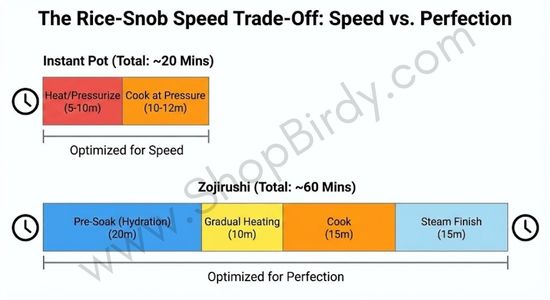
A typical Induction Heating Zojirushi cycle takes 50–60 minutes.
An Instant Pot can deliver rice in 18–22 minutes.
That isn’t a flaw.
It’s a philosophy.
Zojirushi is the Slow Food movement of rice cookers.
That extended cycle allows:
- Full pre-soak hydration
- Gradual starch gelatinization
- Gentle evaporation of excess moisture
- Cooling without pressure shock
Nothing is rushed. Nothing is forced.
The Instant Pot wins on raw speed. There’s no arguing that. If dinner needs to happen now, pressure cooking is the faster tool.
But the Zojirushi’s slower cycle is a deliberate engineering choice, not inefficiency. It trades time for:
- Better starch conversion
- Reduced mechanical stress on the grain
- Zero “starch shear” from rapid depressurization
Think of it this way:
- Instant Pot is optimized for weeknight efficiency
- Zojirushi is optimized for grain perfection
If you eat rice occasionally, speed wins.
If rice is cultural, daily, or foundational, the Zojirushi’s patience pays dividends.
Final Take
The zojirushi vs instant pot debate isn’t about brand loyalty.
It’s about pressure vs precision.
- Instant Pot uses pressure to cook rice quickly.
- Zojirushi uses heat management to cook rice correctly.
If rice is occasional, Instant Pot is sufficient.
If rice is foundational, Zojirushi is unmatched.
Once you understand the physics—starch shear, induction heating, fuzzy logic, and odor retention—the decision becomes obvious.
Choose the tool that respects how often rice shows up on your plate.
The real difference in the zojirushi vs instant pot debate isn’t technology—it’s intent: Instant Pot is built to cook fast, while Zojirushi is built to cook rice correctly, even when that means taking an extra 30 minutes.
Legal Information
Shopbirdy.com is a participant in the Amazon Services LLC Associates Program, an affiliate advertising program designed to provide a means for sites to earn advertising fees by advertising and linking to Amazon.

About the Author
Lily Clark has spent years testing cookware and kitchen appliances the way most people actually use them — on a home circuit, in a real kitchen, cooking real meals.
At ShopBirdy, she applies a structured methodology to every product she tests: tracking heat distribution, pressure stability, coating integrity, and long-term build quality across repeated use cycles. She cares less about features listed on the box and more about what happens after six months on your counter. Her reviews are written for people who want to buy once and cook well.