Updated January 2026 | By Lily Clark
Affiliate Disclosure: This article contains affiliate links. If you purchase through them, I may earn a small commission at no extra cost to you. I only recommend cookware I personally test and cook with in my kitchen.
If you cook for one or two people, buying a full-size 6-quart or 8-quart electric pressure cooker often feels like overkill.
It eats counter space.
It demands more liquid than your recipe actually needs.
And in the worst cases, it fails before cooking even begins.
After years of testing pressure cookers across sizes, brands, and kitchens, one pattern keeps repeating:
For small households, the 3-quart class works with physics instead of against it.
Before we get to model recommendations, let’s talk about why size matters so much.
Why Big Pressure Cookers Fail Small Meals (The Real Physics)
The issue isn’t wattage or features.
It’s vapor density + thermal lag.
Liquid-to-Vapor Ratio (The Part Most Guides Miss)
To build pressure, a cooker must convert liquid into steam fast enough to:
- Fill the empty headspace
- Raise internal pressure
- Trigger the float valve
In a 6-quart or 8-quart pot, the bottom surface area is large and the headspace is huge.
If you’re cooking for one person, you may only have ½ cup of liquid.
That liquid must:
- Heat to boiling
- Continue boiling long enough to generate vapor
- Fill a large volume of empty space
In a 3-quart pot, that same ½ cup reaches the required vapor density quickly.
In a large pot, it often doesn’t.
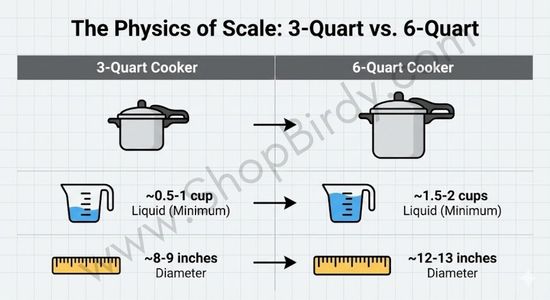
Thermal Lag: Why Burn Happens Before Pressure
Here’s the missing detail most people never hear.
In a large pot with very little food:
- The heating element must run longer at 100% power
- Because it’s heating a larger metal surface area
- With less liquid acting as a heat buffer
This extended “ramp-up” time is when things go wrong.
By the time enough vapor forms:
- The bottom of the pot may already be scorching
- Food sugars start sticking
- The cooker detects overheating and throws a Burn error
This is why people see messages like Instant Pot Burn Message: Why It Happens & How to Fix It on tiny recipes inside big machines.
A 3-quart pot shortens that ramp-up window dramatically.
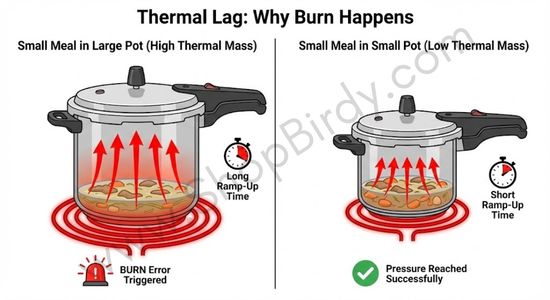
The Physics of Scale (Fast Decision Table)
Pot Size | Minimum Liquid Needed | Typical Diameter |
3-Quart | ~0.5–1 cup | ~8–9 inches |
6-Quart | ~1.5–2 cups | ~12–13 inches |
That 4-inch width difference is the line between:
- “Fits in a cabinet”
- and “Lives on the counter forever”
Lily’s Note: If you’re currently using a 6-quart pot for 1-person meals, you’re likely fighting a losing battle with vapor density.
We’ve audited how different brands handle these thermal requirements in our Best Multi-Cookers & Pressure Cookers: A Technical Audit.
If you’re shopping for a new unit, look for models that include a spare gasket in the box—a sign the manufacturer respects the system’s long-term wear.
One Trade-Off You Should Know: 3-Quart Thermal Recovery
Smaller pots are more efficient—but they cool faster once opened.
Because thermal mass is lower:
- Heat escapes almost immediately
- Pressure rebuild takes longer if you pause
What This Means in Real Cooking
If you’re doing multi-stage cooking:
- Sauté onions
- Brown meat
- Then pressure cook
You need to move with intent.
If you leave the lid open too long:
- The pot cools
- Pressure build slows
- Cook time stretches
This isn’t a flaw—it’s the cost of efficiency. Prep first, cook smoothly.
Best Small Electric Pressure Cookers for 1–2 People
🏆 Best Overall: Instant Pot Duo Mini 7 in 1
This is the most reliable best small electric pressure cooker for one or two people.
Why It Works So Well at This Size
The Duo Mini isn’t a stripped-down model.
It uses the same pressure logic and safety systems as the full-size Duo—scaled correctly.
In real kitchens, that means:
- Rice finishes without scorching
- Lentils hold shape
- Oatmeal doesn’t foam aggressively
- Pressure builds quickly with less liquid
The one-touch programs are actually tuned for the pot size, which matters more than feature count.
Long-Term Ownership (This Is Where Instant Pot Wins)
Pressure cookers are high-wear systems. Gaskets, valves, and rings matter.
Before buying any cooker, understand When to Replace Pressure Cooker Gasket: The Science of Sealing. Instant Pot replacement parts are widely available, affordable, and consistent.
That’s not marketing—it’s lifecycle management.
Perfect for:
Daily cooking, rice, dal, oatmeal, small curries, meal prep for one.
Best for Quiet, Tech-Forward Kitchens: Instant Pot Duo Plus
The Duo Plus is for people who want clarity and calm.
What Feels Different in Daily Use
- Large LCD shows pressurizing, cooking, and releasing stages
- Whisper-Quiet steam release removes the sudden hiss
- Sous Vide and Sterilize modes are actually usable at this scale
If you’ve ever worried whether pressure is fully released, this cooker makes it obvious. Pair this with understanding Pressure Cooker Lid Won’t Open? (Vacuum Lock vs. Pressure Fixes) and most beginner anxiety disappears.
Perfect for:
Apartment kitchens, late-night cooking, users who want visual confirmation.
Best for Maximum Versatility (With Real Warnings): Ninja Foodi Mini 10 in 1
This is the one exception to the 3-quart rule.
If you want pressure cooking + air frying in one machine, the Ninja Foodi Mini is unmatched.
Why People Love It
Its TenderCrisp system lets you:
- Pressure cook to lock in moisture
- Air fry to finish with texture
In practice:
- Chicken thighs finish juicy and crisp
- Wings skip the oven
- Small roasts make sense for two people
Ergonomic Reality Check (Read Before Buying)
1. Lid Weight & Clearance
The air-fryer lid is:
- Heavy
- Hinged
- Permanently attached
In small kitchens with low cabinets, you may not be able to fully open it without pulling the unit to the counter edge.
2. Steam Vent Direction (Often Overlooked)
The Ninja Foodi Mini is taller than the Duo Mini.
That means:
- The steam vent sits closer to upper cabinets
- Concentrated vapor releases upward
If you vent near wood cabinetry, moisture damage happens faster than with shorter units. Always rotate the cooker away from cabinets before releasing pressure.
Perfect for:
Couples who want one appliance to replace several—and have the space to manage it safely.
🚫 Why We Skip Generic 2-Quart Cookers
Cheap 2-quart cookers look perfect on paper.
In practice, they usually fail early.
The Real Issue Isn’t Cooking — It’s Support
Common problems:
- Thin nonstick coatings
- Inconsistent heating
- Poor pressure calibration
But the real failure point is replacement parts.
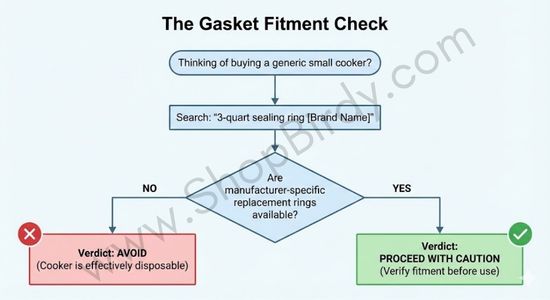
The Gasket Fitment Check (Do This Before Buying)
Before buying any small-brand cooker, search:
“3-quart sealing ring [Brand Name]”
Then verify:
- Gasket thickness
- Groove depth
- Manufacturer-specific fit
⚠️ Important: “3-quart” is a volume, not a universal gasket size.
An Instant Pot 3-quart ring will rarely fit Ninja or generic brands.
If the manufacturer doesn’t sell their own replacement rings, the cooker is effectively disposable.
If steam starts escaping later, you’ll want to understand Pressure Cooker Leaking Steam from Valve? Signal vs. Symptom—and you can’t fix what you can’t replace.
Counter Footprint Reality (Why Inches Matter)
- 3-quart: ~8–9 inches wide
- 6-quart: ~12–13 inches wide
That 4-inch difference decides:
- Cabinet storage vs permanent counter residency
- Ease of cleaning
- Daily convenience
Depth matters less than diameter.
How to Choose the Best Small Electric Pressure Cooker (Quick Logic)
- Mostly rice, lentils, daily meals → Duo Mini
- Want quiet operation + display clarity → Duo Plus
- Want pressure + air fry in one → Ninja Foodi Mini
If you cook small portions often, avoid “buying big just in case.”
Pressure cooking rewards scale matching.
Final Take
The best small electric pressure cooker isn’t about features—it’s about physics alignment.
When pot size matches food volume:
- Pressure builds faster
- Liquid requirements make sense
- Burn errors disappear
- Texture improves
For 1–2 people, that usually means 3 quarts done right—not smaller, and not bigger “just in case.”
Choose the size that works with vapor density and thermal behavior, and pressure cooking becomes boringly reliable—which is exactly what you want.
Legal Information
Shopbirdy.com is a participant in the Amazon Services LLC Associates Program, an affiliate advertising program designed to provide a means for sites to earn advertising fees by advertising and linking to Amazon.
About the Author

Lily Clark has spent years testing cookware and kitchen appliances the way most people actually use them — on a home circuit, in a real kitchen, cooking real meals.
At ShopBirdy, she applies a structured methodology to every product she tests: tracking heat distribution, pressure stability, coating integrity, and long-term build quality across repeated use cycles. She cares less about features listed on the box and more about what happens after six months on your counter. Her reviews are written for people who want to buy once and cook well.