Updated January 2026 | By Lily Clark
Affiliate Disclosure: This article contains affiliate links. If you purchase through them, I may earn a small commission at no extra cost to you. I only recommend cookware I personally test and cook with in my kitchen.
When a pressure cooker won’t seal, most people assume something is “broken.”
It usually isn’t.
A pressure cooker is a closed thermodynamic system. If it fails to build pressure, one of three things is happening:
- Heat isn’t being delivered correctly
- Pressure is escaping faster than it’s being created
- The system never reaches the conditions required to seal
That’s it. No mystery. No bad luck.
Let’s walk through the real reasons—starting with the ones most reviews never explain.
What “Building Pressure” Actually Means
Pressure doesn’t appear magically when you press a button.
In an electric pressure cooker, pressure builds only when:
- Liquid reaches a rolling boil
- Steam production exceeds steam loss
- The sealing system becomes hermetic under heat and torque
If any part of that chain breaks, the cooker stalls in the “preheat” phase forever.
So when someone says “my pressure cooker is not building pressure,” what they really mean is:
“The system is leaking energy or steam faster than it can stabilize.”
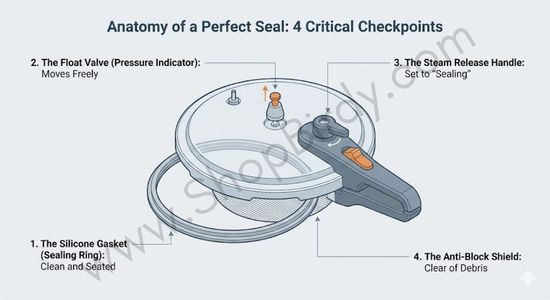
Reason #1: The Gasket Is Installed — But Not Functioning
This is the most common failure point, and it’s rarely obvious.
What people check
- Is the gasket present?
- Is it clean?
What actually matters
- Material density
- Thermal expansion
- Shape memory
Physical Integrity Check: The Snap-Back Test
Before replacing anything, do a simple physical test.
Remove the gasket and stretch a small section outward by about two inches, then release it.
A high-density polymer gasket should snap back instantly to its original diameter. The rebound should feel decisive, not sluggish.
If the gasket:
- Stays slightly elongated
- Feels soft or “gummy”
- Returns slowly instead of snapping back
…the polymer has lost its cross-linked integrity.
At that point, the gasket will never form a true hermetic seal under torque—no matter how clean it looks or how carefully you reinstall it. Heat causes further expansion, and the seal collapses exactly when pressure is supposed to stabilize.
This is why sealing problems often feel random. The material failure isn’t visible—it’s mechanical.
Low-grade silicone gaskets expand unevenly under heat. After repeated cycles, they lose their ability to rebound and maintain a uniform seal. The cooker may look sealed, but steam is bleeding out microscopically around the rim.
This is why a cooker can:
- Seal sometimes
- Fail randomly
- Work better with heavier foods than lighter ones
If your cooker used to seal and now struggles—the gasket is suspect, even if it looks fine.
Analyst rule:
A pressure cooker without gasket integrity is not a pressure cooker. It’s a pot with ambitions.
Reason #2: Lid Lock ≠ Pressure Seal
Many users confuse lid locking with pressure sealing. They are not the same thing.
- Lid lock = mechanical safety
- Pressure seal = thermal + material behavior
A lid can lock perfectly while the gasket fails to expand into a true hermetic seal.
This happens more often with:
- Warped lids
- Misaligned locking tabs
- Worn gasket channels
If you feel resistance when twisting the lid—or if the lid locks but feels “gritty” instead of confident—that’s a structural warning sign.
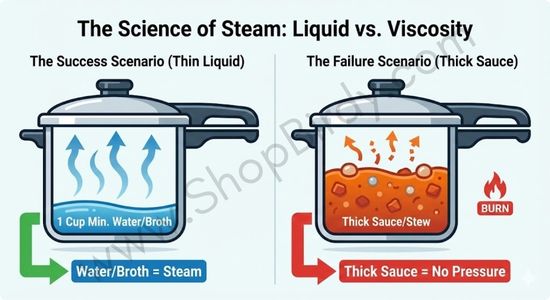
Reason #3: Not Enough Liquid
Pressure cookers don’t pressurize food.
They pressurize steam.
Most electric pressure cookers require a minimum liquid volume to generate sustained vapor. Below that threshold:
- Steam production is weak
- Heat cycles erratically
- Pressure never stabilizes
This is why thick sauces, purees, or oil-heavy recipes often fail to seal. There’s not enough free water to vaporize.
If your pressure cooker won’t build pressure:
- Add water, not oil
- Thin the base liquid
- Avoid starting with reductions
No steam = no pressure.
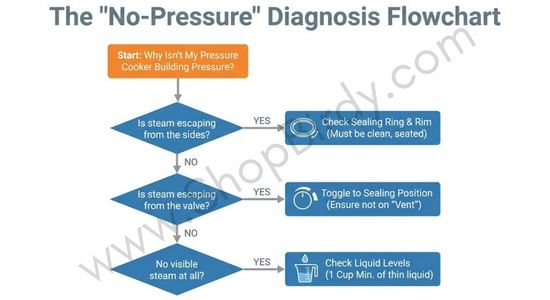
Reason #4: The Release Valve Isn’t Actually Closed
This sounds obvious. It isn’t.
Modern release valves can:
- Sit between positions
- Accumulate starch residue
- Fail to seat cleanly
A valve that’s almost sealed is worse than one that’s fully open. It allows constant pressure bleed while tricking the user into waiting indefinitely.
If steam is escaping continuously from the valve area during preheat, the cooker is never going to seal—no matter how long you wait.
Reason #5: Heat Delivery Is Too Weak or Too Uneven
Pressure is temperature-dependent.
If the pot doesn’t reach boiling efficiently, pressure never forms.
This is where inner pot design and base thickness matter.
Thin stamped bases:
- Lose heat rapidly
- Create hot spots
- Trigger safety throttling
Better-designed cookers use thicker, more stable bases that allow consistent energy transfer.
This is also why performance varies so much between models, even at the same wattage.
If you want a deeper breakdown of which designs actually build pressure reliably—and which ones struggle under real cooking loads—this is covered in detail in our Best Multi-Cookers and Pressure Cookers guide, where we analyze pressure stability, not just features.
Reason #6: Overfilling (Pressure Needs Headspace)
Pressure cookers need empty volume above the liquid to pressurize.
When a cooker is overfilled:
- Steam has nowhere to accumulate
- Foam interferes with the valve
- Safety systems prevent sealing
This is especially common with:
- Beans
- Grains
- Soups
- Starchy foods
If the fill line is exceeded—even slightly—the cooker may refuse to seal by design.
This isn’t a malfunction. It’s the system protecting itself.
Reason #7: The Cooker Is Working — But You’re Expecting Instant Pressure
This is the most misunderstood issue.
Pressure cooking is not instant.
A typical electric pressure cycle looks like:
- 8–12 minutes to preheat
- Pressure ramp-up (variable)
- Only then does the timer start
If you add cold food, large volume, or frozen ingredients, preheat time extends dramatically. During this phase, it can look like nothing is happening—even though the system is behaving correctly.
If there’s no visible steam leakage, patience may be the fix.
How to Diagnose a Pressure Cooker That Won’t Seal (Quick Test)
Ask these questions in order:
- Is steam leaking continuously from the lid or valve?
→ Seal or valve issue - Is there enough thin liquid in the pot?
→ Steam generation issue - Does the lid lock feel confident or forced?
→ Alignment or gasket channel issue - Is the cooker overfilled?
→ Headspace problem - Does this happen with all recipes—or only thick ones?
→ Liquid availability issue
Pressure problems are systematic. Once you isolate the variable, the fix becomes obvious.
Final Verdict: Pressure Failure Is Rarely “Random”
When a pressure cooker is not building pressure, it’s almost never bad luck.
It’s:
- A sealing surface that can’t maintain integrity
- A heat system that can’t stabilize
- Or a recipe that violates basic steam physics
Once you stop blaming presets and start evaluating materials, geometry, and energy flow, pressure cooking becomes predictable again.
And predictability—not speed—is what good pressure cooking is really about.
Legal Information
Shopbirdy.com is a participant in the Amazon Services LLC Associates Program, an affiliate advertising program designed to provide a means for sites to earn advertising fees by advertising and linking to Amazon.
About the Author

Lily Clark has spent years testing cookware and kitchen appliances the way most people actually use them — on a home circuit, in a real kitchen, cooking real meals.
At ShopBirdy, she applies a structured methodology to every product she tests: tracking heat distribution, pressure stability, coating integrity, and long-term build quality across repeated use cycles. She cares less about features listed on the box and more about what happens after six months on your counter. Her reviews are written for people who want to buy once and cook well.