Affiliate Disclosure: This article contains affiliate links. If you purchase through them, I may earn a small commission at no extra cost to you. I only recommend cookware I personally test and cook with in my kitchen.
Updated January 2026 | By Lily Clark
When a fry pan fails, most people blame the coating.
They shouldn’t.
In real kitchens, nonstick pans usually die because of handle-related failures—loosened fasteners, hidden residue buildup, heat creeping toward the grip, or poor balance that causes jerky movements. All of these quietly destroy coatings long before they “wear out.”
That’s why the debate over riveted vs rivetless handles isn’t cosmetic.
It’s structural—and it directly affects how long your pan lasts.
The Real Job of a Handle (What Most Guides Ignore)
A handle isn’t just something you grab. It’s a control arm.
A good handle must:
- Transfer minimal heat to your hand
- Stay rigid under torque
- Keep the pan balanced when tilting, basting, or sliding food
- Remain hygienic over years of use
When handle design fails at any of these, control suffers—and poor control is what kills nonstick coatings.
Riveted Handles: The Traditional Standard
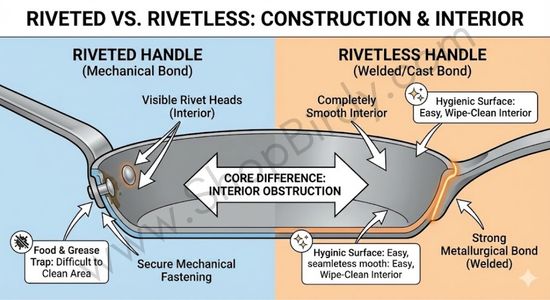
Riveted handles are mechanically fastened through the pan wall using metal rivets. You’ll see them most often on stainless steel and carbon steel cookware.
Why Riveted Handles Exist (The Strength Argument)
Rivets provide:
- Multiple anchor points
- Excellent long-term load strength
- Proven durability under heavy cookware use
From a purely mechanical standpoint, rivets are extremely reliable—if hygiene and coating continuity aren’t priorities.
Pro Insight: Rivet Material Matters More Than You Think
Not all rivets are equal.
- Aluminum rivets (common on cheaper pans) are soft. Over time, they can stretch under heat and torque, leading to that familiar handle rattle.
- Stainless steel rivets have a higher melting point, greater rigidity, and resist deformation under repeated cooking cycles.
If you’re buying a riveted pan, always look for stainless steel rivets. They stay tight and stable long after aluminum rivets start to fail.
The Hidden Cost of Rivets (Where Problems Start)
Rivets introduce three real-world issues most buyers don’t anticipate.
1. Hygiene & Residue Reality
When oil trapped around a rivet head is repeatedly heated, it polymerizes into a sticky brown varnish that is extremely difficult to remove without damaging the surrounding nonstick coating.
Visual diagnosis:
If there’s a brown, tacky ring around your rivets that soap won’t touch, that’s carbonized grease. It’s not just ugly—it creates a friction point where eggs begin to tear exactly at the handle junction.
This is the same issue detailed in How to Clean Sticky Residue from Nonstick Pans.
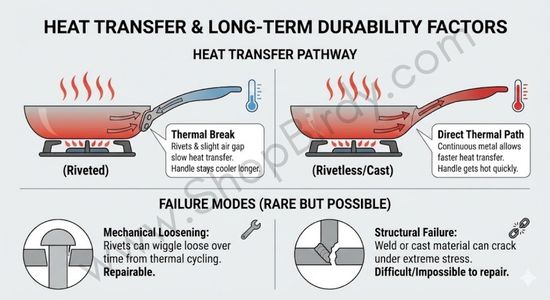
2. Thermal Bridging (Heat Creep)
Rivets act like metal highways, conducting heat directly from the pan body into the handle.
Over longer cooks, this causes:
- Heat creeping toward your palm
- Reduced comfort
- Forced use of towels or mitts
Any barrier between your hand and the handle reduces control—and reduced control shortens pan life.
3. Coating Stress Points
Each rivet hole interrupts the pan’s surface. During repeated heating and cooling, these points experience higher stress.
Nonstick coatings rarely fail in the center first.
They fail at interruptions.
Rivetless Handles: The Modern Argument (With Critical Distinctions)
Rivetless handles are attached using welded joints, cast interfaces, or integrated bodies—common in modern nonstick and hard-anodized cookware.
Why Rivetless Exists (The Control Argument)
A properly engineered rivetless handle offers:
- A completely smooth interior surface
- No residue traps
- Fewer coating stress points
- Easier long-term cleaning
For nonstick cookware, this is a meaningful structural upgrade.
⚠️ The “Screwed-On” Trap (Avoid This Design)
Some brands market “rivetless” convenience but use a single screw through the pan wall to secure the handle.
Avoid these completely.
A screw creates:
- One single point of failure
- Guaranteed loosening as metal expands and contracts
- The worst of both worlds: instability and surface interruption
Red flag:
If you see a Phillips or flathead screw head on the inside or outside of the pan, it’s a budget compromise disguised as a feature.
What to Look for Instead: Welded & Y-Shaped Handles
A Y-shaped welded handle isn’t just a design flourish—it’s functional engineering.
By splitting the connection into two thin arms:
- Heat must travel a longer, thinner path
- Surface area increases, allowing air cooling
- Heat flow slows before it reaches your palm
This creates a natural heat break, dramatically reducing heat creep compared to straight-bar handles.
This is why Y-shaped welded handles feel cooler and more controllable during longer cooks.
Riveted vs. Rivetless: Mobile-Ready Comparison
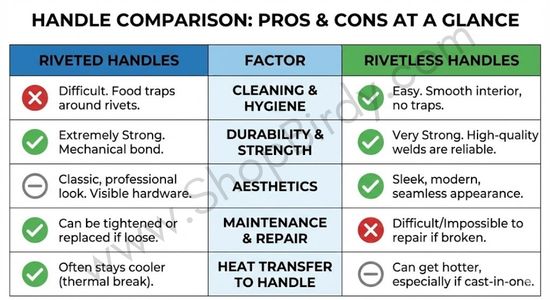
Feature | Riveted | Rivetless (Welded) |
Durability | Max mechanical strength | High (if premium) |
Hygiene | Residue traps | Smooth / clean |
Heat at Grip | Heats faster | Stays cooler |
Interior Surface | Interrupted | 100% smooth |
Best For | Carbon steel, stainless | Nonstick, ceramic |
How Handle Design Kills (or Saves) Nonstick Pans
Here’s the failure chain most people never see:
Loose or hot handle
→ micro-adjustments while cooking
→ jerky pan movements
→ uneven heat exposure
→ localized coating breakdown
Handle quality directly affects coating lifespan.
This is also why better handle engineering accounts for a large part of the price difference explained in $30 vs $100 Nonstick Pan.
When Riveted Handles Still Make Sense
Riveted handles are still the right choice for:
- Stainless steel cookware
- Carbon steel pans
- High-heat, coating-free applications
In these cases:
- There’s no delicate coating to protect
- Cleaning is more aggressive
- Structural redundancy matters more than surface continuity
If you’re using carbon steel, rivets are expected—and manageable with proper seasoning (see How to Season Carbon Steel).
The Handle Stress Test (Use This Anywhere)
In-store or at home:
- Grab the pan by the end of the handle
- Lift and twist gently
- Feel for vibration or flex
- Cheap riveted pan → faint rattle
- Cheap rivetless pan → handle flex
- Well-built pan (either type) → feels like one solid piece
That feeling is structural confidence.
Final Verdict: Riveted vs Rivetless Handle
This isn’t a style debate.
It’s about how heat, force, and residue move through the pan.
- Riveted handles offer maximum strength but introduce hygiene and coating challenges
- Welded rivetless handles remove failure points and extend nonstick lifespan
For nonstick cookware, a well-engineered welded rivetless handle is usually the smarter long-term choice.
Not because it’s newer—but because it removes unnecessary weaknesses.
Ready to upgrade? We put the industry’s top contenders to the test in our roundup of the Best Nonstick Pans for Eggs: Tested & Reviewed
The ShopBirdy Rule of Thumb
If the pan has a coating, minimize interruptions.
If the pan is bare metal, prioritize strength.
That’s how handle design stops being an afterthought—and starts protecting your cookware investment.
Legal Information
Shopbirdy.com is a participant in the Amazon Services LLC Associates Program, an affiliate advertising program designed to provide a means for sites to earn advertising fees by advertising and linking to Amazon.
About the Author

Lily Clark has spent years testing cookware and kitchen appliances the way most people actually use them — on a home circuit, in a real kitchen, cooking real meals.
At ShopBirdy, she applies a structured methodology to every product she tests: tracking heat distribution, pressure stability, coating integrity, and long-term build quality across repeated use cycles. She cares less about features listed on the box and more about what happens after six months on your counter. Her reviews are written for people who want to buy once and cook well.