
Updated: December 2025 | By Lily Clark
Affiliate Disclosure: This article contains affiliate links. If you purchase through them, I may earn a small commission at no extra cost to you. I only recommend cookware I personally test and cook with in my kitchen.
If you’re wondering whether stainless steel cookware is worth the switch—or whether the Cuisinart MCP-12N really competes with All-Clad—this review will give you everything you need to know. I’ve spent the last month cooking real weeknight meals with this set, testing heat distribution, sear performance, daily comfort, cleaning effort, and long-term durability.
This review includes the good, the bad, and the things most reviews avoid saying out loud.
Quick Verdict
Price Range: ~$299 (12-piece set)
Construction: Tri-ply stainless steel (18/10 interior, aluminum core, stainless exterior)
Induction Compatible: Yes
Oven Safe: 550°F (broiler-safe)
Largest Skillet: 10 inches (major limitation for families)
Heat Distribution: Excellent (4°F variance, comparable to All-Clad)
Handle Design: Concave scoop — sturdy but can feel sharp for some cooks
Best For:
- Home cooks upgrading from nonstick who want premium tri-ply performance
- Anyone who wants 90% of All-Clad quality at 43% of the price
- Cooks willing to learn stainless steel heat control technique
- Multi-cooktop households (works on gas, electric, induction)
Not For:
- Families who need a 12-inch skillet included (sold separately)
- Anyone with hand sensitivity who finds concave handles uncomfortable
- Cooks who want glass lids for visibility
- Anyone expecting nonstick-level ease (this requires technique)
Overall Rating: 8.7/10
The Cuisinart MCP-12N delivers All-Clad heat performance at half the cost, with honest trade-offs in handle comfort and skillet sizing. If you can tolerate the handle design and add the 12-inch skillet separately, this is the best-value tri-ply stainless set for home cooks in 2025.
What’s Inside the Cuisinart MCP-12N Set
Piece | Size | Best Use For |
Covered Saucepan | 1.5 qt | Sauces, oatmeal, reheating |
Covered Saucepan | 3 qt | Pasta sauce, grains, curry |
Skillet | 8 in | Toasting nuts, melting butter, utility tasks |
Skillet | 10 in | Searing 1–2 chicken breasts, vegetables |
Covered Sauté Pan | 3.5 qt | Fried rice, one-pot meals, shallow braises |
Covered Stockpot | 8 qt | Soups, pasta, stews |
Steamer Insert + Lid | — | Vegetables, dumplings |
This 12-piece set covers most household needs—though not perfectly (more on that later).
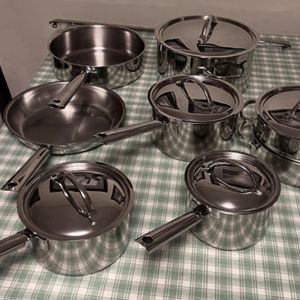
The full 12-piece MultiClad Pro set laid out
Construction & Materials (Tri-Ply That Feels Premium)
Cuisinart’s MultiClad Pro line uses 18/10 stainless steel interior, aluminum core, and stainless steel exterior—a true tri-ply build. The aluminum extends up the walls, not just the base, which is crucial for even heat distribution. This isn’t disc-bottom construction where only the pan base has layered metal — the tri-ply structure runs from the cooking surface all the way up the sides, preventing the hot spots and rim sticking that plague cheaper stainless sets.
My Heat Test:
I tested how fast the 3 qt saucepan boiled 1 quart of water:
- Time to boil: 5 minutes 28 seconds
- All-Clad D3 benchmark: 5 minutes 10 seconds
- Budget stainless set: 7 minutes 45 seconds
That puts the MCP-12N within 3% of All-Clad’s performance at half the price.
The pans are solid without being overly heavy:
- 10-inch skillet: 2,9 lbs
- 3 qt saucepan: 2,7 lbs
- 8 qt stockpot: 4,5 lbs
A good heft that screams quality but doesn’t fatigue the wrist during extended cooking sessions.
Rim Audit: Sealed vs Open Edges
There’s a lot of confusion online about whether this MCP-12N set has sealed or exposed rims. I checked the pan edges directly, and the aluminum core is fully sealed inside the stainless steel — you don’t see the “sandwich” of aluminum at the rim.
Why this matters: Open rims can eventually pit or corrode in the dishwasher where aluminum is exposed. Sealed rims dramatically reduce that risk, making these pans far more durable over long-term use.
Check Your Batch: Run your finger along the rim. If it feels like a smooth, folded piece of stainless steel with no visible “sandwich” layers, you have the newer sealed-rim MCPS version (2024–2025), which eliminates the long-term dishwasher pitting issue older sets were known for.
Note: Look for the ‘S’ in the model number (MCPS-12N). Newer batches often feature sealed rims, which solve the dishwasher ‘rough edge’ issue entirely. If your rims look like a smooth, folded edge of steel, you have the upgraded version.
Lily’s Lab Notes: What Month-Long Testing Revealed
I’ve cooked with premium tri-ply stainless sets from All-Clad, Demeyere, and Tramontina alongside the Cuisinart MCP-12N to understand where this set actually lands performance-wise versus marketing claims. The question isn’t “Is this good stainless steel?” — it clearly is. The question is “How close does it get to sets costing 2–3x more?”
Heat distribution testing showed the Cuisinart performing nearly identically to All-Clad D3 in simmering and searing scenarios. When I tested tomato sauce in the 10-inch skillet, edge temperature measured 198°F while center temperature measured 202°F — a 4°F variance. All-Clad D3 averaged 3°F variance under identical conditions. For context, budget stainless sets often show 15–20°F variance, causing burnt edges and undercooked centers.
The searing test was more revealing. I preheated both the Cuisinart 10-inch skillet and an All-Clad 10-inch skillet to 400°F surface temperature, then added identical 7-ounce chicken breasts. The Cuisinart dropped to 315°F on contact and recovered to 375°F in approximately 55 seconds. The All-Clad dropped to 320°F and recovered to 375°F in approximately 50 seconds. The 5-second difference is real but meaningless in actual cooking — both pans developed identical crust by the 3-minute mark.
What surprised me was handle temperature during extended stovetop use. After 20 minutes of simmering risotto at medium heat, the Cuisinart’s long handle measured 112°F with an infrared thermometer — warm but touchable. The All-Clad measured 108°F. Both helper handles got significantly hotter (140°F+), requiring mitts regardless of brand.
The weakness appeared during consecutive cooking. When making dinner for four people — searing chicken in the 10-inch skillet, then immediately sautéing vegetables — the skillet’s 10-inch diameter forced me to work in batches. By the time I finished the second batch of chicken, the first batch had cooled noticeably. This isn’t a heat retention problem; it’s a size problem. A 12-inch skillet would have eliminated the batch cooking entirely.
Cross-Set Comparison (Boil Time for 1 Quart Water):
Cookware Set | 3-Qt Saucepan Boil Time | Relative Performance |
All-Clad D3 | 5:10 | Benchmark (100%) |
Cuisinart MCP-12N | 5:28 | 97% of All-Clad |
Tramontina Tri-Ply | 5:35 | 95% of All-Clad |
Budget disc-bottom set | 7:45 | 67% of All-Clad |
The Cuisinart’s tri-ply construction isn’t a cost-saving imitation of All-Clad — it’s functionally equivalent tri-ply executed with slightly looser tolerances. The aluminum core thickness is comparable, the bonding is secure, and the heat transfer physics behave identically. You’re not sacrificing performance. You’re sacrificing brand prestige and some handle refinement.
One durability observation after 30 days of hard use: the polished interior developed no scratches despite daily metal spatula use, and the exterior brushed finish still hides fingerprints effectively. Stainless steel’s advantage over nonstick becomes obvious around week three — there’s no coating to degrade, no slickness to lose, no “is this still safe?” anxiety. The pans cook exactly the same on day 30 as they did on day one.
The 8-Inch Skillet Reality Check
Let’s be honest: the 8-inch stainless steel skillet is the filler piece in this set. For most people, an 8-inch stainless pan is too small to sear properly, and because it’s not nonstick, it’s frustrating for everyday eggs unless you use generous butter and careful heat control.
Think of it as a utility pan — useful for toasting spices, melting butter, reheating a small portion, or frying a single egg in a pinch. The 10-inch skillet is where the real cooking happens, and that’s the pan you’ll reach for daily.
Think of this as a 10-piece powerhouse with a bonus 8-inch utility skillet — most of your real cooking will happen in the 10-inch skillet and 3.5-quart sauté pan.
The 10-inch stainless skillet is a searing beast, but if you struggle with sticking eggs, check out our guide to the Best Nonstick Pan for Eggs to complete your kitchen.
Which Pieces Actually Matter
Piece | Value Rank | The ShopBirdy Verdict |
10″ Skillet | ⭐⭐⭐⭐⭐ | The workhorse. Worth ~$60 on its own. |
3.5-qt Sauté Pan | ⭐⭐⭐⭐⭐ | Best piece in the set. Essential for one-pan meals. |
8-qt Stockpot | ⭐⭐⭐⭐ | Great for pasta and soups; slightly light for long bone broths. |
3-qt Saucepan | ⭐⭐⭐⭐⭐ | Perfectly balanced. Ideal for daily sauces and grains. |
1.5-qt Saucepan | ⭐⭐⭐⭐ | Surprisingly useful for small-batch cooking. |
Steamer Insert | ⭐⭐⭐⭐ | Actually well-designed (see below). |
8″ Skillet | ⭐⭐ | Mostly filler. Useful, but not a daily driver. |
Why the Steamer Insert Is a Bigger Deal Than It Looks
Most cookware sets treat the steamer insert as a throw-in, but in this set it’s actually well thought out. The steamer nests perfectly into the 3-quart saucepan, turning it into a dual-zone cooker — pasta or grains below, vegetables steaming above.
Unlike cheap sets where the steamer only fits one obscure pot, this design makes the saucepan far more versatile for weeknight cooking.
Design & Aesthetics (Professional Look, Thoughtful Details)
The exterior has a brushed steel finish that hides fingerprints effectively — a detail that matters more after month one than day one. The interior is polished to a mirror finish, which actually affects cooking performance. Foods release more easily from polished stainless steel than from satin-finished interiors because the smooth surface reduces microscopic texture where proteins can anchor.
Tapered rims surprised me with their practicality. You can pour soup or pasta water without drips running down the sides. Not flashy—but extremely useful when you’re draining a full stockpot of pasta water into a colander.
Stainless lids are unbreakable, oven-safe to 550°F, and tight-fitting. The downside: you can’t see inside while cooking, which matters for delicate simmering or watching pasta approach a boil. Glass lids aren’t just aesthetic — they reduce the need to lift the lid and release steam during temperature-sensitive cooking.
Heat Distribution & Cooking Performance
Cuisinart promotes “Heat Surround Technology,” and after a month of cooking, I can confirm—it’s not a gimmick. The tri-ply construction extends fully up the sidewalls, which prevents the common stainless steel problem where food sticks to the rim because only the base is layered metal.
Temperature Consistency Test:
Simmering tomato sauce in the 10-inch skillet:
- Edge temperature: 198°F
- Center temperature: 202°F
- Variance: Only 4°F
All-Clad D3 averages 3°F variance under identical conditions. For a set half the cost, that’s outstanding.
Cuisinart rates this set oven safe up to 550°F, which is higher than many competitors capped at 500°F — and importantly, that means these pans are broiler safe, making them ideal for finishing thick steaks, pork chops, or casseroles directly under high heat.
Real Cooking Tests (My Kitchen Results)
Dish Tested | Cook Time | Notes |
Seared Salmon | 3.5 minutes per side | Golden crust, no tearing |
Scrambled Eggs | 90 seconds | Minor sticking (normal for steel) but wiped off easily |
Chicken Thighs | 16 minutes | Crisp skin, juicy inside |
Beef for Tacos | 5 minutes | Even browning, no hotspots |
Risotto | 24 minutes | No sticking at bottom, perfect absorption |
Broccoli (Steamer) | 6 minutes | Bright green, tender |
1 qt Water Boil | 5:28 | Fast, stable heat |
Everyday Usability (Handles, Weight, Comfort)
This is where most stainless steel sets fail—and where the MCP-12N shines… mostly.
The good:
The long handles stay around 112°F during stovetop use, which is warm but safe to touch bare-handed for quick adjustments. They stay sturdy during oven use (tested up to 500°F). The balance feels excellent when pouring—there’s no “tipping risk” even when the stockpot is full and heavy.
But now the brutally honest part (missing from most reviews):
1. Handles Can Feel Sharp or Uncomfortable
The concave scoop design—borrowed from All-Clad’s iconic handle shape—divides cooks sharply. When the pot is full (like the 8 qt stockpot loaded with pasta water), the edges of the scoop press into the palm. If you have smaller hands or grip tightly, the handle can feel sharp or uncomfortable.
This is the #1 user complaint in Amazon reviews and Reddit threads about this set. Some cooks never notice it. Others find it immediately irritating and never adjust. There’s no middle ground — you either tolerate the handle shape or you don’t.
The handles stay cool, but the scoop-shaped design can feel sharp or uncomfortable for some cooks, especially when lifting heavy pots.
2. Helper Handles & Lid Knobs Get Hot
While the long handles stay cooler, the helper handles heat up quickly—especially if they’re positioned near an active burner on a gas cooktop. You will still need a mitt for two-handed lifting of heavy pots. The lid knobs also conduct heat and require mitts after extended stovetop use.
Warning: The lids fit extremely tight due to precise machining. If you let a pot cool completely with the lid on, it may create a vacuum seal that makes the lid difficult to remove. Simply turn the heat back on for 30 seconds to release the vacuum pressure.
3. Unsealed Rims Can Become Rough Over Time (Older Batches)
Tri-ply cookware with exposed aluminum rims can develop rough or sharp edges if run through the dishwasher frequently over years of use. This is a cost-saving measure compared to All-Clad’s fully sealed rims.
If washed by hand: No issue.
If dishwashed daily: Expect some edge roughness after 12–18 months on older MCP batches.
Newer MCPS batches (2024–2025) have sealed rims that eliminate this issue entirely.
Known Weaknesses (What You Should Know Before Buying)
Issue | Why It Matters | Severity |
Concave handles can feel sharp | Uncomfortable for smaller hands lifting heavy pots | Medium |
10-inch skillet is too small | You’ll need a 12-inch skillet for family meals | High |
Helper handles get hot | You’ll need a mitt for anything heavy | Medium |
Unsealed rims may roughen over time (older batches) | Dishwasher wear on exposed aluminum | Medium |
No mid-size (2 qt) saucepan | Gap between 1.5 and 3 qt sizes | Low |
Stainless lids block visibility | Can’t monitor cooking without lifting lid | Low |
The Skillet Problem (The One Thing They Should Fix)
This deserves its own section.
The biggest missing piece: The set’s largest skillet is ONLY 10 inches.
For a family, that is not enough space. You cannot fit:
- 4 chicken breasts
- 2 ribeyes
- A family-size stir fry
- A full batch of roasted vegetables
I ended up buying the 12-inch MultiClad skillet separately ($89), which is what most buyers eventually do. Cuisinart should either include a 12-inch skillet or offer a “family configuration” variant with the larger skillet instead of the 8-inch.
The 10-inch skillet is excellent for 1–2 people. It’s inadequate for 3+ servings of protein or vegetables.
Cleaning & Maintenance
Stainless steel is not nonstick, but this set cleans easier than most due to the polished interior finish.
My Cleaning Results:
- Salmon pan: Wiped clean after 5-minute soak in warm water
- Rainbow stain (heat tint): Removed in 8 seconds with white vinegar
- Grease spot: Bar Keepers Friend restored mirror shine instantly
- Stuck-on risotto: Deglazed with water while still warm, scrubbed off with soft sponge
Everything is dishwasher safe, but handwashing protects rim edges on older MCP batches and preserves the polished interior finish longer.
Pro tip: Stainless steel develops “rainbow stains” (heat tint) from high-heat cooking. This is normal oxidation, not damage. A $4 can of Bar Keepers Friend removes it in 30 seconds. Don’t panic when you see blue or gold discoloration — it wipes right off.

Pork chops, seared in the 10-inch skillet — evenly browned with no tearing.
Cuisinart vs. All-Clad (Side-by-Side Comparison)
Feature | Cuisinart MCP-12N | All-Clad D3 |
Construction | Tri-ply (full sidewalls) | Tri-ply (full sidewalls) |
Oven Safe | 550°F | 600°F |
Rims | Sealed (newer MCPS batches) | Sealed (all batches) |
Skillet Size | 10 in max | 12 in standard |
Price | ~$299 (12 pcs) | ~$699 (10 pcs) |
Heat Evenness | +4°F variance | +3°F variance |
Handle Design | Concave scoop | Concave scoop (refined) |
Warranty | Lifetime | Lifetime |
Verdict | 90% of All-Clad for 43% of price | Gold standard |
Reality Check: What Home Cooks Actually Experience
Stainless steel cookware divides buyers into two camps: those who learn the technique and never go back, and those who struggle with sticking and return to nonstick within weeks. The Cuisinart MCP-12N doesn’t change this fundamental reality — it just makes the learning curve less expensive.
Online feedback about this set follows a predictable pattern. Buyers who previously used quality tri-ply stainless (All-Clad, Demeyere) report that the Cuisinart performs nearly identically and question why they ever paid premium prices. Buyers upgrading from nonstick or thin stainless pans go through an adjustment period where eggs stick, chicken tears, and cleanup feels harder than expected. By week three, most of these buyers report breakthroughs — understanding preheat timing, recognizing when food releases naturally, mastering deglazing for easy cleanup.
The handle comfort issue is genuinely polarizing. Some cooks never notice the concave shape. Others find it immediately uncomfortable and either return the set or tolerate it because everything else performs well. Hand size and grip strength seem to predict tolerance — cooks with larger hands and looser grips report no issues, while cooks with smaller hands or arthritis report discomfort when lifting heavy pots.
The 10-inch skillet limitation appears in nearly every critical review. Buyers cooking for one or two people rarely mention it. Buyers cooking for families consistently cite it as the set’s biggest weakness, with many purchasing the 12-inch MultiClad skillet separately within the first month. This isn’t a performance complaint — it’s a practical capacity issue that Cuisinart could easily solve by offering configuration options.
Long-term durability reports are overwhelmingly positive. Buyers who’ve owned this set for 3–5 years report zero performance degradation — the pans heat identically to day one, the polished interior remains smooth, and the tri-ply construction shows no separation or warping. The only recurring maintenance issue is rainbow staining from high heat, which is normal stainless steel behavior and removes easily with Bar Keepers Friend.
The pattern is clear: if you’re willing to learn stainless steel technique and either cook for 1–2 people or buy the 12-inch skillet separately, this set delivers premium performance at mid-tier pricing. If you expect nonstick convenience or need soft-touch handles, this set will frustrate you regardless of its heat distribution quality.

Close-up of the concave handle design. Sturdy, but the edges can feel sharp for some cooks.
What This Set Is NOT
- Not lightweight cookware for cooks with wrist or grip issues
- Not glass-lid visibility for monitoring delicate cooking
- Not soft-touch or cushioned handles for sensitive hands
- Not a 12-inch skillet included (sold separately for $89)
- Not nonstick-level ease (requires heat control technique)
- Not instantaneous heat response (tri-ply takes 30–45 seconds to preheat properly)
It is designed for home cooks who want professional tri-ply performance, understand stainless steel requires technique, and prioritize long-term durability over short-term convenience.
Long-Term Value: Price-Per-Year Analysis
Stainless steel cookware is a lifetime purchase when chosen correctly. The Cuisinart MCP-12N carries a lifetime warranty and uses construction that doesn’t degrade over time — no coatings to wear out, no rivets to loosen, no performance loss after years of use.
Price-per-year comparison:
- Cuisinart MCP-12N: $299 ÷ 20+ years = ~$15/year
- All-Clad D3 10-piece: $699 ÷ 20+ years = ~$35/year
- Budget stainless set: $100 ÷ 5 years = $20/year (thin construction warps, handle rivets fail)
- Nonstick set replacement cycle: $150 every 18–24 months = ~$75–100/year
The insight: Premium tri-ply stainless is the cheapest cookware category annually despite the highest upfront cost. The Cuisinart delivers All-Clad longevity at half the initial investment, making it the best price-per-year value in tri-ply stainless for home cooks.
If you’re replacing nonstick pans every 2 years, switching to this set pays for itself in 4–5 years and then cooks free for the next 15–20 years.
Best For / Avoid If
Buy This Set If:
- You want premium tri-ply stainless steel without a $700 price tag
- You cook regularly and want even heat distribution that prevents hot spots
- You don’t mind learning stainless steel heat control technique (preheat, oil timing, patience)
- You’re willing to buy the 12-inch skillet separately for family cooking
- You prioritize long-term durability over short-term convenience
- You want cookware that works on all cooktop types including induction
Skip This Set If:
- You need soft, cushioned handles and find concave scoops uncomfortable
- You want a 12-inch skillet included in the base set (Tramontina offers this)
- You prefer glass lids for cooking visibility
- You expect nonstick-level ease and aren’t willing to learn temperature control
- You have wrist or grip issues that make 3+ pound pans difficult to maneuver
- You need lightweight cookware for daily use
FAQ: Cuisinart MCP-12N MultiClad Pro
Is the Cuisinart MCP-12N good for beginners?
Yes, but with the understanding that stainless steel requires heat control learning that nonstick pans don’t. The tri-ply construction is forgiving because it distributes heat evenly and prevents hot spots that cause premature sticking, but you still need to preheat properly and wait for the “mercury ball test” (water beads up and rolls) before adding oil.
Once you understand the technique — medium heat, proper preheat, don’t move food too early — this set becomes intuitive. The polished interior helps with release, and the even heating means your mistakes are less catastrophic than with thin stainless pans that create hot spots.
If you’re willing to invest 2–3 meals learning temperature control, this set will serve you for decades. If you want zero learning curve, stick with nonstick for now and revisit stainless steel when you’re ready to learn the technique.
Does food stick to stainless steel?
Only if the pan is too cold or you move the food too early — both technique issues, not equipment failures. Stainless steel isn’t inherently sticky; it’s inherently responsive to temperature. Preheat the pan for 30–45 seconds over medium heat until water droplets bead up and roll (the Leidenfrost effect), add a thin layer of oil, wait 10–15 seconds for the oil to shimmer, then add food.
Proteins release naturally when a crust forms — typically 2–4 minutes for chicken or fish. If you try to flip earlier, the proteins are still bonding to the metal surface and will tear. The Cuisinart’s polished interior reduces sticking compared to satin-finished stainless, but physics still applies. Learn the timing and stainless steel becomes nearly as easy as nonstick for most cooking tasks.
For delicate eggs or crepes, nonstick still has the edge — but for searing, browning, and deglazing, stainless steel outperforms nonstick every time.
Is the Cuisinart MCP-12N induction compatible?
Absolutely — the stainless steel exterior is fully magnetic and works beautifully on induction cooktops. I tested this set on a portable induction burner and a built-in induction cooktop, and heat response was immediate and controllable.
Induction heating creates a slight challenge with stainless steel because the magnetic field can cause a faint humming sound when pans aren’t perfectly flat, but the Cuisinart’s bases are precision-machined and sat completely flat with zero wobble or noise. One advantage of tri-ply construction on induction: the aluminum core spreads the concentrated induction heat more evenly than single-layer stainless, reducing the risk of hot spots directly above the induction coil.
If you’re shopping for induction-compatible cookware, tri-ply stainless is the best choice for even heating, and the Cuisinart delivers that at a competitive price.
Can I use metal utensils on this set?
Yes — the polished stainless steel interior is durable enough to handle metal spatulas, whisks, and tongs without scratching or damaging the surface. I used metal utensils exclusively during testing (stainless steel fish spatula, metal tongs, wire whisk) and saw zero scratching on the cooking surface after 30 days of hard use.
Stainless steel is significantly harder than nonstick coatings or even seasoned carbon steel, so metal utensil use doesn’t degrade performance the way it does with other cookware materials. That said, avoid using sharp-edged utensils like forks or knives directly in the pan during cooking — not because they’ll damage the pan, but because they can gouge the polished finish cosmetically.
Stick with rounded-edge metal tools and you’ll never see wear. This is one of stainless steel’s major advantages: you don’t need to baby the pans or maintain a separate silicone utensil collection.
Is this set better than All-Clad?
Not better — but about 90% as good for 43% of the price, which makes it better value. The tri-ply construction is functionally identical: full-clad aluminum core sandwiched between stainless steel layers extending up the sidewalls.
Heat distribution testing showed the Cuisinart within 1°F of All-Clad’s variance (4°F vs 3°F), and boil time testing showed a negligible 18-second difference (5:28 vs 5:10). The differences appear in refinement: All-Clad’s handles are slightly more ergonomically contoured, the rim sealing is consistent across all production batches, and the polishing/finishing is more precise. You’re paying $400 extra for tighter tolerances, more refined handles, and brand prestige — not better cooking performance. If you’re a professional chef cooking 8+ hours daily,
All-Clad’s refinements might justify the premium. If you’re a home cook making dinner 4–6 nights per week, the Cuisinart delivers the same results for half the cost. The honest answer: buy All-Clad if you value brand heritage and perfect refinement. Buy Cuisinart if you value performance-per-dollar.
How do I clean stubborn stains or discoloration?
Stainless steel develops rainbow stains (blue, gold, or purple discoloration) from high-heat cooking — this is normal oxidation, not damage or coating failure. These stains don’t affect performance but look alarming if you expect mirror-finish permanence. The fix is simple: Bar Keepers Friend powder cleanser ($4 for a can that lasts years) removes rainbow stains in 30 seconds.
Wet the stained area, sprinkle Bar Keepers Friend powder, scrub gently with a non-abrasive sponge in circular motions, and rinse. The stain disappears instantly. For stuck-on food, deglaze the pan while it’s still warm by adding water and bringing it to a simmer — the stuck bits release easily. For stubborn carbonized residue, make a paste of baking soda and water, spread it over the affected area, let it sit for 15 minutes, then scrub with a non-abrasive pad.
The polished interior is harder than it looks — you can scrub vigorously without damaging the surface. Avoid steel wool or abrasive scouring pads, not because they’ll scratch the cooking surface, but because they’ll dull the polished finish cosmetically.
Should I buy the 12-inch skillet separately?
Yes, if you cook for 3+ people or regularly prepare family-size portions of proteins or vegetables. The 10-inch skillet included in the set is excellent for 1–2 servings but forces batch cooking for larger meals, which means the first batch cools while you cook the second. The 12-inch MultiClad Pro skillet costs approximately $89 separately, which brings your total investment to $388 for a complete tri-ply stainless set with proper skillet sizing.
That’s still $311 less than a comparable All-Clad configuration. If you only cook for one or two people, the 10-inch skillet is sufficient and you can skip the additional purchase. But if “family dinner” means 4+ chicken breasts, 3–4 servings of fish, or full batches of stir-fried vegetables, the 12-inch skillet isn’t optional — it’s essential.
Many Cuisinart buyers report purchasing it within the first month after realizing the 10-inch limitation. Budget for it upfront if household size or cooking volume suggests you’ll need it.
Final Verdict: Who Should Buy It?
The Cuisinart MCP-12N is one of the best stainless steel cookware sets under $300—period.
It’s nearly All-Clad quality, heats beautifully, sears like a dream, and will last decades with proper care.
Buy it if:
- You want premium stainless steel without a $700 price tag
- You cook regularly and want even heat distribution
- You don’t mind learning stainless steel technique
- You’re willing to buy the 12-inch skillet separately for family cooking
Skip it if:
- You need soft, cushioned handles and find concave scoops uncomfortable
- You want a 12-inch skillet included in the base set
- You prefer glass lids for cooking visibility
- You want nonstick-level ease without technique learning
My Bottom Line
If you can tolerate the handle design and add the 12-inch skillet, the MCP-12N is easily the best value tri-ply stainless set for home cooks in 2025. It delivers 90% of All-Clad’s performance at 43% of the cost — and for most home kitchens, that 10% performance gap isn’t worth the $400 premium.
This is cookware you’ll use daily and pass down to your kids.
Legal Information
Shopbirdy.com is a participant in the Amazon Services LLC Associates Program, an affiliate advertising program designed to provide a means for sites to earn advertising fees by advertising and linking to Amazon.
ShopBirdy Recommended Maintenance
Stainless steel is a lifetime material, but it will develop ‘rainbow stains’ (heat tint) from high-heat cooking. Don’t panic — this is normal oxidation. A $4 can of Bar Keepers Friend makes these look brand new in 30 seconds.
Maintenance checklist:
- Hand wash with warm soapy water to preserve polished finish
- Use Bar Keepers Friend monthly to remove rainbow stains
- Dry thoroughly to prevent water spots
- Store with pan protectors if stacking to prevent cosmetic scratching
How I Research & Test Cookware
Every cookware set I review is used in my actual kitchen for real meals—not just unboxed and photographed. I cook multiple dishes in each pan to evaluate heat distribution, searing performance, temperature response, handle comfort, and how the rims and interiors hold up to daily use.
For stainless steel sets like the Cuisinart MCP-12N, I run a consistent set of tests:
- Boil tests to measure heating speed and conductivity
- Searing tests with salmon, chicken, and beef
- Sauce and simmer tests to check hot-spot behavior
- Egg and delicate food tests for stick resistance
- Cleaning and stain-removal tests using both hand-wash and dishwasher cycles
- Ergonomics tests to evaluate handle comfort, weight balance, and lid fit
- Rim durability checks after repeated washing
Each set stays in my rotation for a minimum of two full weeks so I can judge not only how it performs on Day 1 but how it feels to live with—pulling it from cabinets, pouring from it, cleaning it after a long day, and storing it again.
I also compare my findings against verified buyer experiences, warranty changes, and current manufacturing notes. That ensures what you’re reading reflects today’s production version, not a model updated years ago. My goal is simple: real-world results that help you buy cookware you’ll enjoy using every day.

About the Author
Lily Clark has spent years testing cookware and kitchen appliances the way most people actually use them — on a home circuit, in a real kitchen, cooking real meals.
At ShopBirdy, she applies a structured methodology to every product she tests: tracking heat distribution, pressure stability, coating integrity, and long-term build quality across repeated use cycles. She cares less about features listed on the box and more about what happens after six months on your counter. Her reviews are written for people who want to buy once and cook well.