
Updated January 2026 | By Lily Clark
Affiliate Disclosure: This article contains affiliate links. If you purchase through them, I may earn a small commission at no extra cost to you. I only recommend cookware I personally test and cook with in my kitchen.
If your pressure cooker sealing ring smells like last week’s curry, it’s not dirty in the way most people think.
It’s chemically loaded.
Sealing rings are made from porous polymer materials designed to flex, expand, and rebound under heat. That same flexibility allows odor molecules to migrate into the polymer matrix, where soap and quick rinses can’t reach.
To clean a pressure cooker sealing ring properly, you have to remove or neutralize those molecules—not just wash the surface.
Why Sealing Rings Hold Odors So Aggressively
Most electric pressure cookers use food-grade silicone or polymer blends for sealing rings. These materials are:
- Heat tolerant
- Elastic under pressure
- Slightly porous at a molecular level
During cooking, volatile aroma compounds (especially sulfur, fat-soluble spices, and acids) diffuse into the polymer. Once embedded, they don’t rinse out.
This is why:
- Mild foods smell fine
- Savory or spiced dishes leave lingering odors
- Soap alone rarely works
The smell isn’t on the ring.
It’s in the ring.
Step 1: Confirm the Ring Is Worth Cleaning
Before deep cleaning, do a quick integrity check.
Remove the sealing ring and stretch a small section gently. If it:
- Feels sticky or gummy
- Fails to rebound cleanly
- Has visible cracks or deformation
Odor is not the problem anymore—material degradation is. At that point, replacement is the correct move.
If the ring still snaps back cleanly, proceed.
💡 Pro Tip from the Kitchen: > If your sealing ring is consistently absorbing odors despite deep cleaning, it may be a sign of low-density silicone found in budget models. In our full lab analysis, we’ve identified which models use high-grade, odor-resistant materials.
Read the Guide: The Best Multi-Cookers and Pressure Cookers of 2026
Step 2: Dishwasher Cycle (Heat + Detergent)
Contrary to old advice, dishwashers are effective for odor removal, not harmful.
Why it works:
- Sustained heat opens polymer pores
- Detergents are designed to break down fat-bound compounds
- Extended cycles matter more than scrubbing
There’s also a chemistry reason this step is effective.
Many of the strongest pressure-cooker odors—curry, chili, garlic, and cooked meats—are lipophilic, meaning they are fat-loving. These compounds bind to fat-soluble chains within the silicone itself.
A high-heat dishwasher cycle works because it raises the temperature high enough to soften or melt those bound fats. Once mobilized, modern detergents can emulsify and extract them from the polymer’s microscopic pores.
Low-temperature hand washing can’t do this. The odor compounds remain locked in place.
How to do it properly
- Place the ring on the top rack
- Use a normal or heavy cycle
- Skip heated dry if your manufacturer warns against it
This alone removes a surprising amount of odor.
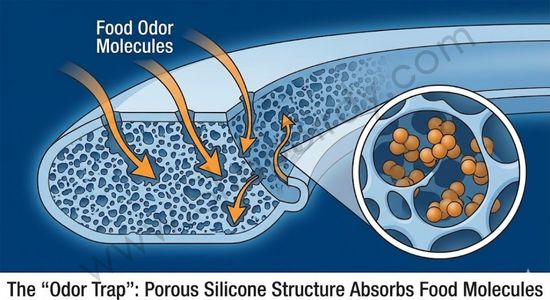
The Polymer Trap: Why Odors Get Stuck in Sealing Rings
Silicone sealing rings behave like a molecular sponge.
When heated during cooking, the polymer lattice expands through thermal expansion. That expansion creates larger gaps at the molecular level, allowing odor compounds to migrate inside.
When the ring cools, the lattice contracts again—locking those compounds in place.
This is why surface washing rarely works. The odor isn’t sitting on the ring; it’s trapped inside it.
The Vinegar Steam Bath works because reheating the ring re-opens the polymer structure, allowing acidic vapor to penetrate the lattice and neutralize odor compounds before they can re-bind as the ring cools.
Step 3: Vinegar Steam Bath (Acid Neutralization)
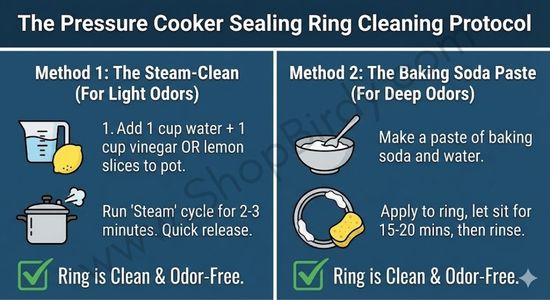
Vinegar doesn’t “clean” silicone—it neutralizes odor compounds.
Method
- Place the ring in the pressure cooker
- Add 1–2 cups of water + 1 cup white vinegar
- Run a short pressure cycle (5 minutes)
- Allow natural release
The steam forces acidic vapor through the polymer structure, disrupting odor-binding compounds.
Rinse thoroughly afterward.
Step 4: Baking Soda Soak (Absorption, Not Abrasion)
Baking soda works by absorbing volatile molecules, not scrubbing them away.
Method
- Mix baking soda with warm water to form a slurry
- Submerge the ring fully
- Soak for 12–24 hours
Do not scrub aggressively. Abrasion roughens the surface and makes future odor absorption worse.
Step 5: UV Exposure (Optional, Controlled)
Sunlight provides mild UV exposure, which can help break down certain odor compounds.
Rules
- Place the ring in indirect sunlight
- Limit exposure to a few hours
- Do not leave it outside all day
Excessive UV degrades polymers over time. This is a light assist, not a primary method.
What Not to Do (These Make Odors Worse)
❌ Boil the ring aggressively
❌ Use bleach or harsh chemicals
❌ Scrub with abrasives
❌ Bake the ring in the oven
High heat and chemical damage increase porosity, which locks odors in more deeply next time.
Preventing Odors in the First Place
The most effective strategy isn’t cleaning—it’s separation.
Best practices
- Keep two sealing rings: one for savory, one for neutral foods
- Remove the ring after cooking and let it air-dry
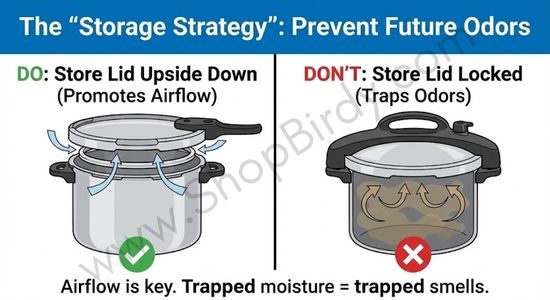
- Store the lid upside down to prevent trapped aromas
Better-engineered pressure cookers also use higher-density gasket materials that absorb fewer odors and rebound more reliably over time. We cover which models use more durable sealing systems in our Best Multi-Cookers and Pressure Cookers guide, where long-term gasket behavior matters more than feature lists.
When Cleaning Isn’t Enough
If odors return immediately after cleaning, the polymer has likely reached saturation.
At that point:
- Cleaning won’t permanently help
- Odors will reappear faster each cycle
- Replacement is more cost-effective
A sealing ring is a wear component. Treating it as permanent only leads to frustration.
Final Verdict: Odors Are a Material Problem, Not a Hygiene Problem
If your pressure cooker sealing ring smells, it doesn’t mean you cleaned it wrong.
It means:
- Odor compounds migrated into the polymer
- Surface washing wasn’t enough
- A deeper chemical approach was required
Once you clean sealing rings based on how materials behave, odors stop feeling mysterious—and start becoming manageable.
Predictable tools make predictable food.
Legal Information
Shopbirdy.com is a participant in the Amazon Services LLC Associates Program, an affiliate advertising program designed to provide a means for sites to earn advertising fees by advertising and linking to Amazon.
About the Author

Lily Clark has spent years testing cookware and kitchen appliances the way most people actually use them — on a home circuit, in a real kitchen, cooking real meals.
At ShopBirdy, she applies a structured methodology to every product she tests: tracking heat distribution, pressure stability, coating integrity, and long-term build quality across repeated use cycles. She cares less about features listed on the box and more about what happens after six months on your counter. Her reviews are written for people who want to buy once and cook well.