
Updated January 2026 | By Lily Clark
Affiliate Disclosure: This article contains affiliate links. If you purchase through them, I may earn a small commission at no extra cost to you. I only recommend cookware I personally test and cook with in my kitchen.
A pressure cooker valve leaking steam doesn’t automatically mean something is wrong.
In many cases, it means the system is doing exactly what it was designed to do.
The mistake most people make is treating all steam as a failure. In reality, pressure cookers use controlled venting as part of their pressure-management logic. The key is knowing when steam is normal—and when it signals a breakdown in sealing or control.
Let’s separate those two clearly.
What the Valve Is Actually For
The pressure release valve is not just an “on/off” switch.
It serves three functions:
- Initial venting during pressure ramp-up
- Pressure regulation once target pressure is reached
- Safety release if internal pressure exceeds limits
Steam at the valve is only a problem when it appears at the wrong phase of the cooking cycle.
Normal Steam vs. Problem Steam (This Matters)
Steam that is normal
- Short bursts during preheat
- Occasional puffs as pressure stabilizes
- Brief venting near the end of cooking
This is the system balancing heat input and pressure.
Steam that is not normal
- Continuous steam during pressure build
- Constant venting after pressure should be sealed
- Hissing that never quiets
That means pressure is being lost as fast as it’s created.
Why a “Loose” or Wobbly Valve Is Normal
If your pressure cooker valve feels loose, wobbly, or freely moving when you touch it, that is not a defect.
It is a weighted deadweight valve, and the looseness is intentional.
The valve relies on a precise relationship between its mass and the force of escaping steam. As pressure inside the cooker rises, steam lifts the valve just enough to vent excess pressure and maintain equilibrium. That lift can only happen if the valve is free to move.
If the valve were screwed down tightly or mechanically locked, it could not lift under excess pressure. That would prevent venting and turn the cooker into a safety hazard.
A valve that can’t wobble can’t regulate pressure.
Do not attempt to tighten it.
A “solid” valve feels reassuring, but it defeats the entire safety mechanism.
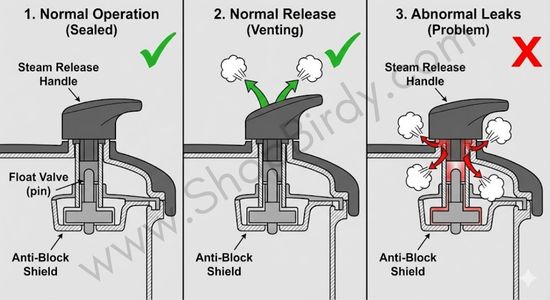
Cause #1: The Valve Isn’t Fully Seated (Most Common)
Modern pressure cooker valves rely on gravity and steam force to seat correctly.
If the valve:
- Is slightly misaligned
- Has starch or oil residue underneath
- Is worn or warped
…it may never seal completely.
Even a fractional gap allows steam to escape continuously, preventing pressure from stabilizing.
Fix
- Remove the valve
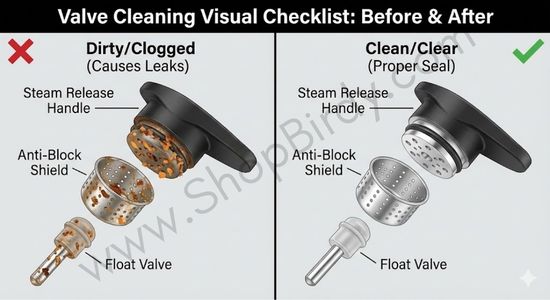
- Clean the stem and housing thoroughly
- Reinstall and ensure it drops freely into place
The valve should move smoothly and seat without resistance.
Cause #2: Foam or Starch Interference
This is common with:
- Beans
- Lentils
- Pasta
- Oatmeal
- Starchy soups
As food boils, foam can rise and physically interfere with the valve, preventing it from sealing.
Follow the Foam Path: The Anti-Block Shield
What most people never see is where the foam actually goes.
Underneath the lid, directly below the pressure valve, is a small metal cage called the anti-block shield. Its job is to stop food particles and foam from entering the valve assembly.
When starch-heavy foam rises, it doesn’t just hit the valve from above. It travels upward and outward, coating the underside of the lid. If the anti-block shield becomes clogged, the valve cannot seat properly—even if the top looks clean.
This is why steam can appear to leak “randomly.”
If you see continuous steam from the valve, always check the bottom of the lid, not just the valve cap. A blocked anti-block shield prevents sealing just as effectively as a misaligned valve.
The cooker keeps heating, steam escapes, and pressure never locks in.
Fix
- Reduce fill level
- Add oil to reduce foaming
- Avoid thick starch-heavy recipes without adequate liquid
This is not a valve defect. It’s a recipe-physics mismatch.
Cause #3: The Cooker Is Venting on Purpose (Pressure Regulation)
Some electric pressure cookers are designed to pulse steam to prevent overshoot.
If you see:
- Rhythmic steam release
- Short, controlled puffs
- Pressure remaining stable
That’s not a leak. That’s active regulation.
People often mistake this for failure because it looks dramatic. It isn’t.
Cause #4: Gasket Failure Masquerading as a Valve Problem
This is where misdiagnosis happens.
If the lid gasket is degraded, steam may escape unevenly around the lid and reroute toward the valve area, making it appear as though the valve is leaking.
A weakened gasket:
- Loses elasticity under heat
- Fails to maintain uniform pressure
- Causes chaotic venting behavior
If steam seems to come from “everywhere,” the valve is often innocent.
Diagnostic shortcut
If the valve looks clean and seated, suspect the gasket next.
Cause #5: Overfilling (Headspace Matters)
Pressure cookers need empty volume above the liquid to build pressure.
When overfilled:
- Steam can’t accumulate
- Foam reaches the valve
- The system vents continuously
Even if you’re below the “Max” line, dense foods can behave like overfilling.
Fix
Respect both volume and density, not just markings.
Cause #6: Warped or Damaged Valve Components
Over time, heat cycling can:
- Warp plastic housings
- Weaken springs
- Distort valve stems
This usually shows up as:
- Inconsistent sealing
- Random venting behavior
- Steam leaks that worsen over time
At this point, cleaning won’t fix it. Replacement is the only solution.
Quick Diagnostic: Is Your Valve Actually Leaking?
Ask these in order:
- Is steam continuous or intermittent?
- Does pressure ever stabilize?
- Is the valve clean and freely moving?
- Is the gasket passing a snap-back test?
- Is the pot overfilled or foaming?
The first “yes” that points to uncontrolled venting is your answer.
What Not to Do
❌ Don’t force the valve down
❌ Don’t block the vent
❌ Don’t ignore continuous steam
❌ Don’t assume the cooker is defective immediately
Forcing a valve disables a critical safety system.
If you’re repeatedly dealing with valve venting issues—especially in starch-heavy recipes—some designs simply handle pressure regulation better than others. We break down which models maintain stable pressure with fewer false vents in our Best Multi-Cookers and Pressure Cookers guide, where sensor behavior and control logic matter more than feature lists.
Final Verdict: Steam Is a Signal, Not a Symptom
A pressure cooker leaking steam from the valve is communicating something specific.
Sometimes it’s saying:
“Pressure is stabilizing.”
Other times it’s saying:
“Pressure can’t stabilize.”
Once you understand when steam is expected and when it’s not, valve behavior stops being confusing—and starts being diagnostic.
Predictable pressure isn’t about silence.
It’s about controlled release at the right time.
Legal Information
Shopbirdy.com is a participant in the Amazon Services LLC Associates Program, an affiliate advertising program designed to provide a means for sites to earn advertising fees by advertising and linking to Amazon.
About the Author

Lily Clark has spent years testing cookware and kitchen appliances the way most people actually use them — on a home circuit, in a real kitchen, cooking real meals.
At ShopBirdy, she applies a structured methodology to every product she tests: tracking heat distribution, pressure stability, coating integrity, and long-term build quality across repeated use cycles. She cares less about features listed on the box and more about what happens after six months on your counter. Her reviews are written for people who want to buy once and cook well.