Affiliate Disclosure: This article contains affiliate links. If you purchase through them, I may earn a small commission at no extra cost to you. I only recommend cookware I personally test and cook with in my kitchen.
Updated December 2025 | By Lily Clark
Induction cooking doesn’t politely hide cookware flaws.
It exposes them.
If you’ve switched to induction, you’ve probably already noticed:
- pans heating faster than expected
- food sticking “for no reason”
- humming or buzzing noises
- error messages like “Pan Not Found”
None of that means induction is difficult.
It means induction is honest.
This guide breaks down the best nonstick pans that actually behave well on induction, why some popular options quietly fail, and how to choose the right pan based on how you cook, not how cookware brands market themselves.
Quick Recommendation
If you have a high-end Bosch/Miele: Go with All-Clad NS Pro.
If you want to sear steak/chicken: Go with Scanpan Classic.
If you mostly cook eggs/pancakes: Go with GreenPan Valencia.
What “Induction-Compatible” Really Means (And Why That’s Not Enough)
For a pan to work on induction, it must have a magnetic base. Usually:
- a bonded steel plate, or
- fully clad stainless steel
If a magnet sticks, the cooktop might turn on.
But induction success depends on far more than magnetism.
What really matters:
- thermal mass (how well the pan holds heat)
- response speed (how fast it reacts to dial changes)
- base coverage (full vs small magnetic plate)
- rim protection (where nonstick often fails first)
- flatness over time (especially on glass tops)
Induction magnifies all of these traits.
The Shortlist: Nonstick Pans That Actually Work on Induction
After months of cooking on induction — eggs, chicken, sauces, pancakes — these are the pans that consistently behaved like adults.
All-Clad HA1 vs All-Clad NS Pro (Budget Entry vs Fixed Design)
These two are often lumped together as “All-Clad nonstick.”
That’s misleading.
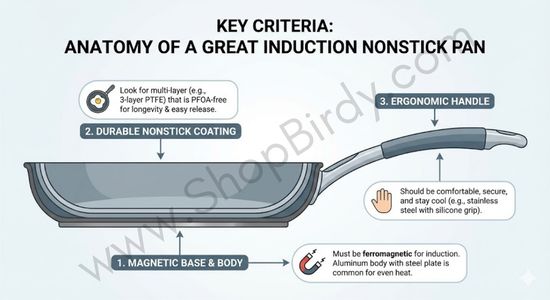
All-Clad HA1 — The Budget Induction Entry
HA1 is All-Clad’s most affordable induction-capable nonstick.
Strengths:
- hard-anodized aluminum body
- bonded steel induction base
- straight, high sides (good for sauces and shallow frying)
The problem shows up over time.
The rim is:
- vertical
- exposed
- vulnerable
Spatulas, pan stacking, and cabinet contact tend to hit that edge. That’s why so many long-term users report chipping or wear at the rim, even with careful use.
HA1 cooks well — but durability is its weak spot.
All-Clad NS Pro — The Corrected Version
NS Pro exists because All-Clad knew HA1 had a durability problem.
What’s different:
- ceramic plasma bonding layer under the nonstick
- flared rim instead of a sharp vertical edge
- heavier, calmer feel
That rim isn’t just aesthetic.
It protects the coating edge from:
- spatula strikes
- pan stacking
- cabinet abrasion
On induction, NS Pro:
- recovers heat better
- handles temperature swings calmly
- lasts noticeably longer
Brutal truth:
HA1 is All-Clad’s budget induction entry.
NS Pro is the fix.
GreenPan Valencia Pro (Best Ceramic / PFAS-Free Option)
If avoiding traditional PTFE is your priority, GreenPan Valencia Pro is the ceramic pan that behaves best on induction.
Why it works:
- stainless induction plate
- thicker body than most ceramic pans
- predictable low-to-medium heat performance
Where it shines:
- eggs
- pancakes
- vegetables
- everyday breakfasts
Where it struggles:
- high-heat searing
- cold protein hitting a hot pan
- repeated boost-mode use
Ceramic and induction can work beautifully — but only with heat restraint.
Scanpan Classic Induction (The Nonstick Rule-Breaker)
Scanpan deserves special attention.
The Stratanium Texture Advantage
Scanpan uses a textured Stratanium coating, not a mirror-smooth surface.
That texture does three important things on induction:
- Reduces suction on glass cooktops
Perfectly smooth pans can “vacuum stick” to flat glass induction surfaces. Scanpan’s texture prevents that. - Improves moisture management
Steam has somewhere to go, which improves browning. - Tolerates light metal contact better
You still shouldn’t use metal utensils — but Scanpan is far less fragile than typical nonstick.
Why This Matters
Scanpan is the best option if you want to sear a steak in a nonstick pan — something usually forbidden.
On induction:
- heat stability is excellent
- temperature recovery is calm
- browning is consistent
It feels less like nonstick and more like a seasoned surface.
Swiss Diamond CXD (Heavy, Stable, Unapologetic)
Swiss Diamond is for cooks who hate babysitting pans.
- thick base
- reinforced textured coating
- strong heat retention
On induction:
- temperature crashes are minimal
- browning is even
- behavior is predictable
It’s heavier and less nimble — but extremely confidence-inspiring.
Made In vs Misen (Do Not Treat These as the Same)
These two are often grouped as “value brands.”
On induction, they behave very differently.
Made In Nonstick — Fully Clad Construction
Made In uses 5-ply stainless-clad construction, even for nonstick.
What that means:
- heavy
- extremely even heat
- very stable temperature
Response Speed (Important Nuance)
Because of the mass:
- Made In reacts more slowly to dial changes
- turning heat down takes longer to show effect
This is not a flaw — it’s a feature.
For cooks making:
- delicate eggs
- custard-like sauces
- reductions
Slower response = more forgiveness.
Misen Nonstick — Aluminum + Steel Plate (Bi-Metal Design)
Misen uses:
- aluminum body
- bonded steel induction plate
This gives:
- faster heat-up
- faster response to dial changes
⚠️ Glass-Top Risk: The Wobble Explained
Aluminum and steel expand at different rates.
On induction:
- repeated heating creates tension
- the base can bow slightly over time
On gas, you’ll never notice.
On flat glass induction, a bowed pan becomes a spinner.
A spinning pan:
- loses contact
- heats unevenly
- slides while stirring
If your induction cooktop is glass-flat, this matters.
Performance Comparison (With Induction-Specific Metrics)
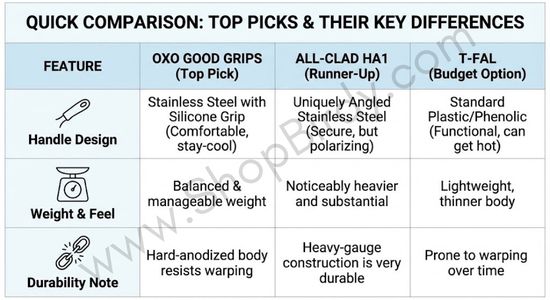
Pan | Heat Stability | Response Speed | Induction Noise | Best Use |
All-Clad HA1 | Good | Medium | Moderate buzz | Sauces, shallow fry |
All-Clad NS Pro | Excellent | Medium | Moderate buzz | Searing, durability |
GreenPan Valencia Pro | Moderate | Fast | Quiet | Eggs, veggies |
Scanpan Classic | Excellent | Medium | Low | Browning, steak |
Swiss Diamond CXD | Very High | Medium-Slow | Low–Moderate | Stress-free cooking |
Made In | Excellent | Slow | Noticeable hum | Precision cooking |
Misen | Moderate | Fast | Low | Quick weekday meals |
Induction Noise: Buzzing, Humming, and Why It’s Normal
Many induction pans buzz or hum — especially:
- bonded steel bases
- fully clad construction
What’s happening:
- magnetic vibration between metal layers
Heavier pans buzz more — and cook more evenly.
If your pan hums on high:
👉 That’s physics, not a defect.
BOOST MODE WARNING (Read This or Kill Your Pan)
Never use “Boost” or “Power” mode on an empty nonstick pan. Ever.
Induction can push a thin pan past 500°F in under 30 seconds.
That causes:
- aluminum expansion
- coating delamination
- early sticking weeks later
Boost mode is for water — not nonstick.
Magnet Test vs Sensor Sensitivity (High-End Stove Owners Read This)
A magnet sticking does not guarantee compatibility.
High-end European induction cooktops (Bosch, Miele, Gaggenau):
- use sensitive pan-detection sensors
- sometimes reject pans with small or thin magnetic plates
This happens most often with:
- budget ceramic pans
- pans with minimal steel discs
If you own a high-end induction range:
👉 Choose pans with full-coverage magnetic bases, like All-Clad or Made In.
They’re far less likely to trigger “Pan Not Found” errors.
Real Cooking Behavior on Induction
Eggs
- Medium heat
- 60–90 seconds preheat
- slower response pans are more forgiving
Pancakes
- heavy bases brown evenly
- fast-response pans need frequent adjustment
Chicken (6 oz breast)
- thin pans crash in temperature
- heavy pans recover faster
- expect ~3–4 minutes per side on stable pans
If food sticks on induction:
- it’s usually thermal mass, not technique
Care Rules That Matter More on Induction
- Hand wash only
- Let pans cool before rinsing
- Never thermal-shock
- Use silicone or wood utensils
Quick fix:
If a pan feels grabby, rub one drop of oil into the cold pan before heating. It often buys you weeks of life.
Final Recommendations (No Fence-Sitting)
🥇 Best Overall Induction Nonstick
All-Clad NS Pro
Best balance of durability, stability, and longevity.
🥈 Best Ceramic / PFAS-Free
GreenPan Valencia Pro
Excellent for gentle, everyday cooking.
🥉 Best for Nonstick Searing
Scanpan Classic Induction
The rare nonstick that browns confidently.
💰 Best Precision Option
Made In Nonstick
Heavy, stable, slow-reacting — perfect for control.
⚠️ Caution Pick
Misen Nonstick
Fast and affordable, but watch for wobble on glass induction.
Final, Human Take
Induction doesn’t forgive weak cookware.
The best induction nonstick pans:
- have real mass
- protect their coating edges
- stay flat
- respond in a way that matches your cooking style
Choose stability if you value calm cooking.
Choose speed if you value responsiveness.
Just don’t confuse “induction-compatible” with “induction-ready.”Top of Form
Legal Information
Shopbirdy.com is a participant in the Amazon Services LLC Associates Program, an affiliate advertising program designed to provide a means for sites to earn advertising fees by advertising and linking to Amazon.
About Me
Hi, I’m Lily and I created Shopbirdy.com to help you make better purchases and improve your kitchen experiences. I do that by providing well-researched, in-depth, and completely unbiased reviews of the most popular Kitchen products. I like cooking that’s why I decided to share my views on various kitchen subjects.

About the Author
Lily Clark has spent years testing cookware and kitchen appliances the way most people actually use them — on a home circuit, in a real kitchen, cooking real meals.
At ShopBirdy, she applies a structured methodology to every product she tests: tracking heat distribution, pressure stability, coating integrity, and long-term build quality across repeated use cycles. She cares less about features listed on the box and more about what happens after six months on your counter. Her reviews are written for people who want to buy once and cook well.