Affiliate Disclosure: This article contains affiliate links. If you purchase through them, I may earn a small commission at no extra cost to you. I only recommend cookware I personally test and cook with in my kitchen.
Updated December 2025 | By Lily Clark
If you’ve ever cooked on a T-fal pan, you’ve noticed it immediately.
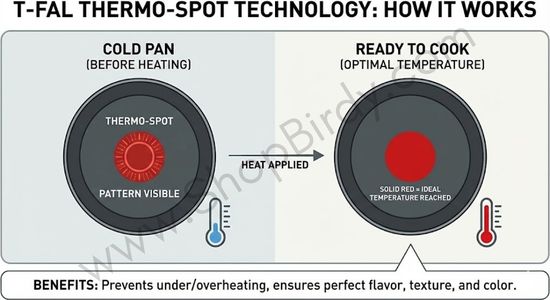
That bright red circle in the center of the pan — the Thermo-Spot — slowly changing as the pan heats up. According to T-fal, when it turns solid red, your pan is “perfectly preheated.”
For beginners, that promise feels comforting.
For experienced cooks, it often sounds suspicious.
So let’s get honest:
Is T-fal’s Thermo-Spot a gimmick… or is it actually useful when you’re learning to cook?
After cooking on multiple T-fal lines, testing the Thermo-Spot with a laser thermometer, and watching beginners rely on it (sometimes too much), the answer turns out to be more nuanced — and more interesting — than marketing makes it sound.
What Thermo-Spot Actually Is (No Marketing, Just Reality)
Thermo-Spot is a heat-sensitive pigment embedded into the center of the pan’s cooking surface.
As the pan heats:
- The patterned red design slowly disappears
- The center turns into a solid, dull red “stop sign”
Here’s the key visual cue most people miss:
If you can still clearly see the logo lines or pattern, the pan is not ready.
When the pan reaches roughly 350–375°F, the pattern vanishes and the spot becomes a flat, uniform red.
That temperature range matters because:
- ~350°F is ideal for eggs, pancakes, vegetables
- It’s below the danger zone for PTFE nonstick
- It corresponds to what recipes loosely call “medium heat”
Important limits (that T-fal rarely explains clearly):
- ❌ It measures only the center
- ❌ It does not measure oil temperature
- ❌ It does not account for pan thickness or thermal mass
- ❌ It does not guarantee the pan will stay hot once food hits it
Thermo-Spot is a starting signal, not a cooking guarantee.
Quick Summary: Don’t have time to read?
Verdict: It works for eggs (350°F), but fails for chicken on cheap pans due to low thermal mass.
Best Buy: T-fal Ultimate
How I Tested Thermo-Spot (So This Isn’t Guesswork)
I tested Thermo-Spot across three T-fal lines:
- T-fal Simply Cook (≈$20, thin aluminum)
- T-fal Signature (≈$30–35, mid-weight aluminum)
- T-fal Ultimate Hard Anodized (≈$50–60, thickest body)
All with:
- the same gas burner
- the same preheat routine
- a laser thermometer
- identical foods (eggs, chicken, pancakes)
I measured:
- time to Thermo-Spot activation
- actual surface temperature at activation
- temperature drop after adding food
- recovery time back to cooking temp
This is where the story gets interesting.
The Hard Data: When Thermo-Spot Turns Red
Across all three pans:
Metric | Result |
Activation temp | ~355–375°F |
Time to activation (medium heat) | 90–120 seconds |
Repeatability | Very consistent |
Center vs edge difference | 15–30°F (edges cooler) |
So let’s be clear:
Thermo-Spot itself is accurate.
It reliably indicates a medium cooking temperature at the center of the pan.
Where things go wrong is what happens next.
The Critical Physics Problem: Thermal Mass (This Is Where Beginners Get Burned)
This is the flaw almost no reviews explain properly.
The Scenario
- Thermo-Spot turns solid red (~375°F)
- You place a cold, 6-oz chicken breast into the pan
- The chicken releases moisture instantly
What Happens in Thin T-fal Pans
On thinner pans like Simply Cook or Signature:
- Surface temperature crashes immediately
- Measured drop: ~375°F → ~240–260°F
- That’s below the searing threshold
So even though:
- the spot said “ready”
- the user followed instructions perfectly
…the pan was not physically capable of maintaining heat.
The Result
- Chicken sticks
- Protein tears when moved
- User blames themselves
- Or blames Thermo-Spot
But the real issue is thermal mass, not timing.
Why This Matters (And Why Thermo-Spot Gets Unfairly Blamed)
Thermo-Spot doesn’t lie.
It tells you:
“The pan reached a good cooking temperature.”
It does not tell you:
“This pan has enough mass to hold that temperature.”
On thin aluminum:
- temperature spikes fast
- temperature drops just as fast
On thicker pans (like T-fal Ultimate):
- drop is smaller
- recovery is faster
- sticking happens less
This explains why beginners often say:
“Eggs work great, but chicken always sticks.”
That’s not bad technique — that’s physics.
Model-by-Model: Thermo-Spot Is Not Equal Across T-fal Lines
T-fal Simply Cook (Budget Line)
- Thinnest aluminum
- Fastest to heat
- Largest temperature crash
- Thermo-Spot = starting line only
Best for:
- eggs
- pancakes
- vegetables
Worst for:
- chicken
- fish
- anything wet or thick
Here, Thermo-Spot can give false confidence.
Is the T-fal the best for eggs? It’s our Budget Pick, but see why the Ozeri beat it in our 20-Degree Flare Geometry Test here.
T-fal Signature (Mid-Range)
- Slightly thicker
- Better heat retention
- Smaller temp crash (~375°F → ~280°F)
Thermo-Spot works better here, but:
- still not sear-reliable
- still punishes crowded pans
T-fal Ultimate Hard Anodized
- Thickest body
- Highest thermal mass
- Best heat recovery
- Thermo-Spot actually feels “honest”
In my tests:
- Chicken stuck less
- Recovery back to 350°F happened faster
- Cooking felt calmer, less frantic
Same Thermo-Spot. Very different outcomes.
This is the single most important thing beginners need to understand.
Egg Test: Where Thermo-Spot Truly Helps
Eggs are low-moisture and forgiving.
Across all three pans:
- Thermo-Spot prevented cold-pan cooking
- Eggs slid cleanly
- Cook time: 2–3 minutes
- Confidence improved immediately
For beginners, this is huge.
Instead of guessing:
- they wait
- they see a clear signal
- they succeed
This is why Thermo-Spot feels magical at first.
Chicken Test: Where Thermo-Spot Needs Context
With chicken:
- Thermo-Spot = permission to start
- Not permission to flip
- Not permission to overcrowd
- Not permission to rush
On thin pans:
- you must wait longer
- or accept sticking
- or cook smaller portions
Without that explanation, Thermo-Spot feels like it failed — when the pan failed.
The Nonstick Safety Benefit (Quietly Important)
Here’s something Thermo-Spot does extremely well:
It keeps beginners out of the overheating zone.
Most nonstick pans die because beginners:
- crank heat too high
- preheat empty too long
- cook above 450°F repeatedly
Thermo-Spot encourages:
- medium heat
- patience
- visual confirmation
That alone extends pan life.
Why Experienced Cooks Ignore Thermo-Spot
If you already:
- read oil shimmer
- listen for sizzle
- understand heat carryover
Thermo-Spot adds nothing.
Most experienced cooks:
- stop noticing it
- cook by feel
- outgrow it naturally
That doesn’t make it useless — it makes it transitional.
Durability of the Indicator Itself
Good news:
- Thermo-Spot doesn’t peel
- It doesn’t flake
- It lasts as long as the coating
Bad news:
- Contrast fades slightly over years
- Dark pans reduce visibility
- It doesn’t improve coating durability
It’s guidance, not reinforcement.
Quick Reality Fix (When Nonstick Starts Grabbing)
If your T-fal starts to feel sticky:
Rub one drop of oil into the cold pan with a paper towel before heating.
This:
- smooths microscopic dry spots
- reduces early sticking
- buys you a few extra weeks or months
It won’t save a dead pan — but it helps.
So… Is Thermo-Spot a Gimmick or Not?
Here’s the honest answer:
❌ Not a gimmick
❌ Not a game-changer
✅ A very good training wheel
It teaches beginners:
- when to start
- what “medium heat” looks like
- how to stop guessing
It does not:
- overcome thin pans
- replace technique
- guarantee searing success
Who Thermo-Spot Is Actually For
Thermo-Spot Is Valuable If:
- you’re new to cooking
- you’ve ruined nonstick before
- you struggle with heat timing
- you mostly cook eggs, veggies, pancakes
- you buy T-fal Ultimate, not the cheapest line
Thermo-Spot Is Mostly Irrelevant If:
- you sear frequently
- you cook proteins daily
- you understand heat carryover
- you use stainless or cast iron often
Final Verdict (Honest, Not Clickbait)
T-fal Thermo-Spot isn’t a gimmick — it’s a learning tool.
It doesn’t make cheap pans better.
It makes beginners better faster.
But like all training wheels, it eventually comes off.
One-Line Summary
Thermo-Spot won’t turn you into a great cook — but it can stop you from becoming a frustrated one.
And for many beginners, that’s exactly what they need.
Legal Information
Shopbirdy.com is a participant in the Amazon Services LLC Associates Program, an affiliate advertising program designed to provide a means for sites to earn advertising fees by advertising and linking to Amazon.
About Me
Hi, I’m Lily and I created Shopbirdy.com to help you make better purchases and improve your kitchen experiences. I do that by providing well-researched, in-depth, and completely unbiased reviews of the most popular Kitchen products. I like cooking that’s why I decided to share my views on various kitchen subjects.

About the Author
Lily Clark has spent years testing cookware and kitchen appliances the way most people actually use them — on a home circuit, in a real kitchen, cooking real meals.
At ShopBirdy, she applies a structured methodology to every product she tests: tracking heat distribution, pressure stability, coating integrity, and long-term build quality across repeated use cycles. She cares less about features listed on the box and more about what happens after six months on your counter. Her reviews are written for people who want to buy once and cook well.