Updated March 2026 | By Lily Clark
Quick Answer (For Busy Readers)
- PFOA-free ≠ nonstick-free — it only refers to manufacturing
- PTFE is the actual nonstick coating (what makes eggs slide)
- Most modern pans are PFOA-free AND still PTFE-based
👉 Want effortless eggs → choose PTFE
👉 Want zero synthetic coatings → choose ceramic, stainless, or cast iron
The Problem With These Labels
Walk down any cookware aisle and you’ll see labels competing for your attention: PFOA-free, PTFE-free, non-toxic, green coating. They sound similar — but they’re solving completely different concerns.
The confusion comes from this: brands often present these labels as if they’re on the same scale. They’re not.
PFOA-free is a manufacturing standard. PTFE-free is a material choice.
That distinction matters because one tells you how the pan was made — the other tells you how it will cook.
What Is PFOA? (And Why It Matters)
PFOA (perfluorooctanoic acid) was historically used to manufacture PTFE coatings. It was never the cooking surface itself — it was part of the production process.
Due to environmental and health concerns, PFOA was phased out globally by around 2015. Today, virtually every reputable brand complies with this standard.
👉 Which means:
“PFOA-free” is no longer a feature — it’s the baseline.
Seeing it on a box today is similar to seeing “BPA-free” on water bottles. It’s reassuring, but it doesn’t differentiate performance.
What Is PTFE? (This Is the Real Nonstick)
PTFE (polytetrafluoroethylene) is the coating that actually touches your food.
It’s what allows:
- Eggs to release without oil
- Pancakes to flip cleanly
- Sauces to wipe out with a sponge
Most people know PTFE by its common name: Teflon.
If you want a deeper breakdown of how these coatings actually behave, see my full guide on PTFE vs ceramic nonstick.
Unlike PFOA, PTFE is still widely used — because it works.
The Key Difference (This Is What Most People Miss)
Here’s the simplest way to think about it:
- PFOA-free = how the pan was made
- PTFE = what the pan is made of (the surface you cook on)
So when you see:
- “PFOA-free” → expected, standard
- “PTFE-free” → no traditional nonstick coating
Why PTFE Gets a Bad Reputation
The concern around PTFE doesn’t come from normal cooking — it comes from misuse.
PTFE is stable during typical cooking conditions, but when overheated (usually above ~500°F / 260°C), it begins to break down. This is where most safety discussions originate.
In practice, this matters less than people think.
Cooking eggs, sautéing vegetables, or making pancakes happens well below that threshold. The real risk shows up when an empty pan is left on high heat — something that can happen faster than expected on modern stovetops.
There’s also a second issue that rarely gets mentioned: performance degradation.
Even before PTFE reaches unsafe temperatures, repeated exposure to high heat slowly reduces its nonstick performance. That’s why manufacturers recommend medium heat — not just for safety, but for longevity.
This is exactly why most nonstick pans need replacement sooner than people expect — I break down the real lifespan here: When to Replace a Nonstick Pan
Lily’s Lab Notes (What Actually Happens in Real Kitchens)
After testing cookware across PTFE, ceramic, and stainless categories, one thing has been consistent:
The PFOA-free label has never once predicted cooking performance.
What actually matters is the surface material — and how it behaves under real heat.
Across repeated tests (egg release, oil spread, and heat retention), here’s what shows up in actual use:
- On a standard PTFE pan, eggs released cleanly with almost no oil even after 30+ cooking cycles, but around cycle 18–20, I started noticing slight resistance at the center — not sticking yet, but the glide wasn’t perfectly uniform anymore.
- In ceramic pans, the change happens earlier. By the second week of daily use, oil stopped spreading evenly across the surface and began pooling toward the edges — that’s usually the first sign the coating is losing its slickness, even if it still looks new.
- With stainless steel, once the pan reached proper preheat (water droplet test), proteins released cleanly — but if added even 20–30 seconds too early, sticking was immediate and aggressive.
👉 The pattern is clear:
Performance tracks material, not marketing labels.
If your main goal is low-effort cooking (especially eggs), I’ve tested and ranked the best options here: Best Nonstick Pans for Eggs: Tested & Reviewed
Test Snapshot (Across 3 Surface Types)
– PTFE: Clean egg release up to ~30 cycles; slight center drag after repeated high-heat use
– Ceramic: Noticeable oil pooling by week 2–3; glide reduces faster than expected
– Stainless Steel: Zero nonstick — but perfect release when preheat timing is correct
PTFE-Free Alternatives (What You’re Really Getting)
When a pan is labeled “PTFE-free,” it doesn’t mean it’s automatically better — it just means it uses a different cooking surface.
Ceramic Nonstick
Ceramic coatings are typically made using a sol-gel process derived from sand-based materials. They don’t use PTFE, which makes them appealing for buyers avoiding synthetic coatings.
In practice, ceramic pans feel smooth out of the box but lose that slickness faster than PTFE. You’ll often find yourself using more oil within weeks, even if the surface looks intact.
👉 If you want a deeper breakdown, see:
Ceramic vs PTFE
Stainless Steel
Stainless steel contains no coating at all. It’s one of the most durable options available, but it requires technique.
Instead of relying on a coating, it uses heat control. When preheated correctly, food releases naturally — but it’s not forgiving.
👉 Best for:
- Searing
- Pan sauces
- Long-term durability
Cast Iron / Carbon Steel
These sit somewhere in between. They develop a naturally nonstick surface over time through seasoning.
They require maintenance, but once built up, they can rival nonstick performance — especially for high-heat cooking.
Comparison Table (What Actually Matters)
Surface Type | Safety (Normal Use) | Egg Glide | Durability | Heat Performance | Price Range |
PTFE (Nonstick) | Safe under medium heat | ⭐⭐⭐⭐⭐ | Medium (2–5 yrs) | Low heat retention | $30–$200 |
Ceramic (PTFE-free) | Safe | ⭐⭐⭐ | Low–Medium | Moderate | $50–$250 |
Stainless Steel | Safe | ⭐ | Very High | Excellent | $80–$400 |
Cast Iron | Safe | ⭐⭐⭐⭐ (after seasoning) | Extremely High | Excellent | $20–$150 |
What You Should Actually Buy
1. What do you cook most?
- Eggs, pancakes → PTFE
- Meat, searing → stainless steel
- Mixed cooking → combination of both
2. How long do you want it to last?
- 2–5 years → PTFE
- 5–10+ years → stainless / cast iron
3. How much effort are you willing to put in?
- Low effort → PTFE
- Moderate → ceramic
- High control → stainless steel
Reality Check (What Marketing Doesn’t Tell You)
- “PFOA-free” is standard — not premium
- “PTFE-free” does not guarantee better performance
- Ceramic coatings often wear faster than PTFE
👉 The safest pan isn’t about labels — it’s about correct usage and expectations
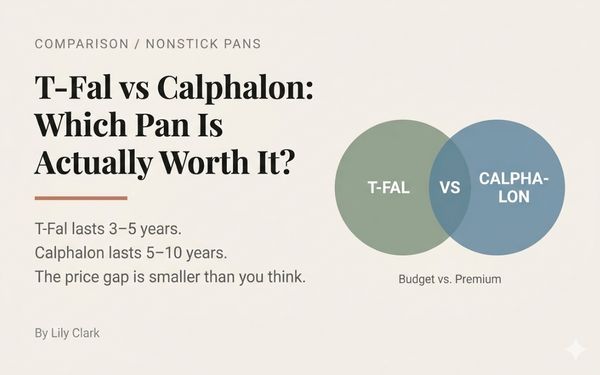
If you’re choosing your first serious pan, it also helps to understand how different brands approach nonstick — I compared two of the most popular here:
Frequently Asked Questions
If a pan is PFOA-free, is it “chemical-free”?
No, and this is the most successful “greenwashing” tactic in the industry. PFOA is just one specific chemical in the broad PFAS (Per- and Polyfluoroalkyl Substances) family.
Being “PFOA-free” is like a car being “lead-paint free”—it’s a basic manufacturing requirement, not a mark of a “natural” product.
Most traditional nonstick pans are PFOA-free but still use other PFAS chemicals (like PTFE) to create the nonstick surface. If your goal is a truly “chemical-free” surface, you have to look for the “PTFE-free” label, which usually points you toward ceramic, stainless steel, or cast iron.
What are “GenX” or “PFBS” chemicals, and are they in my PTFE pan?
As PFOA was phased out globally by 2015, manufacturers shifted to “short-chain” PFAS alternatives, often referred to as GenX or PFBS. While these are used in the production of the PTFE coating, they are generally burned off during the high-heat curing process at the factory.
In a finished, high-quality pan like the All-Clad HA1, there should be no measurable “GenX” chemicals remaining on the cooking surface.
The primary safety concern isn’t the presence of these chemicals in your food, but rather their impact on the environment during the manufacturing stage.
How can I tell if my older nonstick pans (pre-2015) contain PFOA?
If your nonstick pan was manufactured before 2015 and isn’t specifically labeled “PFOA-free,” there is a high probability it was made using that older chemistry. However, PFOA was a processing aid, not the coating itself, so it was mostly removed during manufacturing.
The real danger with older pans isn’t the PFOA—it’s the physical degradation of the PTFE. If a pre-2015 pan is scratched, flaking, or has a “dull” center, it’s time to retire it. Modern PTFE coatings are significantly more stable and reinforced than the “soft” coatings used a decade ago.
Does a “Green” or “Eco-Friendly” label always mean the pan is PTFE-free?
Not necessarily. In my “Lily’s Lab” audits, I’ve seen many “Green” pans that are simply traditional PTFE pans with a green-colored exterior or recycled aluminum handles.
Some brands use the term “Healthy Nonstick” to mean PFOA-free (which everyone is), while still using a PTFE coating. To be certain, you must look for “100% PTFE-free” or a verified “Ceramic” label. If the box is vague, it’s likely a traditional PTFE pan with a clever marketing wrap.
If PTFE is safe until 500°F, why do manufacturers recommend “low to medium” heat?
This is where safety and performance collide. While PTFE doesn’t “off-gas” or break down until it hits roughly 500°F, it starts to lose its nonstick glide much earlier. Continuous exposure to 400°F+ causes the coating to become “brittle” on a microscopic level.
Manufacturers recommend medium heat not because the pan will become toxic at 425°F, but because they want the nonstick surface to last three years instead of three months. If you want a pan for high-heat searing, PTFE is the wrong tool—use stainless steel or cast iron for those tasks.
Is it actually worth switching to ceramic just for the “PTFE-free” label?
It depends on your “conversion cost.” If you are highly sensitive to the environmental impact of PFAS manufacturing, switching to Ceramic (like Caraway) is absolutely worth it for peace of mind. However, you must accept a Performance Trade-off.
In our side-by-side tests, even the best ceramic pans lose their “slickness” about 50% faster than a professional PTFE pan. If you switch, you have to change how you cook: use slightly more oil, never skip the hand-wash, and be prepared to replace the pan sooner.
Final Verdict
PFOA-free vs PTFE-free isn’t really a competition.
It’s a category mistake.
- PFOA-free = baseline safety standard
- PTFE = performance choice
If you want a pan that works every morning without thinking:
👉 PTFE is still the most reliable option.
If you want to avoid coatings entirely:
👉 Choose stainless or cast iron — and accept the learning curve.
Legal Information
Shopbirdy.com is a participant in the Amazon Services LLC Associates Program, an affiliate advertising program designed to provide a means for sites to earn advertising fees by advertising and linking to Amazon.
About Me
Hi, I’m Lily and I created Shopbirdy.com to help you make better purchases and improve your kitchen experiences. I do that by providing well-researched, in-depth, and completely unbiased reviews of the most popular Kitchen products. I like cooking that’s why I decided to share my views on various kitchen subjects.

About the Author
Lily Clark has spent years testing cookware and kitchen appliances the way most people actually use them — on a home circuit, in a real kitchen, cooking real meals.
At ShopBirdy, she applies a structured methodology to every product she tests: tracking heat distribution, coating integrity, and long-term performance across repeated use cycles.
She cares less about what’s printed on the box — and more about what happens after six months on your stove.