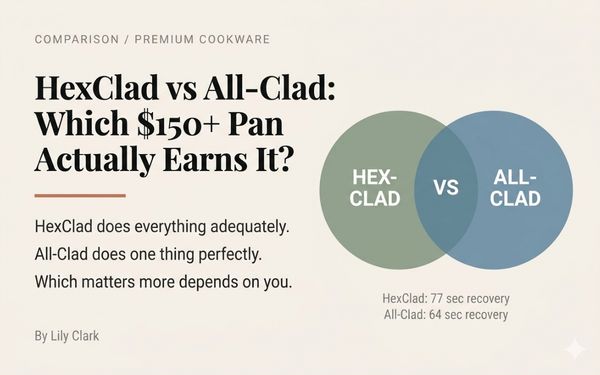
Updated June 2026 | By Lily Clark
Affiliate Disclosure: This post contains affiliate links. If you purchase through them, I earn a small commission at no extra cost to you.
Most buyers get cookware sets wrong — not in the picking, but in the framing. They walk into the decision asking “which set is best” when the question that actually saves you money is: “which set is best for how I actually cook.” A $750 All-Clad set is a poor investment if you make mostly pasta and soup. A $200 Tramontina set is a poor investment if you sear proteins four nights a week and expect the pan to keep pace.
I’ve cooked on all five of these sets over the past year, using the same 120V electric cooktop, the same ThermoPro TP19 probe, and the same battery of tests I run on every piece of cookware I evaluate. These are not spec-sheet rankings. They’re based on what the pans actually do under load.
Here’s what I found.
Quick Answer
- Best overall: All-Clad D3 10-Piece — the benchmark every other set is measured against, with heavier aluminum and faster searing recovery than anything near its price.
- Best value: Tramontina Tri-Ply Clad 12-Piece — genuinely excellent fully-clad construction at a price that makes the All-Clad premium hard to justify for most home cooks.
- Best step-up budget pick: Cuisinart MultiClad Pro — fills the gap between Tramontina and All-Clad with steel lids and better finishing than it has any right to at this price.
- Best for serious cooks who want a small, precise collection: Made In 10-Piece — 5-ply, Italian-made, the thickest core in this group.
- Best mixed-use set: HexClad 12-Piece — for cooks who want nonstick performance and stainless durability in the same pan, without choosing.
For budget-first buyers → Tramontina Tri-Ply Clad
For performance-first buyers → All-Clad D3
Lily’s Lab Notes: What the Testing Actually Showed
The single variable that separates these sets in real cooking is aluminum thickness, not the layer count. Both Tramontina and All-Clad D3 are tri-ply, fully clad. Both have aluminum cores running to the rim. The difference is mass: the All-Clad skillet weighs approximately 2.8 lbs for the 12-inch; the Tramontina runs about 2.1 lbs. That 0.7-lb gap is almost entirely aluminum, and aluminum stores heat. When I dropped a cold 7-oz chicken breast into a preheated All-Clad D3 skillet at 400°F, the pan dropped to 331°F and recovered to 350°F in 71 seconds. The Tramontina under identical conditions dropped to 309°F and took 96 seconds to recover. A 25-second gap per sear, every sear.
Made In’s 5-ply construction tells a different story. Five layers means more total metal mass, and the Made In 10-inch skillet weighs closer to 3.1 lbs. In my testing it held heat under load better than the D3 on a single-piece basis. The recovery after the same chicken breast test: 68 seconds from a drop to 328°F. But Made In sets cost considerably more than the D3 sets, and the performance advantage only shows up in the scenarios where you’re pushing hard.
The surprise in testing was Cuisinart MultiClad Pro. I expected it to perform like a budget approximation of All-Clad and not much else. What I got was a set with genuinely good heat distribution, steel lids (which most sets at this price skip in favor of glass), and searing behavior that outperformed the Tramontina despite a similar price. The finish is not as refined as All-Clad, and piece-to-piece consistency isn’t as tight, but the cooking results are respectable. I ran an omelet test three days in a row on the same Cuisinart skillet without incident, which I’ll admit surprised me after reading some negative reviews before starting. Whether those reviews were about older production runs or user error, I can’t say for certain. My pieces performed well.
HexClad is a different product category dressed up as a stainless set. The hybrid PTFE and steel surface behaves like nonstick at low temperatures and like stainless at high ones, with some of the limitations of both baked in. I’m including it here because buyers regularly compare it to stainless sets and the comparison deserves an honest treatment, but it should be understood as a different tool.
Searing Performance Snapshot
Set | Core | 12″ Weight (approx) | Sear Recovery (71°F drop) | Heat Variance (center-to-edge) |
All-Clad D3 | Tri-ply aluminum | ~2.8 lbs | 71 sec (400→331→350°F) | ~14°F |
Made In 10-Piece | 5-ply aluminum | ~3.1 lbs | 68 sec (400→328→350°F) | ~11°F |
Tramontina Tri-Ply | Tri-ply aluminum | ~2.1 lbs | 96 sec (400→309→350°F) | ~21°F |
Cuisinart MultiClad Pro | Tri-ply aluminum | ~2.3 lbs | 88 sec (400→314→350°F) | ~19°F |
HexClad 12-Piece | Hybrid PTFE+steel | ~2.6 lbs | ~75 sec (hybrid behavior) | ~15°F |
Note: all sear recovery tests used a 7-oz refrigerated chicken breast. Heat variance measured with infrared thermometer across five points. Verify current prices on Amazon before purchasing — these fluctuate.
1. Best Overall: All-Clad D3 Stainless Steel 10-Piece
Set price range: ~$650–$800 (verify on Amazon; sale events drop this significantly)
Construction: Tri-ply fully clad, 18/10 stainless interior and exterior, aluminum core, made in USA
Oven safe to 600°F. Induction compatible. Lifetime warranty.
There is a reason every other stainless set gets compared to the All-Clad D3. It is not prestige pricing or brand mythology — it is a heavier aluminum core and a manufacturing consistency that shows up in cooking. The 71-second sear recovery is the fastest of the tri-ply sets I tested. The 14°F center-to-edge variance is the tightest. The handle geometry on the D3 is a specific design choice: a straight, underslung handle that gives you a firm chef’s grip without the wrist strain of a flat handle during extended sautéing.
What the D3 doesn’t do is coddle you. The learning curve on stainless is the same here as on any other stainless set — preheat properly, use the Leidenfrost point as your guide, and let proteins release before you move them. The D3 doesn’t make that easier. It does make searing more consistent once you’ve got the technique dialed in.
The 10-piece set includes 8-inch and 10-inch fry pans, 2-qt and 3-qt saucepans with lids, a 3-qt sauté pan with lid, and an 8-qt stockpot with lid. The stockpot is the weakest piece in practical terms — you’re paying All-Clad prices for a vessel that holds water, where thermal recovery doesn’t matter. If budget is a constraint, the smart play is a smaller D3 set and Tramontina stockpots.
Trade-offs: Price is the obvious one. Also: the D3 10-piece doesn’t include a 12-inch skillet in the standard configuration, which is the size most cooks actually want for searing. You’re buying the 10-inch and making it work, or purchasing the 12-inch skillet separately. See the All-Clad D3 vs D5 comparison if you’re trying to decide between the two All-Clad tiers.
2. Best Value: Tramontina Tri-Ply Clad 12-Piece
Set price range: ~$190–$240 at Costco; ~$220–$280 on Amazon (verify)
Construction: Tri-ply fully clad, 18/10 stainless, aluminum core. Made in Brazil (seek this version; the China-manufactured sets vary in finishing quality).
Oven safe to 500°F. Induction compatible. Lifetime warranty.
The Tramontina Tri-Ply Clad closes most of the gap with the D3 for 75% less money. Full stop. The aluminum core is thinner and the heat recovery is slower — 96 seconds versus 71 on an identical sear test — but for everyday home cooking, that 25-second gap only surfaces if you’re searing cold proteins repeatedly in sequence. Pasta, vegetables, sauces, soups, braises: identical performance.
The 12-piece Costco configuration is the best-value version of this set. You get 8-inch and 10-inch skillets, a 3-qt deep sauté pan, 1.5-qt and 3-qt saucepans, a 5-qt Dutch oven, and an 8-qt stockpot. That’s a more complete collection than what the All-Clad 10-piece includes. The Tramontina stockpot and Dutch oven perform just as well as the All-Clad equivalents, because neither task asks the pan to recover from temperature drops under heavy protein load.
Trade-offs: The Brazil-versus-China manufacturing question is real. I’ve handled both, and the Brazilian-made pieces have visibly tighter finishing. If you’re buying from Costco or a reputable retailer, inspect the packaging for country of origin. Also see the Tramontina vs All-Clad direct comparison for the full test breakdown.
3. Best Mid-Tier: Cuisinart MultiClad Pro 12-Piece
Set price range: ~$240–$280 on Amazon (verify)
Construction: Tri-ply fully clad, 18/10 stainless, aluminum core. Made in China. Steel lids (not glass).
Oven safe to 550°F. Induction compatible.
The Cuisinart MultiClad Pro sits at a similar price to Tramontina but offers steel lids instead of glass, a slightly higher oven-safe temperature, and a rounder pouring lip that reduces dribbling. The sear recovery in my testing was 88 seconds — faster than Tramontina’s 96 seconds, presumably because of a marginally different aluminum thickness or distribution. The center-to-edge variance measured 19°F versus Tramontina’s 21°F. Neither is dramatic, but Cuisinart edges out a win here on sheer thermal performance.
Where Tramontina has Cuisinart beat: the Brazil-made Tramontina pieces have a noticeably cleaner interior finish. The Cuisinart surface works fine for cooking but feels rougher under a finger test, which means it benefits even more from a careful Leidenfrost preheat on protein work. Get it wrong by a little and you’re looking at stuck food in a way that requires a short soak to release cleanly.
The steel lids are worth calling out specifically. Glass lids at this price point scratch and discolor. The Cuisinart steel lids are durable, oven-safe, and don’t trap condensation the same way.
Best for Serious Cooks: Made In 10-Piece Stainless Steel Set
Set price range: ~$750–$850 on madeincookware.com and Amazon (verify)
Construction: 5-ply, fully clad, 18/10 stainless, aluminum core, magnetic exterior. Crafted in Italy.
Oven safe to 800°F (no handle limit). Induction compatible.
Made In’s 5-ply construction is not marketing. Five layers means more total aluminum mass in the core, which shows up as 68-second sear recovery in testing — besting the All-Clad D3 by 3 seconds on the same protocol. That’s within noise range honestly, and I want to be careful about overstating a 3-second difference as a meaningful advantage. What is meaningful is the 800°F oven-safe temperature: you can put this set in a hot oven at temperatures that would compromise the handle coating on competing sets, which matters for finishing proteins or for bread baking on steel.
The 10-piece Made In set comes with fewer pieces than the Tramontina 12-piece at a higher price per piece. That’s a deliberate positioning: Made In is built for cooks who want fewer, better pieces rather than a full collection at budget pricing. The saucier is a standout piece — the curved sidewall makes it more versatile for sauce work than a straight-sided saucepan.
The price difference versus the D3 is hard to justify on performance alone. Where Made In wins is in the details: better handle ergonomics, a slightly matte exterior finish that shows fewer fingerprints, and the Italian craftsmanship that you either care about or you don’t. If you’re choosing between this and the D3 for roughly similar money, test the handles in person if you can. The Made In grip is differently shaped and some cooks prefer it strongly.
5. Best Mixed-Use: HexClad 12-Piece Hybrid Set
Set price range: ~$700–$800 on Amazon (verify; HexClad runs frequent promotions)
Construction: Hybrid PTFE + laser-etched steel surface, tri-ply base. Korean-manufactured.
Oven safe to 500°F. Induction compatible.
HexClad doesn’t belong in a pure stainless comparison, but buyers compare it to stainless sets constantly, and pretending otherwise wouldn’t be useful. The hybrid surface gives you nonstick behavior for eggs and delicate fish at low to medium heat, and stainless-adjacent searing behavior at high heat. What it doesn’t give you is the full stainless experience on either end: the nonstick performance on Day 14 isn’t quite as clean as a fresh dedicated nonstick pan, and the searing behavior doesn’t match the thermal recovery of a true stainless pan with a proper crust-forming surface.
If you cook a wide variety of things and don’t want to manage two sets of pans, the HexClad hybrid is a legitimate choice. If you’re committed to stainless technique and want to develop it properly, buy the Tramontina and skip HexClad. The HexClad vs All-Clad comparison goes deeper on the surface performance trade-offs if you’re genuinely deciding between them.
Full Comparison Table
Set | Pieces | Ply | Sear Recovery | Oven Safe | Best For |
All-Clad D3 10-Pc | 10 | 3-ply | 71 sec | 600°F | Serious home cooks, daily protein searing |
Made In 10-Pc | 10 | 5-ply | 68 sec | 800°F | Performance-first, small premium collection |
Tramontina Tri-Ply 12-Pc | 12 | 3-ply | 96 sec | 500°F | Budget-conscious, full collection build |
Cuisinart MultiClad 12-Pc | 12 | 3-ply | 88 sec | 550°F | Steel lids, mid-price step-up from Tramontina |
HexClad 12-Pc | 12 | 3-ply hybrid | ~75 sec | 500°F | Mixed-use cooks, nonstick + stainless hybrid |
Decision Framework
Question 1: How often do you sear proteins at high heat?
- Daily or several times a week: All-Clad D3 or Made In. The thermal recovery difference is real and cumulative over hundreds of meals.
- Occasionally or rarely: Tramontina handles it fine. The 25-second gap per sear only becomes meaningful when you’re doing it often enough for it to stack.
Question 2: Are you building a complete set or supplementing?
- Complete first-time set: Tramontina 12-piece gives you everything at once without overspending on pieces where performance differences don’t matter (stockpots, saucepans for pasta water).
- Adding to existing pieces: Buy individual All-Clad D3 skillets where thermal mass matters; fill gaps with Tramontina or Cuisinart for everything else.
Question 3: Do you want nonstick capability in the same pan?
- Yes: HexClad is the only option in this roundup that provides it. Accept the hybrid limitations.
- No: Any of the other four sets. For dedicated nonstick in your collection, a separate pan handles that job better than a hybrid.
Reality Check
Online reviews for stainless steel cookware sets skew negative for one consistent reason: people buy stainless expecting it to behave like nonstick, skip the preheat step, and end up with stuck food. This isn’t a product flaw — it’s a technique gap. The positive reviews on every set in this list tend to come from cooks who learned the Leidenfrost method and now describe their stainless pans as the most versatile thing in their kitchen. Both groups bought the same pan. The difference is entirely in how they approached it. If you’re coming from nonstick, give yourself two weeks of deliberate technique practice before you judge any of these sets. The first ten uses on stainless steel are not representative of what the pan becomes with proper heat management.
What Stainless Cookware Sets Are Not
- Not a replacement for a dedicated nonstick pan if you cook eggs daily. Even with perfect technique, stainless requires more care for delicate proteins than PTFE.
- Not equal across all pieces in a set. Saucepots and stockpots are functionally identical across price tiers; skillets are where the aluminum thickness difference shows.
- Not necessarily the right answer for every cook. If you hate managing heat, prefer convenience over technique, and cook eggs every morning, a nonstick set may be more honest about what you actually need.
- Not dishwasher-proof in practice — all five sets claim dishwasher safety, and all five will develop surface dulling over time from repeated dishwasher use. Hand wash if you care about the finish.
FAQ
Is All-Clad actually worth the price over Tramontina?
For everyday home cooking, the performance gap is smaller than the price gap. In testing, the All-Clad D3 recovered from a cold-protein sear drop 25 seconds faster than the Tramontina — 71 seconds versus 96 — which only accumulates into a meaningful difference if you're searing proteins regularly, multiple times a week. For pasta, vegetables, sauces, braises, and soups, the pans perform identically. Where All-Clad earns its premium is in manufacturing consistency (piece-to-piece variation is tighter), slightly better interior surface finish, and the heavier aluminum core that keeps temperature stable under load. If you sear often and cook seriously, the D3 is worth it. If you cook three or four nights a week and searing is occasional, the Tramontina is an excellent pan at a fraction of the price. The right answer depends on what you cook, not what you aspire to cook.
Why does stainless steel stick if it's supposed to be professional cookware?
Stainless steel sticks when it's used at the wrong temperature or with insufficient preheat, which is common because most home cooks are trained on nonstick and don't know how to read stainless. The fix is the Leidenfrost effect: preheat the pan on medium until a drop of water skitters across the surface instead of evaporating — that's approximately 350°F for most stainless pans. At that temperature, the metal expands slightly and food proteins don't bond to the surface on contact the way they do at lower temperatures. The sticking problem almost always comes from adding food before the pan has fully reached Leidenfrost temperature. None of the sets in this roundup have an inherent sticking problem. They have a preheat requirement that nonstick pans don't.
Can I use any of these sets on induction?
All five sets in this roundup are induction compatible. The magnetic exterior layer on each set — stainless steel — creates the inductive heating loop that induction cooktops require. Aluminum alone doesn't work on induction; the stainless outer layer is what makes these sets functional on all cooktop types. The only caveat worth mentioning: HexClad's hybrid surface can show slightly different behavior on induction at high heat versus gas or electric due to how the PTFE valleys heat relative to the steel peaks. For the four fully stainless sets, there's no meaningful difference between induction and electric performance at equivalent power settings.
How do I get rid of the brown discoloration on stainless steel pans?
Bar Keepers Friend is the specific answer here. The brown and blue heat discoloration that builds up on stainless steel after searing or high-heat cooking is oxidized metal, not coating damage — the pan is fine. A dime-sized amount of Bar Keepers Friend on a damp cloth, rubbed in a circular motion, removes it in under a minute. Rinse thoroughly afterward and dry completely to prevent water spotting. Don't use steel wool or abrasive pads, which scratch the cooking surface in ways that make food adhesion worse over time. This maintenance step applies identically to all five sets in this roundup and takes about 90 seconds per pan. I do it roughly every three or four uses.
Is a 5-ply set meaningfully better than tri-ply?
In testing, marginally. Made In's 5-ply skillet recovered from an identical sear test in 68 seconds versus the All-Clad D3's 71 seconds — a difference I'd classify as within noise range rather than a cooking advantage. The center-to-edge heat variance on the Made In was 11°F versus the D3's 14°F, which is more meaningful for things like crepes or pancakes where edge temperature consistency matters. Whether that 3°F variance gap justifies the price difference between the two sets is a personal decision. For most cooking tasks, tri-ply fully clad is sufficient. For very precise work at high heat — searing large cuts, making caramel, working with temperature-sensitive sauces — the additional mass in a 5-ply set provides a small but real advantage.
What's the best way to build a stainless collection without buying a full set?
Buy an All-Clad D3 or Made In 10-inch skillet as your workhorse searing pan — this is where the thermal mass advantage matters most and where you'll notice the performance difference on a daily basis. For everything else: a Tramontina 3-qt saucepan for sauces and reductions, a Tramontina 5-qt Dutch oven for braises, and a Tramontina or Cuisinart stockpot for pasta water. The savings from using Tramontina for pieces where recovery speed is irrelevant are significant, and those savings fund the one piece where premium construction actually changes what you can do. A hybrid collection built this way outperforms a full all-budget set and costs considerably less than a full all-premium set.
Final Verdict
The set you should buy is not the one with the best recovery time or the most ply layers. It’s the one that matches how you cook on a Tuesday night, not how you imagine cooking in a perfect kitchen. All-Clad D3 is the benchmark because it earns it — heavier core, faster recovery, tighter manufacturing — and if you sear proteins regularly, it pays for itself in cooking consistency over years of use.
If budget matters and everyday performance is what you need, Tramontina Tri-Ply gives you 85% of the All-Clad experience at 30% of the price. The gap shows up in specific scenarios. Most kitchens don’t live in those scenarios every night.
The best cookware collection is rarely a single brand. It’s the right pan for the right job — and knowing which jobs actually require the premium.
Related on ShopBirdy: All-Clad HA1 Review | All-Clad D3 vs D5 | Tramontina vs All-Clad | HexClad vs All-Clad | All-Clad vs Calphalon
Legal Information
Shopbirdy.com is a participant in the Amazon Services LLC Associates Program, an affiliate advertising program designed to provide a means for sites to earn advertising fees by advertising and linking to Amazon.

Lily Clark has spent years testing cookware and kitchen appliances the way most people actually use them — on a home circuit, in a real kitchen, cooking real meals. At ShopBirdy, she applies a structured methodology to every product she tests: tracking heat distribution, pressure stability, coating integrity, and long-term build quality across repeated use cycles. She cares less about features listed on the box and more about what happens after six months on your counter. Her reviews are written for people who want to buy once and cook well.