
Affiliate Disclosure: This article contains affiliate links. If you purchase through them, I may earn a small commission at no extra cost to you. I only recommend cookware I personally test and cook with in my kitchen.
Updated December 2025 | By Lily Clark
The first time you watch a French omelet slide across carbon steel like it’s floating on air, something clicks.
No coating.
No spray.
No scraping.
Just eggs moving freely, edges intact, zero resistance.
That result isn’t tradition or luck. It’s correct seasoning, done properly before the first egg ever hits the pan. Eggs are the hardest food to cook on carbon steel. If your seasoning works for eggs, it will work for everything else.
This guide shows you how to build that surface the way professionals do—calmly, deliberately, and without folklore.
What Seasoning Really Is
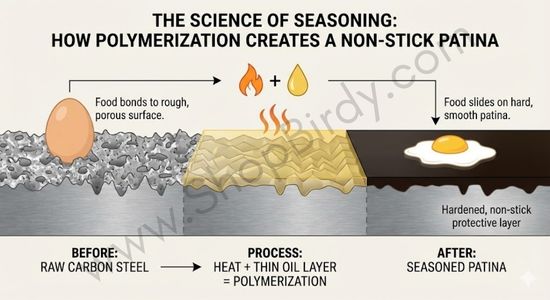
Seasoning isn’t a “layer” sitting on top of the pan. It’s oil that has been heated until it polymerizes, filling microscopic pores in the steel and smoothing the surface at a molecular level.
Color doesn’t matter.
Thickness doesn’t help.
Smoothness is everything.
Eggs don’t care how black your pan looks. They care how even it feels.
(Unlike cast iron, which is porous and “thirsty,” carbon steel is dense—it actually requires less oil than most people expect. That’s why the invisible oil layer matters so much.)
Seasoning creates a natural, chemical-free slickness, but it requires a commitment to maintenance. If you prefer a pan that works perfectly without any prep or ‘break-in’ phase, you might prefer a easiest pan for frying eggs.
Step Zero: Strip the Factory Coating
Most carbon steel pans ship coated in beeswax or protective oil to prevent rust. This must be removed completely.
For light coatings, boiling water helps.
For heavy-duty wax (common on de Buyer or Mauviel), boiling water alone isn’t enough.
Do This Properly
- Wash the pan with hot, soapy water
- Scrub with a chainmail scrubber or abrasive sponge
- Keep scrubbing until the steel looks silver, not grey
- Rinse and dry thoroughly
The surface should feel slightly grippy, not slick.
If it still feels slippery, there’s wax left. Keep going.
Step One (The Pro Secret): Blue the Steel First
Before the first drop of oil touches the pan, professionals blue carbon steel.
This isn’t cosmetic—it’s functional.
How to Blue a Pan
- Heat the dry, bare pan over high heat
- Watch the steel change color:
- Straw → purple → deep blue
- Rotate the pan to blue it evenly
- Let it cool slightly
This heat tint is a controlled oxidation layer. It tightens the surface structure of the steel and helps seasoning bond more aggressively.
When you “turn the pan blue,” you’re not cooking—you’re preparing the metal.
Important: Start on medium heat and walk it up gradually. Slamming a cold carbon steel pan onto a high-output gas burner or induction “Power Boost” can cause the center to expand faster than the edges, warping the pan before seasoning even begins.
Choosing the Right Oil (Egg-Focused)
Some oils polymerize cleanly. Others flake later and ruin eggs.
Best Oils for Carbon Steel Seasoning
Oil Type | Smoke Point | Why It Wins / Loses for Eggs |
Grapeseed | ~420°F | 🏆 Gold standard. Smooth, flexible polymer that releases eggs cleanly. |
Canola | ~400°F | Reliable and cheap. Slight odor at high heat but works well. |
Flaxseed | ~225°F | ❌ Fail. Hard but brittle—will flake into your eggs over time. |
For eggs, flexibility beats hardness. Skip flaxseed.
The Most Important Technique: The Invisible Oil Layer
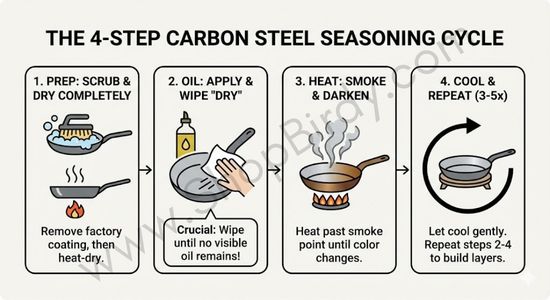
This step decides whether your pan succeeds or frustrates you.
- Add oil
- Then wipe it out like you’ve made a terrible mistake
Use a lint-free cloth or blue shop towel, not paper towels (lint ruins a clean finish).
If the pan looks shiny, there’s too much oil.
If it looks dry but feels smoother, you nailed it.
Thin layers bond. Thick layers blister.
Stovetop Seasoning Method (Safest for All Handles)
Note: If your pan has an epoxy-coated handle, avoid oven seasoning. Stovetop is always safe.
Step 1: Heat the Pan
Medium-high heat until fully dry and warm.
Step 2: Apply Oil (Barely)
½ teaspoon max. Wipe until nearly invisible.
Step 3: Heat Until Light Smoke
Let the oil smoke gently for 30–60 seconds, then remove from heat.
Step 4: Repeat 2–3 Times
Uneven color is normal. Don’t chase black.
What the Pan Should Look Like
- Mottled color
- Brown or amber patches
- Smooth feel, not glossy
If it looks like a leopard, you used too much oil. This is cosmetic and won’t ruin eggs. Don’t strip the pan—just keep cooking.
The Egg Break-In Phase (Where Seasoning Is Locked In)
Your first few cooks matter more than the seasoning session itself.
Cook First
- Eggs
- Pancakes
- Potatoes
Avoid Early
- Tomatoes
- Vinegar
- Wine
Eggs actively improve carbon steel seasoning when done correctly.
Cooking Your First Egg (Guaranteed Release Method)
Subjective words like “warm pan” cause sticking. Use a test instead.
The Water Drop Test (Leidenfrost Effect)
- Flick a drop of water onto the pan
- If it sizzles → too cold
- If it beads up and dances like a marble → ready
This is the Leidenfrost point.
Once the water droplet beads up and dances (the Leidenfrost point), do not cook immediately.
Pull the pan off the heat for about 20 seconds, or move it to a cool burner. This keeps the surface nonstick while dropping it out of the “browning zone.”
You want the pan hot enough to release the egg—but not so hot that the butter burns and the egg fries on contact.
Now add oil.
Lower heat slightly, then add the egg.
Don’t touch it.
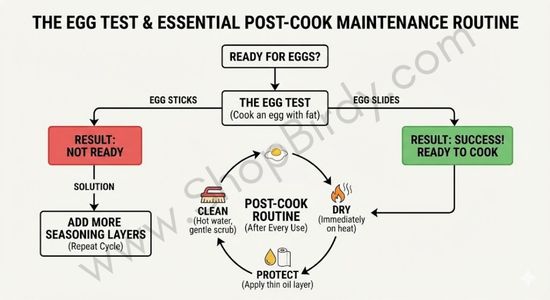
After 20–40 seconds, it will release naturally.
Soap Myth (Modern Reality)
Traditional advice says “never use soap.” That’s outdated.
- Modern dish soap won’t kill seasoning
- Long soaking will
Use soap sparingly if needed. Never soak. Always dry and lightly oil after washing.
Thermal Shock Warning
Never put a 400°F pan under a cold tap.
This won’t just damage seasoning—it can warp the steel permanently, turning a flat pan into a spinner that never heats evenly again.
Let the pan cool naturally.
Final Truth
Seasoning carbon steel for eggs isn’t magic.
It isn’t instant.
And it isn’t about color.
It’s about:
- stripping factory wax properly
- blueing the steel
- applying microscopic oil layers
- letting eggs finish the job
Once it’s dialed in, eggs release cleanly—and the pan only gets better with time.
One-Line Takeaway
If your carbon steel pan releases eggs, the seasoning is right—everything else is just technique.
Legal Information
Shopbirdy.com is a participant in the Amazon Services LLC Associates Program, an affiliate advertising program designed to provide a means for sites to earn advertising fees by advertising and linking to Amazon.
About Me
Hi, I’m Lily and I created Shopbirdy.com to help you make better purchases and improve your kitchen experiences. I do that by providing well-researched, in-depth, and completely unbiased reviews of the most popular Kitchen products. I like cooking that’s why I decided to share my views on various kitchen subjects.

About the Author
Lily Clark has spent years testing cookware and kitchen appliances the way most people actually use them — on a home circuit, in a real kitchen, cooking real meals.
At ShopBirdy, she applies a structured methodology to every product she tests: tracking heat distribution, pressure stability, coating integrity, and long-term build quality across repeated use cycles. She cares less about features listed on the box and more about what happens after six months on your counter. Her reviews are written for people who want to buy once and cook well.