Affiliate Disclosure: This article contains affiliate links. If you purchase through them, I may earn a small commission at no extra cost to you. I only recommend cookware I personally test and cook with in my kitchen.
Updated December 2025 | By Lily Clark
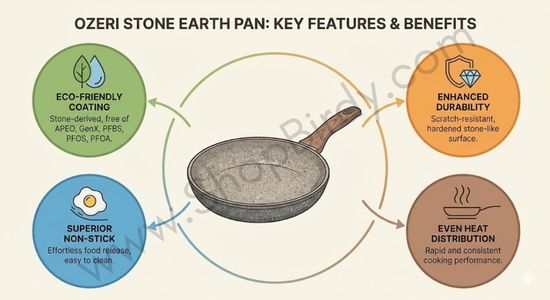
If you’ve been scrolling through cookware online, you’ve probably seen the Ozeri Stone Earth pan pop up over and over again — usually accompanied by the kind of marketing language that makes you feel like you’re buying something cleaner, healthier, and more natural than typical nonstick. “Stone-derived.” “Eco-friendly.” “APEO and PFOA free.”
That’s exactly why I bought it. And after cooking with it for months — eggs every morning, chicken, veggies, fried rice, the usual weeknight chaos — I wanted to see whether the Stone Earth pan actually lives up to its claims.
Here’s the honest truth:
When new, the Ozeri Stone Earth pan cooks beautifully… but the long-term durability is not what most people expect.
This review breaks down the real science behind its Greblon C3+ coating, what actually happens as the pan ages, and who the Stone Earth pan is (and isn’t) right for.
What Is Greblon C3+? (The Real Science Behind the “Stone” Story)
Before we get into the performance, let’s clear up what the coating actually is.
Greblon C3+ is:
- A PTFE-based nonstick system
- Reinforced with ceramic particles
- Built as a triple-coat system for better scratch resistance
- Manufactured by Weilburger in Germany
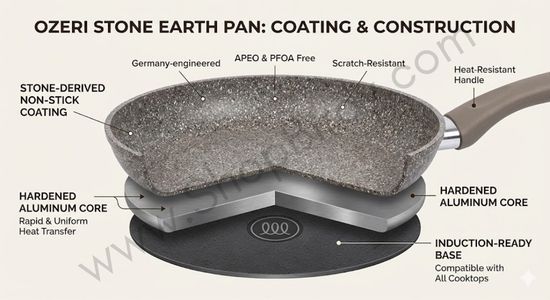
Despite the “stone-derived coating” marketing, this is not a pure ceramic pan. Greblon C3+ uses the same base fluoropolymer used in traditional nonstick, just with extra ceramic strengthening for improved wear resistance.
This matters — because PTFE coatings behave differently from ceramic over time. And durability is the biggest deciding factor for most home cooks.
What to Know — The Real Drawbacks
Durability Declines Faster Than Expected
This is the most important part of the review, so let’s address it first.
Despite its reinforced coating, the Stone Earth pan does not outperform high-quality ceramic pans or premium PTFE pans in long-term nonstick retention.
Here’s what happened in my testing:
- Months 1–2: Excellent nonstick
- Months 3–5: Subtle dullness; oil spread unevenly
- Months 6–9: Eggs started sticking at the edges; glide decreased
- After Month 9: Noticeable wear in the center cooking zone
The pan doesn’t peel or fall apart — but its “new pan magic” definitely fades.
This is typical of PTFE cookware but notable because Ozeri markets this pan as a more resilient, more “natural” alternative.
If long-term slipperiness is your priority, you’ll need to treat this pan very gently.
It’s PTFE (Not Ceramic), Despite the Stone Marketing
Many people buy this pan under the impression that it is:
- ceramic,
- stone-derived,
- or PTFE-free.
It isn’t.
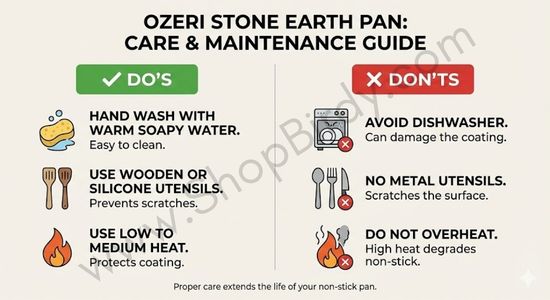
This doesn’t make it unsafe — but it does mean you need to cook with it the way you cook with any PTFE pan:
- no high heat
- no empty preheating
- no metal utensils
- no dishwasher
If someone wants true ceramic, this isn’t the right match.
“Eco-Friendly” Claims Are Misleading
The packaging highlights that it is:
- PFOA-free
- APEO-free
But these are now industry-wide standards, not unique features.
Meanwhile, PTFE is still a fluoropolymer, and calling it “eco-friendly” is, at best, selective marketing.
If you expected a green, natural alternative — this isn’t it.
My 6–9 Month Real-Life Test Results
I used the Ozeri Stone Earth pan heavily for months — eggs, stir-fries, chicken breasts, veggies, breakfast potatoes, you name it.
What held up:
- Good heat distribution
- Solid feel
- No peeling or bubbling
- Easy to clean when residue hasn’t built up
What changed:
- Nonstick performance declined around Month 5
- Slight roughness developed in the center
- Egg glide decreased noticeably
- Brown edges required deeper cleaning than PTFE pans usually do
Final performance at Month 9
Still usable?
Yes.
Still “great nonstick”?
Not really.
By Month 9, it cooked more like a 3-year-old budget PTFE pan than a “durability-enhanced stone-derived” pan.
Strengths — Where Ozeri Stone Earth Actually Shines
Here’s where it earns points:
✔ Excellent nonstick performance when new
Eggs slide, pancakes flip themselves, and cleanup is a breeze.
✔ Better scratch resistance than cheap PTFE pans
The ceramic reinforcement helps in the short term.
✔ Even heat distribution
The aluminum base cooks evenly without major hot spots.
✔ Easy cleaning during the first few months
Residue wipes right off when the coating is fresh.
✔ Good introductory pan for low–medium heat cooks
If you don’t cook on high heat, you’ll appreciate the performance in the early months.
Who Should Buy the Ozeri Stone Earth Pan?
Buy it if:
- You want an affordable pan that works beautifully for the first several months
- You cook mostly eggs, pancakes, veggies
- You don’t need restaurant-level durability
- You’ll treat it with care (low heat, handwashing, no spray oils)
- You prefer the feel of PTFE but want a textured surface
Who Should Skip It?
Skip the Stone Earth pan if:
- You want a pure ceramic nonstick pan
- You want a long-lasting nonstick (3–5+ years)
- You cook frequently on medium-high or high heat
- You want a pan that tolerates rougher use
- You bought this thinking “stone-derived” means chemical-free
For those needs, you’d be happier with:
- A truly ceramic nonstick pan
- Or a premium PTFE pan with multi-layer bonding
- Or cast iron / stainless steel for high-heat searing
Updated Final Thoughts
The Ozeri Stone Earth pan is a good-performing PTFE pan with a smart marketing story — not a miracle stone pan and not a chemical-free ceramic alternative.
If you use it gently, it cooks extremely well in the beginning. But the long-term wear will show sooner than you expect, especially if you’re cooking daily.
If durability or chemical-free cookware is your priority, you may want to:
👉 Consider pure ceramic pans instead — and check out our full PTFE vs. Ceramic nonstick guide for a detailed safety and longevity comparison.
And if you love PTFE but want a longer-lasting option, I’d recommend looking at:
- T-fal Ultimate Hard Anodized (great budget PTFE)
- All-Clad HA1 (premium PTFE durability)
For many ho me cooks, the Stone Earth pan will be a solid everyday performer — just not the lifelong, stone-strong pan its branding suggests.
Legal Information
Shopbirdy.com is a participant in the Amazon Services LLC Associates Program, an affiliate advertising program designed to provide a means for sites to earn advertising fees by advertising and linking to Amazon.
About Me
Hi, I’m Lily and I created Shopbirdy.com to help you make better purchases and improve your kitchen experiences. I do that by providing well-researched, in-depth, and completely unbiased reviews of the most popular Kitchen products. I like cooking that’s why I decided to share my views on various kitchen subjects.

About the Author
Lily Clark has spent years testing cookware and kitchen appliances the way most people actually use them — on a home circuit, in a real kitchen, cooking real meals.
At ShopBirdy, she applies a structured methodology to every product she tests: tracking heat distribution, pressure stability, coating integrity, and long-term build quality across repeated use cycles. She cares less about features listed on the box and more about what happens after six months on your counter. Her reviews are written for people who want to buy once and cook well.