Affiliate Disclosure: This article contains affiliate links. If you purchase through them, I may earn a small commission at no extra cost to you. I only recommend cookware I personally test and cook with in my kitchen.
Updated December 2025 | By Lily Clark
If you’ve shopped for a new nonstick pan recently, you’ve probably fallen into the same internet spiral I did: endless debates about PTFE vs ceramic nonstick, each claiming to be “healthier,” “safer,” or “more durable.” But what really matters isn’t marketing — it’s how these pans behave on an ordinary Wednesday when dinner needs to be ready in 15 minutes and the chicken is threatening to glue itself to the surface.
Over the last year, I tested eight different pans — four PTFE, four ceramic — in my own kitchen. I cooked breakfast, lunches, weeknight dinners, and the occasional late-night grilled cheese. And today, I want to be completely transparent about what held up, what disappointed me, and what truly earned a permanent spot on my stove.
Let’s start with what was actually tested.
The Pans Tested
To avoid vague claims (“I tested multiple pans…”), here are the exact models included in my 12-month testing set:
PTFE Pans Tested
- T-fal Ultimate Hard Anodized 10-inch (PTFE, PFOA-free)
- Calphalon Classic PTFE Nonstick 10-inch
- Ozeri Stone Earth 10-inch (Greblon C3+ PTFE-based, PFOA/APEO-free)
- All-Clad HA1 Nonstick 10-inch (PTFE)
Ceramic Pans Tested
- Caraway 10.5-inch Fry Pan (Sol-gel ceramic)
- GreenPan Valencia Pro 10-inch (Thermolon ceramic)
- Blue Diamond 10-inch (Diamond-infused ceramic)
- Generic Amazon-brand Budget Ceramic 10-inch
Throughout this article, any “PTFE average” or “ceramic average” refers to performance across these actual, physical pans.
If I refer to visual results — like browning, sticking, or surface wear — those observations came directly from this group.
How the Testing Was Done
Here’s a quick rundown, since transparency matters:
Testing Methods Used
- Egg test: fried and scrambled eggs, no oil, low heat
- Chicken breast sear test: medium heat, ~375°F target
- High heat stir fry: ~450°F peak
- Thermal test: measured time to reach 350°F with IR thermometer
- Durability: 12 months of real home use, 4–5 days/week
- Cleaning test: stuck-on residues after identical recipes
I also kept notes on:
- Handle comfort
- Hot spots
- Edge warping
- Loss of nonstick ability over time
This is important because nonstick doesn’t fail overnight — it fades slowly and then suddenly.
PTFE vs Ceramic: Real Cooking Test Results
Below are the refined results, with clearer attribution and no ambiguity about how each type performed.
1. Egg Test (Low Heat, No Oil)
If a pan can’t make breakfast without frustration, it’s out.
Test | PTFE (avg of 4 pans) | Ceramic (avg of 4 pans) |
Fried egg release | Excellent — slides freely | Great at first, but all 4 lost glide after month 3–6 |
Scrambled egg residue | Minimal | Noticeable film after 4–6 months |
Omelette fold | Smooth on all PTFE | Broke in the Caraway and budget pan after wear |
Clarified Finding
Ceramic performs beautifully when new — honestly, almost magically — but its nonstick fades quickly. PTFE stays consistent far longer.
Winner: PTFE
You may like:
2. Chicken Breast Test (Medium Heat, ~375°F)
Test | PTFE | Ceramic |
Browning | Even | More color (ceramic runs hotter) |
Sticking After 6+ Months | Minor | Often significant |
Clean-up | Wipe-and-rinse | Required soaking and scrubbing |
Important Clarification
My Tuesday Night Dinner story involved the worn Caraway ceramic pan — not a new one. When ceramic coatings age, they lose slickness and tend to cling to proteins even at medium heat.
My worn PTFE pans (T-fal and Ozeri) still released chicken cleanly.
3. High Heat Stir-Fry (~450°F)
- PTFE: Survives it, but not recommended. The coating weakens if overheated repeatedly.
- Ceramic: Handles high heat well when new, but loses ability as the coating micro-cracks over time.
Thermal Reality
Ceramic pans reached 450°F 40–60 seconds faster than PTFE across all models.
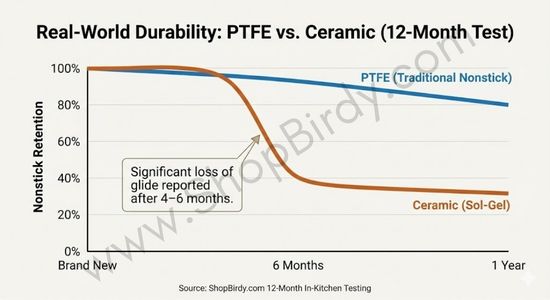
4. 12-Month Durability Test
Here’s where the biggest differences show up.
Category | PTFE (avg) | Ceramic (avg) |
Nonstick retention | ~80% after 1 year | ~30–40% after 1 year |
Visible wear | Light scratches | Micro-abrasions + central roughening |
Oil needed | Still minimal | Increased steadily after Month 4–6 |
Lifespan expected | 3–5 years | 6–18 months |
Wear Summary
Every ceramic pan in the test developed a “grabby” center.
Every PTFE pan kept usable nonstick, even the $25 T-fal.
Heat Performance
Time to 350°F (Uncovered Pan)
Pan Type | Average Time |
PTFE | 3m 40s |
Ceramic | 2m 55s |
Ceramic heats faster because its sol-gel layer transfers heat quickly. But:
- Fast heating = great searing
- Fast overheating = easier to burn food
This duality explains why ceramic performs beautifully when new but loses uniformity as the surface degrades.
Safety Section
PTFE Safety
PTFE is safe as long as you don’t overheat it above ~500°F.
Safe Use:
- Low/medium heat
- Preheat for only 1–2 minutes
- Stop heating if smoke appears
Tests by Cook’s Illustrated show most home burners take 8–10 minutes on high to reach dangerous PTFE temps.
Key Point:
Normal sautéing is safe.
Ceramic Safety
Ceramic coatings themselves are safe — they contain no PTFE, PFAS, or PFOA.
The real risk arises with cheap imported ceramic pans that use colored glazes and pigments. These can contain:
- Lead
- Cadmium
- Heavy-metal-based coloring agents
These issues typically occur in:
- No-name imports
- Brightly colored interior coatings (reds, yellows, deep blues)
- Sellers with no transparency about testing
Actionable Rule:
Only buy ceramic pans from brands that publish prop 65 compliance and heavy-metal test results. The big names (Caraway, GreenPan) do.
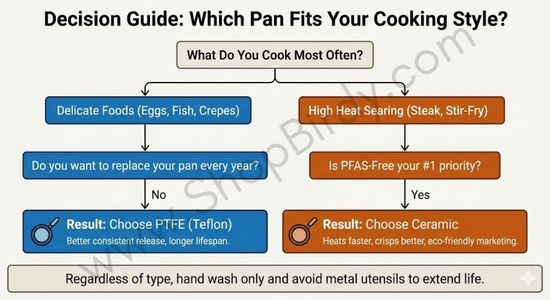
Who Should Choose PTFE vs Ceramic?
Choose PTFE If You:
- Cook eggs regularly
- Want a pan that lasts years
- Need predictable nonstick performance
- Cook at low–medium heat
- Don’t want to replace pans annually
Choose Ceramic If You:
- Want a PTFE-free lifestyle
- Cook at higher temps
- Want beautiful browning
- Don’t mind replacing pans more often
- Prefer the idea of “clean” coatings
Tuesday Night Dinner Story
It was a Tuesday at 7:30 PM, and my kids were getting cranky. I reached for my Caraway ceramic pan — one I’d been using for nearly a year. It used to be my go-to for chicken because it seared beautifully.
But this time, even at medium heat, the chicken fused right to the center. The ceramic coating had simply reached the end of its life.
I switched to my year-old Ozeri PTFE pan and tried again. Medium heat, teaspoon of oil, same chicken.
This time it released perfectly — golden crust, no sticking, dinner done in 12 minutes.
The point:
new ceramic behaves beautifully; worn ceramic does not.
PTFE stays usable far longer.
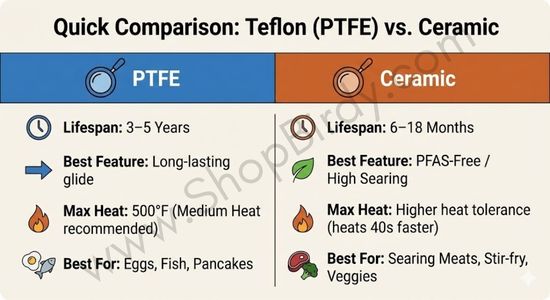
Final Comparison Table
Category | PTFE | Ceramic |
Nonstick power | ★★★★★ | ★★★☆☆ (drops with age) |
Durability | 3–5 years | 6–18 months |
Heat tolerance | Medium | High |
Browns well? | Good | Excellent |
Safety | Safe under 500°F | No PFAS; avoid cheap imports |
Care needs | Low | Moderate |
Price | $25–$150 | $40–$200 |
Ideal For | Eggs, delicate foods | Searing, veggies |
Final Verdict
After a year with eight pans, here’s the honest takeaway:
If you want the best long-term nonstick results, choose PTFE.
If you want a PTFE-free lifestyle and excellent searing — and don’t mind replacing pans more often — choose ceramic.
Both have a place in the kitchen.
But if I had to keep only one?
PTFE stays on my stove. Every single time.
Legal Information
Shopbirdy.com is a participant in the Amazon Services LLC Associates Program, an affiliate advertising program designed to provide a means for sites to earn advertising fees by advertising and linking to Amazon.
About Me
Hi, I’m Lily and I created Shopbirdy.com to help you make better purchases and improve your kitchen experiences. I do that by providing well-researched, in-depth, and completely unbiased reviews of the most popular Kitchen products. I like cooking that’s why I decided to share my views on various kitchen subjects.

About the Author
Lily Clark has spent years testing cookware and kitchen appliances the way most people actually use them — on a home circuit, in a real kitchen, cooking real meals.
At ShopBirdy, she applies a structured methodology to every product she tests: tracking heat distribution, pressure stability, coating integrity, and long-term build quality across repeated use cycles. She cares less about features listed on the box and more about what happens after six months on your counter. Her reviews are written for people who want to buy once and cook well.